



 Chat with AI
Exam 1: The Role and Method of Economics

Exam 1: The Role and Method of Economics198 Questions
Exam 2: Economics: Eight Powerful Ideas197 Questions
Exam 3: Scarcity, Trade-Offs, and Production Possibilities189 Questions
Exam 4: Demand, Supply, and Market Equilibrium240 Questions
Exam 5: Markets in Motion and Price Controls228 Questions
Exam 6: Elasticities206 Questions
Exam 7: Market Efficiency and Welfare136 Questions
Exam 8: Market Failure215 Questions
Exam 9: Public Finance and Public Choice64 Questions
Exam 10: Consumer Choice Theory149 Questions
Exam 11: The Firm: Production and Costs198 Questions
Exam 12: Firms in Perfectly Competitive Markets207 Questions
Exam 13: Monopoly and Antitrust189 Questions
Exam 14: Monopolistic Competition and Product Differentiation159 Questions
Exam 15: Oligopoly and Strategic Behavior146 Questions
Exam 16: The Markets for Labor, Capital, and Land177 Questions
Exam 17: Income, Poverty, and Health Care138 Questions
Exam 18: Introduction to Macroeconomics: Unemployment, Inflation, and Economic Fluctuations171 Questions
Exam 19: Measuring Economic Performance147 Questions
Exam 20: Economic Growth in the Global Economy127 Questions
Exam 21: Financial Markets, Saving, and Investment65 Questions
Exam 22: Aggregate Demand and Aggregate Supply163 Questions
Exam 23: The Aggregate Expenditure Model69 Questions
Exam 25: Monetary Institutions182 Questions
Exam 26: The Federal Reserve System and Monetary Policy147 Questions
Exam 27: Issues in Macroeconomic Theory and Policy130 Questions
Exam 28: International Trade182 Questions
Exam 29: International Finance138 Questions
Select questions type


The basic difference between macroeconomics and microeconomics is:
(Multiple Choice)
5.0/5  (67)
(67) Which of the following is an example of a relationship with a negative slope?
(Multiple Choice)
4.8/5 (81)
(81) When economists use the term "ceteris paribus," they mean that:
(Multiple Choice)
4.8/5 (88)
(88) Microeconomics is the branch of economics in which you study inflation and unemployment in the economy.
(True/False)
4.9/5 (79)
(79) Which of the following graphs or charts must add up to one hundred percent?
(Multiple Choice)
4.8/5 (78)
(78) Economics is the study of choices we make among our many wants and desires.
(True/False)
4.9/5 (84)
(84) 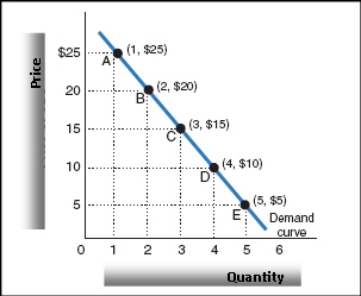 Exhibit 1-1 demonstrates that:
Identify the error in judgment in each of the following statements:
I."If you leave a concert during the encore,you will avoid traffic and get home more rapidly; therefore everyone should leave during the encore."
II."Whenever I wear my lucky baseball cap to an exam,I receive an "A." My baseball cap must induce the teacher to give me good grades."
(Essay)
4.9/5 (70)
(70) Microeconomics explores the allocation of scarce resources from the perspective of small economic units such as consumers and firms.
(True/False)
4.8/5 (75)
(75) The basic difference between macroeconomics and microeconomics is that:
(Multiple Choice)
5.0/5 (74)
(74) Which of the following best illustrates the fallacy of composition?
(Multiple Choice)
4.8/5 (84)
(84) In economic terms,religious and spiritual services are treated as:
(Multiple Choice)
4.8/5 (82)
(82) Which of the following is most likely an example of correlation but not an example of causation?
(Multiple Choice)
4.8/5 (67)
(67) Scarcity forces us to choose,and choices are costly because we must give up other opportunities that we value
(True/False)
4.8/5 (81)
(81) 
Filters
- Essay(0)
- Multiple Choice(0)
- Short Answer(0)
- True False(0)
- Matching(0)