



 Chat with AI
Exam 11: Corporations-An Introduction

Exam 1: Taxation-Its Role in Decision Making10 Questions
Exam 2: Fundamentals of Tax Planning10 Questions
Exam 3: Liability for Tax, Income Determination, and Administration of the Income Tax System10 Questions
Exam 4: Income From Employment6 Questions
Exam 5: Income From Business10 Questions
Exam 6: The Acquisition, Use, and Disposal of Depreciable Property10 Questions
Exam 7: Income From Property10 Questions
Exam 8: Gains and Losses on the Disposition of Capital Property-Capital Gains10 Questions
Exam 9: Other Income, Other Deductions, and Special Rules for Completing Net Income for Tax Purposes10 Questions
Exam 10: Individuals: Determination of Taxable Income and Taxes Payable10 Questions
Exam 11: Corporations-An Introduction10 Questions
Exam 12: Organization, Capital Structures, and Income Distributions of Corporations10 Questions
Exam 13: The Canadian-Controlled Private Corporation8 Questions
Exam 14: Multiple Corporations and Their Reorganization7 Questions
Exam 15: Partnerships8 Questions
Exam 16: Limited Partnerships and Joint Ventures8 Questions
Exam 17: Trusts8 Questions
Exam 18: Business Acquisitions and Divestitures-Assets Versus Shares8 Questions
Exam 19: Business Acquisitions and Divestitures-Tax-Deferred Sales8 Questions
Exam 20: Domestic and International Business Expansion8 Questions
Exam 21: Tax Aspects of Corporate Financing8 Questions
Select questions type


Johnson Co.is a CCPC with active business income of $350,000 in 20X2.The company engages in retail and wholesale activities.Capital gains in 20X0 were $84,000.
Johnson Co.will utilize a net capital loss carry-over of $28,000 on its 20X2

Free
(Essay)
4.9/5  (71)
(71) Correct Answer: Verified
tax return.
Required:
Calculate the federal tax payable by Johnson Co.in 20X2. 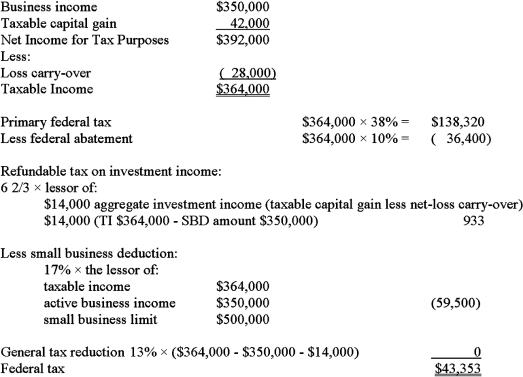
The Stevens Company is a public Canadian corporation that is primarily engaged in manufacturing.The company's head office is located in Saskatchewan.In 20X1,a small branch was established in Manitoba,to be used for sales purposes only.
In 20X2,the company's books showed the following: 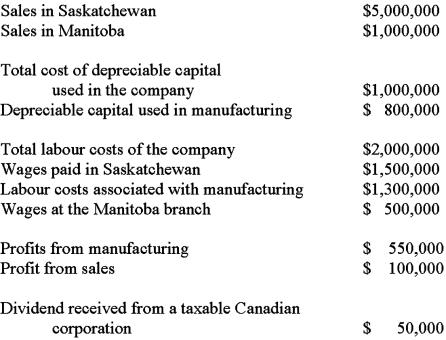 Required:
A)Calculate the company's net income for tax purposes for 20X2.
B)Calculate the company's taxable income,both federal and provincial.(Round all number to two decimal places.)
C)Calculate the manufacturing and processing profits for the company.
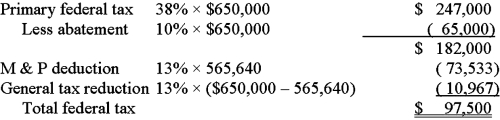
D)Calculate the federal tax liability.(Round all numbers to zero decimal points.)
Required:
A)Calculate the company's net income for tax purposes for 20X2.
B)Calculate the company's taxable income,both federal and provincial.(Round all number to two decimal places.)
C)Calculate the manufacturing and processing profits for the company.
D)Calculate the federal tax liability.(Round all numbers to zero decimal points.)Free
(Essay)
4.8/5 (87)
(87) Correct Answer:Verified
VerifiedA)Net income for tax purposes: 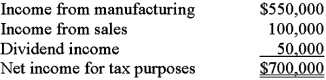 B)Federal taxable income:
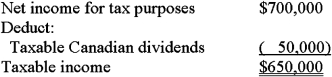 Provincial taxable income:
Saskatchewan: 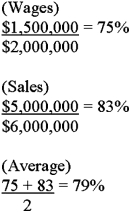 $650,000 × .79 = $513,500
Manitoba:
100 - 79% = 21%
$650,000 × .21 = $136,500
C)Manufacturing and processing profit: 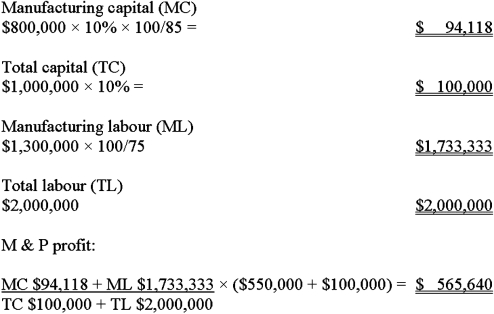 D)Federal tax:
Bride and Groom Co.is a Canadian controlled private corporation with active business income of $750,000.The company is in the business of producing and selling bridal wear.Dividends were received from a taxable Canadian corporation in the amount of $80,000.
Additional information is as follows:
Net capital loss carry-over balance is $200,000.
Non capital loss carry-over balance is $70,000.
Required:
Calculate the minimum federal Part I tax payable by Bride and Groom Co.
Free
(Essay)
4.8/5 (98)
(98) Correct Answer:Verified
Verifiedfor the year. 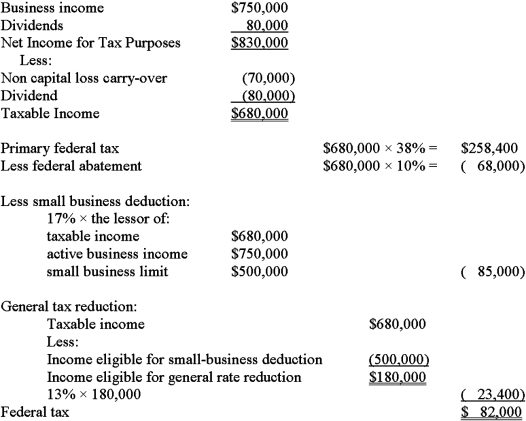
Using general terms,explain how a change in control of a corporation can affect the net-capital losses and the non-capital losses.
(Essay)
4.9/5 (76)
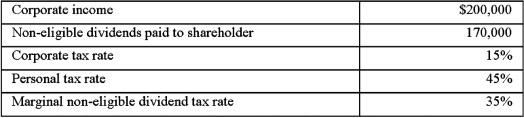
(76) The Canadian tax system practices integration between corporations and individuals.Using the data in Table 1 and assumed rates,illustrate and explain the concept of integration.
Table 1
(Essay)
5.0/5 (88)
(88) Which of the following statements accurately describes the tax treatment for Canadian corporations?
(Multiple Choice)
4.9/5 (87)
(87) Many corporations carry on business in more than one province.Assuming a corporation from Province A wishes to conduct business in Province B,the corporation will not have to pay tax in Province B if:
(Multiple Choice)
4.9/5 (81)
(81) Which of the following is false with regard to dividends,corporations,and shareholders?
(Multiple Choice)
4.8/5 (89)
(89) When shares are transferred from one group of shareholders to another and there is a change in control,which of the following is correct?
(Multiple Choice)
5.0/5 (65)
(65) In 20X0,Coffee Co.recognized $37,000 in business income and $1,000 in taxable capital gains.In 20X1,the company incurred a business loss of $25,000,a taxable capital gain of $2,000,and an allowable capital loss of $5,000.Business income for 20X2 was $50,000,taxable capital gains were $4,000,and the company received $10,000 in dividends from a taxable Canadian corporation.Assuming Coffee Co.utilizes any unused losses in the earliest years possible,which of the following taxable incomes are correct,after all carry-over adjustments have been made?
(Multiple Choice)
4.7/5 (86)
(86) 
Filters
- Essay(0)
- Multiple Choice(0)
- Short Answer(0)
- True False(0)
- Matching(0)