



 Chat with AI
Exam 17: Trusts


A trust account holds two buildings as its assets.Building 1 originally cost $150,000 and Building 2 originally cost $210,000.It is now the 21st anniversary of the trust,and the assets have not been transferred to the beneficiary.The undepreciated capital cost of Building 1 is $85,000 and its market value is $200,000.The undepreciated capital cost of Building 2 is $145,000 and its market value is $190,000.Which costs will be the deemed acquisition values of the buildings for the trust?

 (94)
 Verified
D
Walter Adamson passed away this year at the age of 62.
Previously,Walter had structured his will so that his wife would receive his stocks and land,to be held in a trust on her behalf.Additionally,his 33 year old son,Steven,would receive a building to be held in a trust until Steven reached the age of 45.
The assets transferred to Mrs.Adamson consist of a piece of land with an ACB of $100,000 and a FMV of $300,000; and stocks valued at $200,000,with a cost base of $150,000.
The assets transferred to Steven consist of a building with an ACB of $200,000,a UCC of $180,000,and a FMV of $300,000.
Required:
Discuss the immediate tax consequences for Walter's tax return,Mrs.Adamson,and Steven,regarding the initial transfer of these assets,showing calculations where necessary.
(80) VerifiedWalter:
Walter's estate will have a taxable capital gain of $50,000 and recapture of $20,000 upon the disposal of the building bequeathed to Steven.
Building transferred to Steven's testamentary trust: 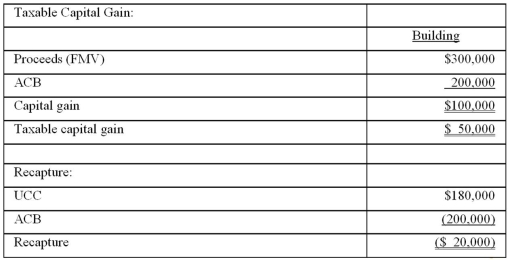 Mrs.Adamson:
There will be no tax consequence on the $100,000 cash received by Mrs.Adamson.
The other assets will be transferred to a testamentary spousal trust at their tax values,and therefore,there will not be any immediate tax effects.
Steven:
The building will be transferred to a testamentary trust at its FMV.The taxable capital gain and recapture realized on the transfer are taxed in Walter's estate.
Jasmine is the beneficiary of an inter vivos trust.During 20X4,the trust received the following income:
Capital gains: $16,000
Interest: $12,000
Non-eligible dividends: $8,000
One half of the trust's income from 20X4 was paid to Jasmine,who does not currently have any other sources of income.The remainder of the income stayed in the trust.
Required:
a)Determine the federal tax payable for Jasmine.
b)Explain how the federal tax liability will differ for the trust.(Support your answer with calculations.)
(82) Verifieda)Net and taxable income for Jasmine:
$16,000 × 50% × 50% = $4,000
$12,000 × 50% = $6,000
$8,000 × 1.18 × 50% = $4,720
$4,000 + $6,000 + $4,720 = $14,720
$14,720 × 15% federal tax = $2,208 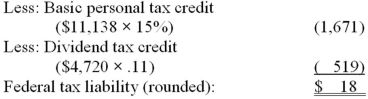 b)The federal tax liability will differ for the trust because the trust is taxed at the highest tax bracket of 29%,and the basic personal tax credit is not available to the trust.
Therefore,the trust will have a federal tax liability of $3,683.
Net and taxable income for the trust:
$16,000 × 50% × 50% = $4,000
$12,000 × 50% = $6,000
$8,000 × 1.18 × 50% = $4,720
$4,000 + $6,000 + $4,720 = $14,720
$14,720 × 29% federal tax = $4,269 
A trust that is created upon the death of an individual,and which is taxed applying the full range of tax rates within the individual's progressive scale is a(n):
(84) If a trust qualifies as a spousal trust,which of the following does not apply?
(73) Your friend Andrew has heard that you are studying Canadian income taxation.He has heard people discussing something called the '21 Year Rule' with regard to trusts.He has come to you with questions regarding this rule,since his father recently established inter vivos trusts for Andrew and his mother.
Required:
Briefly answer the following questions.(Base your answers to Questions 1 - 4 on non-spousal trusts.)
1)What is the purpose of the "21 Year Rule"?
2)What event occurs on the 21st anniversary of a trust?
3)What types of properties are subject to the 21 Year Rule?
4)How can the consequences of the 21 Year Rule be avoided?
5)What is the exception to the 21 Year Rule for spousal trusts?
(83) Which of the following statements accurately describes the rules pertaining to testamentary trusts?
(86) 
Filters
- Essay(0)
- Multiple Choice(0)
- Short Answer(0)
- True False(0)
- Matching(0)