



 Chat with AI
Exam 6: Receivables: Selling a Product or a Service

Exam 1: Accounting Information: Users and Uses47 Questions
Exam 2: Financial Statements: An Overview118 Questions
Exam 3: The Accounting Cycle: The Mechanics of Accounting109 Questions
Exam 4: Completing the Accounting Cycle112 Questions
Exam 5: Internal Controls: Ensuring the Integrity of Financial Information108 Questions
Exam 6: Receivables: Selling a Product or a Service115 Questions
Exam 7: Inventory and the Cost of Sales148 Questions
Exam 8: Completing the Operating Cycle93 Questions
Exam 9: Investments: Property, Plant, and Equipment and Intangible Assets130 Questions
Exam 10: Financing: Long-Term Liabilities113 Questions
Exam 11: Financing: Equity86 Questions
Exam 12: Investments: Debt and Equity Securities89 Questions
Exam 13: Statement of Cash Flows97 Questions
Exam 14: Analyzing Financial Statements91 Questions
Exam 15: Management Accounting and Cost Concepts104 Questions
Exam 16: Cost Flows and Business Organizations136 Questions
Exam 17: Activity-Based Costing64 Questions
Exam 18: Budgeting and Control128 Questions
Exam 19: Controlling Cost and Profit137 Questions
Exam 20: Inventory Management and Variable and Absorption Costing89 Questions
Exam 21: Cost Behavior and Decisions Using C-V-P Analysis152 Questions
Exam 22: Relevant Information and Decisions97 Questions
Exam 23: Capital Investment Decisions103 Questions
Exam 24: New Measures of Performance83 Questions
Select questions type


A U.S. company entered into a sales transaction with a Japanese company on September 15 for 200,000 yen. The U.S. company prepares quarterly financial statements. The Japanese company will pay for the sale on November 20. The exchange rates were as follows:
 Prepare the appropriate journal entries to record the sale, the quarterly adjustment, and the collection.
 (Essay)
4.8/5  (84)
(84) Following are the account balances from the December 31 trial balance of Lark Company:  If 10 percent of the Accounts Receivable is estimated to be uncollectible, the entry to record the estimate of bad debts would include a debit to Bad Debt Expense for
 (Multiple Choice)
4.8/5 (71)
(71) When a specific customer's account is written off by a company using the allowance method, the effect on net income and the net realizable value of the accounts receivable is
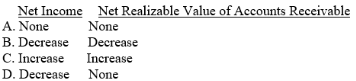
(Short Answer)
4.9/5 (67)
(67) In preparing a monthly bank reconciliation, which of the following items would be added to the balance reported on the bank statement to arrive at the correct cash balance?
(Multiple Choice)
4.7/5 (88)
(88)  would be made when
Following are the account balances from the December 31 trial balance of Lark Company:  If 10 percent of the Accounts Receivable is estimated to be uncollectible, the entry to record the estimate of bad debts would include a debit to Bad Debt Expense for
 (Multiple Choice)
4.9/5 (84)
(84) Charles Company sells foods wholesale. On May 15, Charles sold 400 cases of beans to Robin Company for $8 per case with terms of 2/10, n/30. On May 25, Swoops Company paid Edwards the full amount due. Given these data, the entry to record the collection of cash on May 25 would include a
(Multiple Choice)
4.7/5 (86)
(86) Which type of the major activities of a business are best described as those events that are associated with the primary purpose of a business?
(Multiple Choice)
4.8/5 (73)
(73) On March 1, Chickadee Company sold merchandise to Oriole Company for $5,000 with terms of 3/10, net 30. On March 10, Oriole Company paid 50% of the amount due (assume the company allows the discount on partial payments). On March 25, Oriole Company returned $500 of merchandise and also paid the remaining balance due.
Prepare the necessary journal entries that Chickadee Company should make on March 1, March 10, and March 25.
(Essay)
4.8/5 (90)
(90) Following are the account balances from the December 31 trial balance of Lark Company: Accounts Receivable \ 60,000 Allowance for Bad Debts 2,400 (dr) Sales Revenue 405,000 Sales Retums and Allowances 15,000 If 1 percent of the net sales is estimated to be uncollectible, the entry to record the estimate of bad debts would include a debit to Bad Debt Expense for
(Multiple Choice)
4.9/5 (89)
(89) Wilbur Company's monthly bank statement showed an ending balance of $36,928. The bank reconciliation included a deposit in transit, $3,274; outstanding checks, $4,340; an "NSF" check, $1,576; a bank service charge, $50; and proceeds of a customer's note collected by the bank, $4,600. The correct cash balance at the end of the month is
(Multiple Choice)
4.9/5 (77)
(77) Sally is a college student who decided that she spends entirely too much time inside of the library studying. She decided to join a health club in order to become more active. After researching several Health Clubs and Gyms, Sally decided to purchase a membership at Deseret Health Club. Sally bought a contract for one year. Upon signing this contract, Sally agreed to pay an upfront membership fee, which will ensure use of the health facilities during the full year. She also agreed to pay a monthly fee that will be paid at the beginning of each month during the length of the contract. According to GAAP and assuming that the up-front fee does not relate to a specific activity and is nonrefundable, when is the best time for Deseret Health Club to recognize the revenue for the up-front fee paid by Sally?
(Multiple Choice)
4.9/5 (70)
(70) The two criteria that need to be met in order revenue to be recognized are
(Multiple Choice)
4.9/5 (86)
(86) Deuce Company uses the allowance method to estimate losses from uncollectible receivables. Net sales for the year are $120,000, and the company estimates its bad debts as 1 percent of net sales. If there is already a $1,200 debit balance in Allowance for Bad Debts, how much should be recorded as Bad Debt Expense?
(Multiple Choice)
4.8/5 (71)
(71) On June 30, Parrott Company sold goods for $800 on account. The journal entry to record the recognition of revenue would include
(Multiple Choice)
4.9/5 (86)
(86) Which of the following demonstrates that a company is managing its receivables well?
(Multiple Choice)
4.8/5 (91)
(91) The following information is available for Bridges Company: 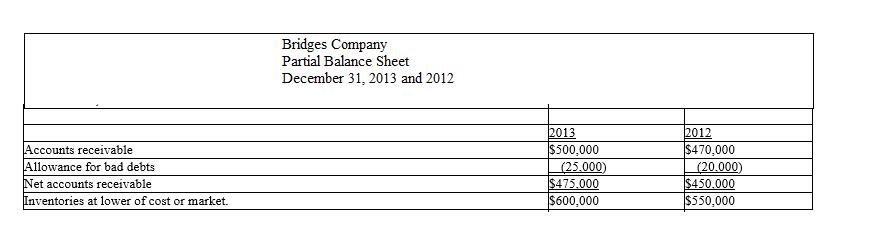
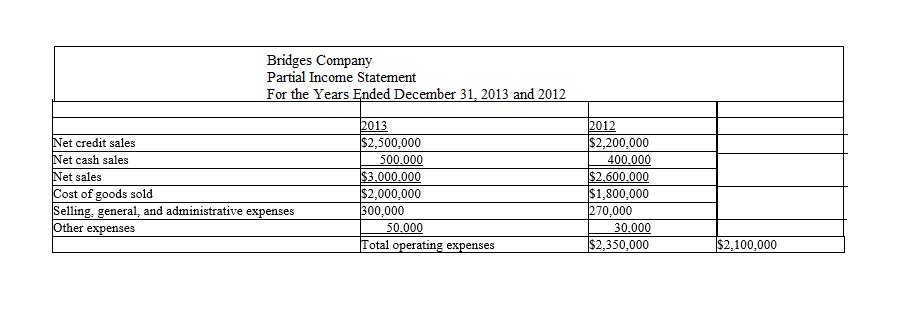 The accounts receivable turnover for 2013 is computed as follows:
 (Multiple Choice)
4.7/5 (87)
(87) 
Filters
- Essay(0)
- Multiple Choice(0)
- Short Answer(0)
- True False(0)
- Matching(0)