



 Chat with AI
Exam 10: Financing: Long-Term Liabilities

Exam 1: Accounting Information: Users and Uses47 Questions
Exam 2: Financial Statements: An Overview118 Questions
Exam 3: The Accounting Cycle: The Mechanics of Accounting109 Questions
Exam 4: Completing the Accounting Cycle112 Questions
Exam 5: Internal Controls: Ensuring the Integrity of Financial Information108 Questions
Exam 6: Receivables: Selling a Product or a Service115 Questions
Exam 7: Inventory and the Cost of Sales148 Questions
Exam 8: Completing the Operating Cycle93 Questions
Exam 9: Investments: Property, Plant, and Equipment and Intangible Assets130 Questions
Exam 10: Financing: Long-Term Liabilities113 Questions
Exam 11: Financing: Equity86 Questions
Exam 12: Investments: Debt and Equity Securities89 Questions
Exam 13: Statement of Cash Flows97 Questions
Exam 14: Analyzing Financial Statements91 Questions
Exam 15: Management Accounting and Cost Concepts104 Questions
Exam 16: Cost Flows and Business Organizations136 Questions
Exam 17: Activity-Based Costing64 Questions
Exam 18: Budgeting and Control128 Questions
Exam 19: Controlling Cost and Profit137 Questions
Exam 20: Inventory Management and Variable and Absorption Costing89 Questions
Exam 21: Cost Behavior and Decisions Using C-V-P Analysis152 Questions
Exam 22: Relevant Information and Decisions97 Questions
Exam 23: Capital Investment Decisions103 Questions
Exam 24: New Measures of Performance83 Questions
Select questions type


On March 1, 2012, Enid Corporation borrowed $800,000 on a 30-year mortgage to purchase land and a building. The land and building are pledged as collateral on the mortgage, which has an interest rate of 6 percent compounded monthly. The payments of $4,800 are made at the end of each month, beginning on March 31, 2012. Prepare a mortgage amortization schedule for the first year of the mortgage. (Round amounts to the nearest dollar.)

Free
(Essay)
4.8/5  (89)
(89) Correct Answer: Verified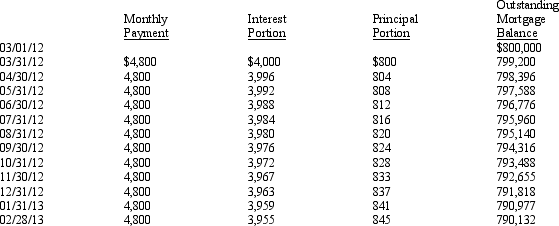
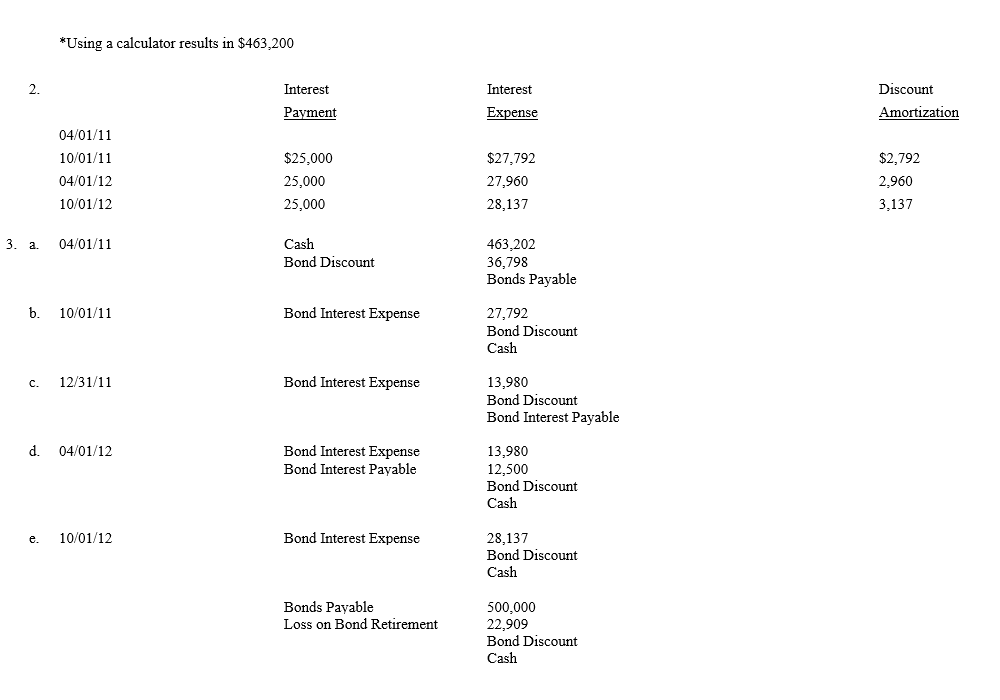
On April 1, 2011, Jenkins Corporation issued $500,000 of 10 percent, 5-year bonds at a yield of 12 percent compounded semiannually. Interest is payable on April 1 and October 1 of each year. The corporation is a calendar-year corporation. Bond premiums and discounts are amortized on interest-paying dates and at year-end. On October 1, 2012, Jenkins reacquired the bonds for retirement when they were selling at 99 on the open market (assume no call premium).
 a. April 1, 2011
b. October 1,2011
c. December 31,2011
d. April 1, 2012
e. October 1,2012
a. April 1, 2011
b. October 1,2011
c. December 31,2011
d. April 1, 2012
e. October 1,2012 Free
(Essay)
4.9/5 (72)
(72) Correct Answer:Verified
Verified
Use the present value and future value tables included in Appendix 8 and on the textbook companion website.
- For a 10-year bond paying semiannual interest, how many compounding periods are there over the life of the bond?
Free
(Multiple Choice)
4.9/5 (69)
(69) Correct Answer:Verified
VerifiedD
Use the present value and future value tables included in Appendix 8 and on the textbook companion website.
-Generally accepted accounting principles specify that a long-term noncancelable lease for a period equal to the life of the equipment is
(Multiple Choice)
4.9/5 (81)
(81) Use the present value and future value tables included in Appendix 8 and on the textbook companion website.
-The effective interest rate on bonds is higher than the stated rate when bonds sell
(Multiple Choice)
5.0/5 (69)
(69) Use the present value and future value tables included in Appendix 8 and on the textbook companion website.
-IWhich of the following ratios is used to evaluate a company's ability to meet its periodic interest payments?
(Multiple Choice)
4.8/5 (77)
(77) Use the present value and future value tables included in Appendix 8 and on the textbook companion website.
-Flute Corporation issued $200,000, 10-year, 9 percent bonds at a time when the market rate of interest was 7 percent. These bonds will be issued for
(Multiple Choice)
4.8/5 (76)
(76) Use the present value and future value tables included in Appendix 8 and on the textbook companion website.
-A $100,000 bond with a carrying value of $104,000 was called at 107 and retired. In recording the retirement, the issuing company should
(Multiple Choice)
4.9/5 (94)
(94) Use the present value and future value tables included in Appendix 8 and on the textbook companion website.
-The total interest expense on a $600,000, 8 percent, 10-year bond issued at 106 would be
(Multiple Choice)
4.8/5 (77)
(77) Use the present value and future value tables included in Appendix 8 and on the textbook companion website.
-Riverview County issued a $500,000, 10 percent, 10-year bond on January 1, 2012, for 113.6 when the effective interest rate was 8 percent. Interest is payable on June 30 and December 31. Riverview uses the effective-interest method to amortize all premiums and discounts. How much premium or discount should be amortized on June 30, 2012?
(Multiple Choice)
4.9/5 (77)
(77) Use the present value and future value tables included in Appendix 8 and on the textbook companion website.
-Debentures are
(Multiple Choice)
4.7/5 (69)
(69) Use the present value and future value tables included in Appendix 8 and on the textbook companion website.
-On January 1, 2012, Cabuki Corporation issued $500,000 of 10 percent, 10-year bonds at 88.5. Interest is payable on December 31. If the market rate of interest was 12 percent at the time the bonds were issued, how much cash was paid for interest in 2012?
(Multiple Choice)
4.7/5 (81)
(81) Use the present value and future value tables included in Appendix 8 and on the textbook companion website.
-Smith Corporation issued a $100,000, 10-year, 10 percent bond on January 1, 2010, for $112,000. Smith uses the straight-line method of amortization. On April 1, 2013, Smith reacquired the bonds for retirement when they were selling at 102 on the open market. Assuming no call premiums, how much gain or loss should Smith recognize on the retirement of the bonds?
(Multiple Choice)
4.9/5 (86)
(86) Use the present value and future value tables included in Appendix 8 and on the textbook companion website.
- The amount of a company's future operating lease payments must be disclosed in the
(Multiple Choice)
4.9/5 (77)
(77) Use the present value and future value tables included in Appendix 8 and on the textbook companion website.
- You are purchasing a home. You know the monthly mortgage payment amount that you can afford, and you want to calculate the corresponding mortgage total amount. The technique you will use is the
(Multiple Choice)
4.9/5 (67)
(67) Use the present value and future value tables included in Appendix 8 and on the textbook companion website.
-On January 1, 2012, Lawton Corporation issued 10-year, $1,000,000 bonds with a stated interest rate of 10%. The effective interest rate is 10% and interest is paid semi-annually on January 1 and July 1. The journal entry to record the first semi-annual interest payment on July 1, 2012 would include a
(Multiple Choice)
4.9/5 (85)
(85) Use the present value and future value tables included in Appendix 8 and on the textbook companion website.
-Bonds that have a pledge of company assets are called
(Multiple Choice)
5.0/5 (92)
(92) Use the present value and future value tables included in Appendix 8 and on the textbook companion website.
-Hakeem, Inc. reported the following data in its 2011 financial statements: total liabilities $38,400; total stockholders' equity, $19,200; net income, $4,320; income tax expense, $2,880; and interest expense, $2,400. The debt-to-equity ratio is
(Multiple Choice)
4.7/5 (97)
(97) Use the present value and the future value tables or a financial calculator to calculate answers to the following problems.

(Essay)
4.8/5 (82)
(82) Use the present value and future value tables included in Appendix 8 and on the textbook companion website.
-Assuming the straight-line method of amortization is used, the average yearly interest expense on a $450,000, 11 percent, 20-year bond issued at 106 would be
(Multiple Choice)
4.8/5 (81)
(81) 
Filters
- Essay(0)
- Multiple Choice(0)
- Short Answer(0)
- True False(0)
- Matching(0)