



 Chat with AI
Exam 6: Bonds, Bond Prices, and the Determination of Interest Rates

Exam 1: An Introduction to Money and the Financial System30 Questions
Exam 2: Money and the Payments System109 Questions
Exam 3: Financial Instruments, Financial Markets, and Financial Institutions120 Questions
Exam 4: Future Value, Present Value, and Interest Rates119 Questions
Exam 5: Understanding Risk110 Questions
Exam 6: Bonds, Bond Prices, and the Determination of Interest Rates128 Questions
Exam 7: The Risk and Term Structure of Interest Rates132 Questions
Exam 8: Stocks, Stock Markets, and Market Efficiency125 Questions
Exam 9: Derivatives: Futures, Options, and Swaps120 Questions
Exam 10: Foreign Exchange114 Questions
Exam 11: The Economics of Financial Intermediation117 Questions
Exam 12: Depository Institutions: Banks and Bank Management117 Questions
Exam 13: Financial Industry Structure126 Questions
Exam 14: Regulating the Financial System120 Questions
Exam 15: Central Banks in the World Today113 Questions
Exam 16: The Structure of Central Banks: The Federal Reserve and the European Central Bank116 Questions
Exam 17: The Central Bank Balance Sheet and the Money Supply Process109 Questions
Exam 18: Monetary Policy: Stabilizing the Domestic Economy116 Questions
Exam 19: Exchange-Rate Policy and the Central Bank122 Questions
Exam 20: Money Growth, Money Demand, and Modern Monetary Policy114 Questions
Exam 21: Output, Inflation, and Monetary Policy116 Questions
Exam 22: Understanding Business Cycle Fluctuations115 Questions
Exam 23: Modern Monetary Policy and the Challenges Facing Central Bankers107 Questions
Select questions type


If the federal government were to offer larger tax breaks on the purchase of new equipment for businesses, all other factors constant, we would expect to see the:
(Multiple Choice)
4.9/5  (87)
(87) The market for bonds is initially described by the supply of bonds - S0, and the demand for bonds - D0, with the equilibrium price and quantity being P0 and Q0.If the U.S.government's borrowing needs decrease, all other factors constant: 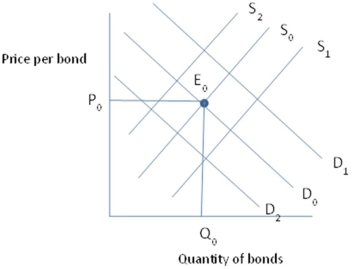
(Multiple Choice)
4.9/5 (89)
(89) Explain the relationship between coupon rate (or coupon yield) and current yield.
(Essay)
4.9/5 (83)
(83) The relationship between the price and the interest rate for a zero coupon bond is best described as:
(Multiple Choice)
4.9/5 (69)
(69) Suppose there is a decrease in the price at which a bondholder sells her bond.In this case, the holding period return will:
(Multiple Choice)
4.8/5 (88)
(88) A 30-year Treasury bond as a face value of $1,000, price of $1,200 with a $50 coupon payment.Assume the price of this bond decreases to $1,100 over the next year.The one-year holding period return is equal to:
(Multiple Choice)
4.8/5 (84)
(84) As general business conditions improve, we would witness the following in the bond market:
(Multiple Choice)
4.9/5 (85)
(85) The size of the bond dealer's spread is mainly a function of the:
(Multiple Choice)
4.9/5 (73)
(73) When the current yield and the coupon rate are equal, the bond is:
(Multiple Choice)
4.9/5 (74)
(74) A $1,000 face value bond purchased for $965.00, with an annual coupon of $60, and 20 years to maturity has a:
(Multiple Choice)
4.8/5 (73)
(73) The market for bonds is initially described by the supply of bonds - S0, and the demand for bonds - D0, with the equilibrium price and quantity being P0 and Q0.Suppose that the expected return on bonds falls relative to other assets.In the bond market this will result in: 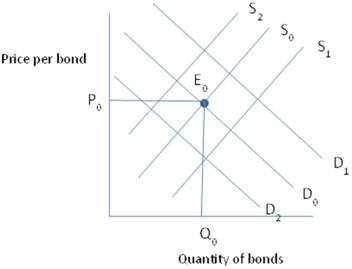
(Multiple Choice)
4.8/5 (88)
(88) A decrease in expected inflation for any given nominal interest rate will cause:
(Multiple Choice)
4.8/5 (87)
(87) If the U.S.government's borrowing needs increase, in the bond market this would be seen as:
(Multiple Choice)
4.8/5 (77)
(77) When the price of a bond is above face value the yield to maturity:
(Multiple Choice)
4.8/5 (84)
(84) If the U.S.government's borrowing needs increase, all other factors constant the:
(Multiple Choice)
4.8/5 (71)
(71) The market for bonds is initially described by the supply of bonds - S0, and the demand for bonds - D0, with the equilibrium price and quantity being P0 and Q0.An increase in the nation's wealth, all else constant, would cause the 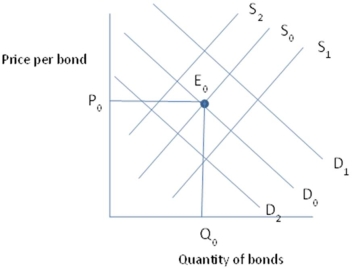
(Multiple Choice)
4.8/5 (73)
(73) As general business conditions deteriorate, all other factors constant:
(Multiple Choice)
4.8/5 (89)
(89) Which of the following would lead to an increase in bond supply?
(Multiple Choice)
5.0/5 (73)
(73) As general business conditions improve, all other factors constant the:
(Multiple Choice)
4.7/5 (75)
(75) 
Filters
- Essay(0)
- Multiple Choice(0)
- Short Answer(0)
- True False(0)
- Matching(0)