



 Chat with AI
Exam 6: Bonds, Bond Prices, and the Determination of Interest Rates

Exam 1: An Introduction to Money and the Financial System30 Questions
Exam 2: Money and the Payments System109 Questions
Exam 3: Financial Instruments, Financial Markets, and Financial Institutions120 Questions
Exam 4: Future Value, Present Value, and Interest Rates119 Questions
Exam 5: Understanding Risk110 Questions
Exam 6: Bonds, Bond Prices, and the Determination of Interest Rates128 Questions
Exam 7: The Risk and Term Structure of Interest Rates132 Questions
Exam 8: Stocks, Stock Markets, and Market Efficiency125 Questions
Exam 9: Derivatives: Futures, Options, and Swaps120 Questions
Exam 10: Foreign Exchange114 Questions
Exam 11: The Economics of Financial Intermediation117 Questions
Exam 12: Depository Institutions: Banks and Bank Management117 Questions
Exam 13: Financial Industry Structure126 Questions
Exam 14: Regulating the Financial System120 Questions
Exam 15: Central Banks in the World Today113 Questions
Exam 16: The Structure of Central Banks: The Federal Reserve and the European Central Bank116 Questions
Exam 17: The Central Bank Balance Sheet and the Money Supply Process109 Questions
Exam 18: Monetary Policy: Stabilizing the Domestic Economy116 Questions
Exam 19: Exchange-Rate Policy and the Central Bank122 Questions
Exam 20: Money Growth, Money Demand, and Modern Monetary Policy114 Questions
Exam 21: Output, Inflation, and Monetary Policy116 Questions
Exam 22: Understanding Business Cycle Fluctuations115 Questions
Exam 23: Modern Monetary Policy and the Challenges Facing Central Bankers107 Questions
Select questions type


A 10-year Treasury note as a face value of $1,000, price of $1,200, and a 7.5% coupon rate.Based on this information, we know the:
(Multiple Choice)
4.8/5  (73)
(73) If the annual interest rate is 5%(.05), the price of a six-month Treasury bill would be:
(Multiple Choice)
4.9/5 (83)
(83) Consider a $1,000.00 face value bond with a $55 annual coupon and 10 years until maturity.Calculate the current yield; the coupon rate and the yield to maturity under each of the following:
a) The bond is purchased for $940.00
b) The bond is purchased for $1,130.00
c) The bond is purchased for $1,000.00
(Essay)
4.9/5 (76)
(76) The most common form of zero-coupon bonds found in the United States is:
(Multiple Choice)
4.9/5 (82)
(82) Suppose that general business conditions improve, and at the same time, wealth increases.Based on this information, we know that:
(Multiple Choice)
4.9/5 (72)
(72) When the price of a bond is below the face value, the yield to maturity:
(Multiple Choice)
4.7/5 (81)
(81) If the annual interest rate is 5%(.05), the price of a one-year Treasury bill per $100 of face value would be:
(Multiple Choice)
4.7/5 (77)
(77) The market for bonds is initially described by the supply of bonds - S0, and the demand for bonds - D0, with the equilibrium price and quantity being P0 and Q0.If the federal government were to offer larger tax breaks on the purchase of new equipment for businesses, all other factors constant, we would expect to see: 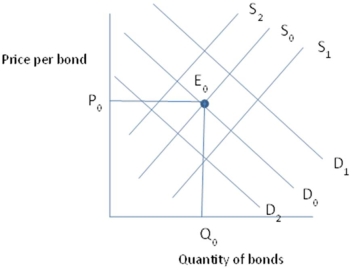
(Multiple Choice)
4.8/5 (75)
(75) An increase in the nation's wealth, all other factors constant, would cause:
(Multiple Choice)
4.9/5 (83)
(83) If the risk on foreign government bonds increases relative to U.S.government bonds, the price of U.S.government bonds should:
(Multiple Choice)
4.9/5 (75)
(75) A $1,000 face value bond purchased for $965.00, with an annual coupon of $60, and 20 years to maturity has a:
(Multiple Choice)
4.8/5 (68)
(68) At the time the government of Bulgrovia issued new bonds, they issued them at a price that reflected the risk-free rate because investors had no concerns regarding default risk, so did not require a risk premium.That risk-free rate was 4%.These bonds currently have one year to maturity and you notice the yield is 20%.Can you calculate the probability that the Bulgrovian government will default?
(Essay)
5.0/5 (83)
(83) The demand for U.S.government bonds is high relative to other bond issues because:
(Multiple Choice)
4.9/5 (78)
(78) Consider a zero-coupon bond with a $1,100 payment in one year.Suppose the interest rate decreases from 10% to 8%.The price of this bond:
(Multiple Choice)
4.8/5 (86)
(86) 
Filters
- Essay(0)
- Multiple Choice(0)
- Short Answer(0)
- True False(0)
- Matching(0)