



 Chat with AI
Exam 31: Atomic Physics

Exam 1: Introduction to Physics98 Questions
Exam 2: One-Dimensional Kinematics138 Questions
Exam 3: Vectors in Physics69 Questions
Exam 4: Two-Dimensional Kinematics51 Questions
Exam 5: Newtons Laws of Motion54 Questions
Exam 6: Applications of Newtons Laws104 Questions
Exam 7: Work and Kinetic Energy55 Questions
Exam 8: Potential Energy and Conservation of Energy62 Questions
Exam 9: Linear Momentum and Collisions114 Questions
Exam 10: Rotational Kinematics and Energy60 Questions
Exam 11: Rotational Dynamics and Static Equilibrium69 Questions
Exam 12: Gravity53 Questions
Exam 13: Oscillations About Equilibrium79 Questions
Exam 14: Waves and Sound142 Questions
Exam 15: Fluids103 Questions
Exam 16: Temperature and Heat110 Questions
Exam 17: Phases and Phase Changes93 Questions
Exam 18: The Laws of Thermodynamics90 Questions
Exam 19: Electric Charges, Forces, and Fields75 Questions
Exam 20: Electric Potential and Electric124 Questions
Exam 21: Electric Current and Direct-Current Circuits228 Questions
Exam 22: Magnetism147 Questions
Exam 23: Magnetic Flux and Faradays Law of Induction98 Questions
Exam 24: Alternating-Current Circuits72 Questions
Exam 25: Electromagnetic Waves63 Questions
Exam 26: Geometrical Optics133 Questions
Exam 27: Optical Instruments103 Questions
Exam 28: Physical Optics: Interference and Diffraction119 Questions
Exam 29: Relativity98 Questions
Exam 30: Quantum Physics88 Questions
Exam 31: Atomic Physics97 Questions
Exam 32: Nuclear Physics and Nuclear Radiation137 Questions
Select questions type


Calculate the orbital Bohr radius of the  Excited state in a hydrogen atom.
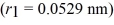
Excited state in a hydrogen atom. (Multiple Choice)
4.7/5  (78)
(78) Which one of the following is the correct electronic configuration for carbon,which has 6 electrons?
(Multiple Choice)
4.8/5 (77)
(77) A hydrogen atom is excited to the n = 11 level.Its decay to the n = 7 level is detected in a photographic plate.What is the wavelength of the light photographed? (c = 3.00 × 10⁸ m/s,1 eV = 1.60 × 10⁻¹⁹ J,h = 6.626 × 10⁻³⁴ J ∙ s)
(Multiple Choice)
4.8/5 (94)
(94) Which of the following values can be taken by the electron spin quantum number,ms?
(Multiple Choice)
4.9/5 (70)
(70) What is the energy of the photon emitted when an electron drops from the  State to the
 State in a hydrogen atom?
State to the
State in a hydrogen atom? (Multiple Choice)
4.8/5 (65)
(65) What is the ionization energy of the neutral hydrogen atom?
(Multiple Choice)
4.9/5 (65)
(65) In its ground state,the quantum numbers (n,ℓ,m1,ms)for hydrogen are,respectively,
(Multiple Choice)
4.8/5 (81)
(81) Which one of the following is the correct electronic configuration for the sodium atom,which has 11 electrons?
(Multiple Choice)
4.9/5 (88)
(88) In the n = 1 state,the energy of the hydrogen atom is -13.6 eV.What is its energy in the n = 2 state?
(Multiple Choice)
4.8/5 (83)
(83) What is the atomic number of a neutral atom that has an electron configuration of 1s2 2s2 2p6 3s2 3p2?
(Multiple Choice)
5.0/5 (82)
(82) If a hydrogen atom originally in a state with principal quantum number n is excited to state n' = 2n,then
(Multiple Choice)
4.9/5 (72)
(72) The orbital angular momentum quantum number ℓ can have any integer value ranging from
(Multiple Choice)
4.8/5 (90)
(90) What value of n corresponds to a wavelength of 91.7 nm in the Lyman series?
(Multiple Choice)
4.8/5 (86)
(86) Hydrogen atoms can emit four spectral lines with visible colors from red to violet.These four visible lines emitted by hydrogen atoms are produced by electrons
(Multiple Choice)
4.8/5 (94)
(94) How many values of the magnetic quantum number,mℓ,correspond to a value of ℓ = 4?
(Multiple Choice)
4.8/5 (80)
(80) An atom has completely filled inner shells and a single valence electron in an excited p state.The filled inner shells have an orbital momentum equal to zero.What is the magnitude of the orbital angular momentum of the atom?
(Multiple Choice)
5.0/5 (93)
(93) If ℓ = 4,which one of the following is a possible quantum number for n?
(Multiple Choice)
4.9/5 (83)
(83) 
Filters
- Essay(0)
- Multiple Choice(0)
- Short Answer(0)
- True False(0)
- Matching(0)