



 Chat with AI
Exam 17: Phases and Phase Changes

Exam 1: Introduction to Physics98 Questions
Exam 2: One-Dimensional Kinematics138 Questions
Exam 3: Vectors in Physics69 Questions
Exam 4: Two-Dimensional Kinematics51 Questions
Exam 5: Newtons Laws of Motion54 Questions
Exam 6: Applications of Newtons Laws104 Questions
Exam 7: Work and Kinetic Energy55 Questions
Exam 8: Potential Energy and Conservation of Energy62 Questions
Exam 9: Linear Momentum and Collisions114 Questions
Exam 10: Rotational Kinematics and Energy60 Questions
Exam 11: Rotational Dynamics and Static Equilibrium69 Questions
Exam 12: Gravity53 Questions
Exam 13: Oscillations About Equilibrium79 Questions
Exam 14: Waves and Sound142 Questions
Exam 15: Fluids103 Questions
Exam 16: Temperature and Heat110 Questions
Exam 17: Phases and Phase Changes93 Questions
Exam 18: The Laws of Thermodynamics90 Questions
Exam 19: Electric Charges, Forces, and Fields75 Questions
Exam 20: Electric Potential and Electric124 Questions
Exam 21: Electric Current and Direct-Current Circuits228 Questions
Exam 22: Magnetism147 Questions
Exam 23: Magnetic Flux and Faradays Law of Induction98 Questions
Exam 24: Alternating-Current Circuits72 Questions
Exam 25: Electromagnetic Waves63 Questions
Exam 26: Geometrical Optics133 Questions
Exam 27: Optical Instruments103 Questions
Exam 28: Physical Optics: Interference and Diffraction119 Questions
Exam 29: Relativity98 Questions
Exam 30: Quantum Physics88 Questions
Exam 31: Atomic Physics97 Questions
Exam 32: Nuclear Physics and Nuclear Radiation137 Questions
Select questions type


The absolute temperature of an ideal gas is directly proportional to which of the following quantities?
(Multiple Choice)
4.7/5  (71)
(71) An ideal gas has a pressure of 2.5 atm,a volume of 1.0 L at a temperature of 30°C.How many molecules are there in this gas? (R = 8.31 J/mol ∙ K,1.00 atm = 101 kPa,NA = 6.022 × 10²³)
(Multiple Choice)
4.8/5 (79)
(79) A substance has a melting point of 20°C and a heat of fusion of 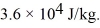 The boiling point is
 And the heat of vaporization is
 At a pressure of one atmosphere.The specific heats for the solid,liquid,and gaseous phases are 600 J/kg ∙ K (solid),1000 J/kg ∙ K (liquid),and 400 J/kg ∙ K (gaseous).How much heat is given up by
 Of this substance when it is cooled from 170°C to 86°C at a pressure of one atmosphere?
The boiling point is
And the heat of vaporization is
At a pressure of one atmosphere.The specific heats for the solid,liquid,and gaseous phases are 600 J/kg ∙ K (solid),1000 J/kg ∙ K (liquid),and 400 J/kg ∙ K (gaseous).How much heat is given up by
Of this substance when it is cooled from 170°C to 86°C at a pressure of one atmosphere? (Multiple Choice)
4.8/5 (95)
(95) The root-mean-square speed of the molecules of an ideal gas is v.The gas is now slowly compressed to one-half its original volume with no change in temperature.What is the root-mean-square speed of the molecules now?
(Multiple Choice)
4.8/5 (72)
(72) If the temperature of an ideal gas is increased from 20°C to 40°C,by what percent does the speed of the molecules increase?
(Multiple Choice)
4.8/5 (80)
(80) When a sample of water at 0.0°C is cooled to -36.0°C and freezes in the process,935,000 kJ of heat is liberated.What is the mass of this sample of water? For water LF = 334,000 J/kg,LV = 2.256 × 10⁶ J/kg,and the specific heat of ice is 2050 J/kg ∙ °C.
(Multiple Choice)
4.9/5 (85)
(85) At what temperature would the root-mean-square speed of hydrogen,H2,molecules equal 11.2 km/s (the earth's escape speed)? The mass of a hydrogen atom is 1.67 × 10⁻²⁷ kg,and the Boltzmann constant is 1.38 × 10⁻²³ J/K.
(Multiple Choice)
4.8/5 (73)
(73) Solar houses use a variety of energy storage devices to retain the heat absorbed during the day so that it can be released during the night.Suppose that you were to use a device of this kind to produce steam at 100°C during the day,and then allow the steam to cool to 0°C and freeze during the night.How many kilograms of water would be needed to store 20.0 kWh of energy in this way? The latent heat of vaporization of water is 22.6 × 10⁵ J/kg,the latent heat of fusion of water is 33.5 × 10⁴ J/kg,and the specific heat capacity of water is 4186 J/kg ∙ K.
(Multiple Choice)
4.8/5 (81)
(81) A laboratory vacuum pump can reduce the pressure in a chamber to 1.0 × 10⁻⁷ Pa.If the volume of the chamber is 0.500 m3 and the temperature is 27°C,how many molecules are left inside the chamber? (NA = 6.022 × 10²³ molecules/mol,R = 8.31 J/mol ∙ K)
(Multiple Choice)
4.9/5 (100)
(100) How many moles are there in 2.00 kg of copper? The atomic weight of copper is 63.5 g/mol and its density is 8.90 g/cm3.
(Multiple Choice)
4.8/5 (90)
(90) As one stretches a metal wire,which condition is reached first?
(Multiple Choice)
4.9/5 (99)
(99) A 3.9-L volume of ideal neon gas (monatomic)is at a pressure of 5.6 aym and a temperature of 330 K. The atomic mass of neon is 20.2 g/mol. The temperature of the gas is now increased to 430 K and the volume is increased to 5.9 L.
What is the final pressure of the gas?
(Multiple Choice)
4.9/5 (82)
(82) The melting point of aluminum is 660°C,its latent heat of fusion is 4.00 × 10⁵ J/kg,and its specific heat is 900J/kg ∙ K.How much heat must be added to 500 g of aluminum originally at 27°C to completely melt it?
(Multiple Choice)
4.9/5 (80)
(80) A weather balloon containing 2.0 m3 of hydrogen gas rises from a location at which the temperature is 22°C and the pressure is 101 kPa to a location where the temperature is -39°C and the pressure is 20 kPa.If the balloon is free to expand so that the pressure of the gas inside is equal to the ambient pressure,what is the new volume of the balloon?
(Multiple Choice)
4.8/5 (70)
(70) A vertical cylinder,closed at the bottom end,contains 0.0100 mol of ideal gas.It is fitted at the top with a piston that can move freely.The mass of the piston is 14.0 kg and the initial height of the piston above the bottom of the cylinder is 25 cm.What is the temperature of the gas? (R = 8.31 J/mol ∙ K)
(Multiple Choice)
4.9/5 (75)
(75) A 4.2-L flask of ideal neon gas (which is monatomic)is at a pressure of 3.3 atm and a temperature of 450 K.The atomic mass of neon is 20.2 g/mol.How many neon atoms are in the flask? (R = 8.31 J/mol ∙ K,1 atm = 101 kPa,NA = 6.022 × 10²³ molecules/mol)
(Multiple Choice)
4.7/5 (68)
(68) A 44.0-g block of ice at -15.0°C is dropped into a calorimeter (of negligible heat capacity)containing 100g. Of water at 5.0°C.When equilibrium is reached,how much of the ice will have melted? The specific heat of ice is 2090 J/kg ∙ K,that of water is 4186 J/kg ∙ K,and the latent heat of fusion of water is 33.5 × 10⁴ J/kg.
(Multiple Choice)
4.8/5 (82)
(82) A 0.50 m3 Gas tank holds 3.0 moles of ideal diatomic nitrogen gas at a temperature of 350 K. The atomic mass of nitrogen is 14.0 g/mol. What is the rms speed of the molecules? (The Boltzmann constant is 1.38 × 10⁻²³ J/K,NA = 6.022 × 10²³ molecules/mol. )
(Multiple Choice)
4.8/5 (89)
(89) A 1200-kg car is being raised at a constant speed if 25 cm/s by a crane,using a 20-m long steel cable that is 1.5 cm in diameter.Young's modulus for steel is 2.0 × 10¹¹ Pa.What is the change in length of the cable caused by the car?
(Multiple Choice)
4.8/5 (85)
(85) If you add 1.33 MJ of heat to 500 g of water at 50°C in a sealed container,what is the final temperature of the steam? The latent heat of vaporization of water is 22.6 × 10⁵ J/kg,the specific heat of steam is 2010 J/kg ∙ K,and the specific heat of water is 4186 J/kg ∙ K.
(Multiple Choice)
4.7/5 (83)
(83) 
Filters
- Essay(0)
- Multiple Choice(0)
- Short Answer(0)
- True False(0)
- Matching(0)