



 Chat with AI
Exam 16: Temperature and Heat

Exam 1: Introduction to Physics98 Questions
Exam 2: One-Dimensional Kinematics138 Questions
Exam 3: Vectors in Physics69 Questions
Exam 4: Two-Dimensional Kinematics51 Questions
Exam 5: Newtons Laws of Motion54 Questions
Exam 6: Applications of Newtons Laws104 Questions
Exam 7: Work and Kinetic Energy55 Questions
Exam 8: Potential Energy and Conservation of Energy62 Questions
Exam 9: Linear Momentum and Collisions114 Questions
Exam 10: Rotational Kinematics and Energy60 Questions
Exam 11: Rotational Dynamics and Static Equilibrium69 Questions
Exam 12: Gravity53 Questions
Exam 13: Oscillations About Equilibrium79 Questions
Exam 14: Waves and Sound142 Questions
Exam 15: Fluids103 Questions
Exam 16: Temperature and Heat110 Questions
Exam 17: Phases and Phase Changes93 Questions
Exam 18: The Laws of Thermodynamics90 Questions
Exam 19: Electric Charges, Forces, and Fields75 Questions
Exam 20: Electric Potential and Electric124 Questions
Exam 21: Electric Current and Direct-Current Circuits228 Questions
Exam 22: Magnetism147 Questions
Exam 23: Magnetic Flux and Faradays Law of Induction98 Questions
Exam 24: Alternating-Current Circuits72 Questions
Exam 25: Electromagnetic Waves63 Questions
Exam 26: Geometrical Optics133 Questions
Exam 27: Optical Instruments103 Questions
Exam 28: Physical Optics: Interference and Diffraction119 Questions
Exam 29: Relativity98 Questions
Exam 30: Quantum Physics88 Questions
Exam 31: Atomic Physics97 Questions
Exam 32: Nuclear Physics and Nuclear Radiation137 Questions
Select questions type


Two metal rods are to be used to conduct heat from a region at 100°C to a region at 0°C as shown in the figure.The rods can be placed in parallel,as shown on the left,or in series,as on the right.When steady state flow is established,the heat conducted in the series arrangement is 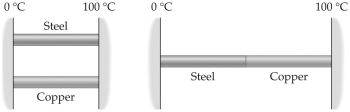
(Multiple Choice)
4.9/5  (83)
(83) An object having a fixed emissivity of 0.725 radiates heat at a rate of 10 W when it is at an absolute temperature T.If its temperature is doubled to 2T,at what rate will it now radiate?
(Multiple Choice)
4.8/5 (82)
(82) A temperature change of 20°C corresponds to a Fahrenheit temperature change of
(Multiple Choice)
4.7/5 (82)
(82) A thermally isolated system is made up of a hot piece of aluminum and a cold piece of copper,with the aluminum and the copper in thermal contact.The specific heat capacity of aluminum is more than double that of copper.Which object experiences the greater magnitude gain or loss of heat during the time the system takes to reach thermal equilibrium?
(Multiple Choice)
4.9/5 (70)
(70) Two metal rods,one silver and the other gold,are attached to each other end-to-end.The free end of the silver rod is immersed in a steam chamber at 100°C,and the free end of the gold rod in an ice water bath at 0°C.The rods are both 5.0 cm long and have a square cross-section that is 2.0 cm on a side.No heat is exchanged between the rods and their surroundings,except at the ends.How much total heat flows through the two rods each minute? The thermal conductivity of silver is 417 W/m ∙ K,and that of gold is 291 W/m ∙ K.
(Multiple Choice)
4.7/5 (78)
(78) An aluminum rod is 10.0 cm long and a steel rod is 80.0 cm long when both rods are at a temperature of 15°C.Both rods have the same diameter.The rods are now joined end-to-end to form a rod 90.0 cm long.If the temperature is now raised from 15°C to 90°C,what is the increase in the length of the joined rod? The coefficient of linear expansion of aluminum is 2.4 × 10⁻⁵ K-1 and that of steel is 1.2 × 10⁻⁵ K-1.
(Multiple Choice)
4.8/5 (79)
(79) A giant star radiates energy at the rate of 3.0 × 1030 W,and its surface temperature has been measured to be 3000 K.Assuming that it is a perfect emitter,what is the radius of this star? (σ = 5.67 × 10⁻⁸ W/m2 ∙ K4)
(Multiple Choice)
4.8/5 (82)
(82) By what length will a slab of concrete that is originally 18 m long contract when the temperature drops from 24°C to -16°C? The coefficient of linear thermal expansion for this concrete is 1.0 × 10⁻⁵ K-1.
(Multiple Choice)
4.8/5 (69)
(69) Which one of the following quantities is the smallest unit of heat energy?
(Multiple Choice)
4.8/5 (77)
(77) A hole in a brass plate has a diameter of 1.200 cm at 20°C.What is the diameter of the hole when the plate is heated to 220°C? The coefficient of linear thermal expansion for brass is 19 × 10-6 K-1.
(Multiple Choice)
4.8/5 (81)
(81) 
Filters
- Essay(0)
- Multiple Choice(0)
- Short Answer(0)
- True False(0)
- Matching(0)