



 Chat with AI
Exam 16: Temperature and Heat

Exam 1: Introduction to Physics98 Questions
Exam 2: One-Dimensional Kinematics138 Questions
Exam 3: Vectors in Physics69 Questions
Exam 4: Two-Dimensional Kinematics51 Questions
Exam 5: Newtons Laws of Motion54 Questions
Exam 6: Applications of Newtons Laws104 Questions
Exam 7: Work and Kinetic Energy55 Questions
Exam 8: Potential Energy and Conservation of Energy62 Questions
Exam 9: Linear Momentum and Collisions114 Questions
Exam 10: Rotational Kinematics and Energy60 Questions
Exam 11: Rotational Dynamics and Static Equilibrium69 Questions
Exam 12: Gravity53 Questions
Exam 13: Oscillations About Equilibrium79 Questions
Exam 14: Waves and Sound142 Questions
Exam 15: Fluids103 Questions
Exam 16: Temperature and Heat110 Questions
Exam 17: Phases and Phase Changes93 Questions
Exam 18: The Laws of Thermodynamics90 Questions
Exam 19: Electric Charges, Forces, and Fields75 Questions
Exam 20: Electric Potential and Electric124 Questions
Exam 21: Electric Current and Direct-Current Circuits228 Questions
Exam 22: Magnetism147 Questions
Exam 23: Magnetic Flux and Faradays Law of Induction98 Questions
Exam 24: Alternating-Current Circuits72 Questions
Exam 25: Electromagnetic Waves63 Questions
Exam 26: Geometrical Optics133 Questions
Exam 27: Optical Instruments103 Questions
Exam 28: Physical Optics: Interference and Diffraction119 Questions
Exam 29: Relativity98 Questions
Exam 30: Quantum Physics88 Questions
Exam 31: Atomic Physics97 Questions
Exam 32: Nuclear Physics and Nuclear Radiation137 Questions
Select questions type


The process in which heat flows by the mass movement of molecules from one place to another is known as
(Multiple Choice)
4.7/5  (81)
(81) The coefficient of linear expansion of copper is 17 × 10-6 K-1 and that of steel is 12 × 10-6 K-1.At 12°C a steel rod has a diameter of 2.540 cm and a copper pipe has a diameter of 2.536 cm.If they are heated together to a higher temperature,which one of the following quantities is closest to the common temperature at which the steel rod will fit snugly in the copper pipe?
(Multiple Choice)
4.9/5 (73)
(73) At room temperature,a typical person loses energy to the surroundings at the rate of 62 W.If this energy loss has to be made up by an equivalent food intake,how many kilocalories (food calories)does this person need to consume every day just to make up this heat loss? (1 cal = 4.186 J)
(Multiple Choice)
4.8/5 (79)
(79) Object 1 has three times the specific heat capacity and four times the mass of Object 2.The two objects are given the same amount of heat.If the temperature of Object 1 changes by an amount ΔT,the change in temperature of Object 2 will be
(Multiple Choice)
4.8/5 (81)
(81) A steel bridge is 1000 m long at -20°C in winter.What is the change in length when the temperature rises to 40°C in summer? The average coefficient of linear expansion of this steel is 11 × 10-6 K-1.
(Multiple Choice)
4.9/5 (77)
(77) A mercury thermometer has a glass bulb of interior volume 0.100 cm3 at 10°C.The glass capillary tube above the bulb has an inner cross-sectional area of 0.012 mm2.The coefficient of volume expansion of mercury is 1.8 × 10⁻⁴ K-1.If the expansion of the glass is negligible,how much will the mercury rise in the capillary tube when the temperature rises from 5°C to 35°C if the bulb was full at 5°C?
(Multiple Choice)
4.7/5 (82)
(82) A thermally isolated system is made up of a hot piece of aluminum and a cold piece of copper,with the aluminum and the copper in thermal contact.The specific heat capacity of aluminum is more than double that of copper.Which object experiences the greater temperature change during the time the system takes to reach thermal equilibrium?
(Multiple Choice)
4.8/5 (88)
(88) A brass rod is 69.5 cm long and an aluminum rod is 49.3 cm long when both rods are at an initial temperature of 0° C.The rods are placed in line with a gap of 1.2 cm between them,as shown in the figure.The distance between the far ends of the rods is maintained at 120.0 cm throughout.The temperature of both rods is raised equally until they are barely in contact.At what temperature does contact occur? The coefficients of linear expansion of brass and aluminum are 2.0 × 10⁻⁵ K-1 (brass)and 2.4 × 10⁻⁵ K-1 (aluminum). 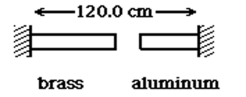
(Multiple Choice)
4.9/5 (79)
(79) A heat-conducting rod that is wrapped in insulation is constructed with a 0.15-m length of alloy A and a 0.40-m length of alloy B,joined end-to-end.Both pieces have cross-sectional areas of 0.0020 m2.The thermal conductivity of alloy B is known to be 1.8 times as great as that for alloy A.The end of the rod in alloy A is maintained at a temperature of 10°C,and the other end of the rod is maintained at an unknown temperature.When steady state flow has been established,the temperature at the junction of the alloys is measured to be 40° C,and the rate of heat flow in the rod is measured at 56 W.What is the temperature of the end of the rod in alloy B?
(Multiple Choice)
4.8/5 (91)
(91) When 50 g of a certain material at 100°C is mixed with 100 g of water at 0°C,the final temperature is 40°C.What is the specific heat of the material? The specific heat of water is 1.00 kcal/kg ∙ °C.
(Multiple Choice)
4.9/5 (79)
(79) A carpenter is driving a 15.0-g steel nail into a board.His 1.00-kg hammer is moving at 8.50 m/s when it strikes the nail.Half of the kinetic energy of the hammer is transformed into heat in the nail and does not flow out of the nail.What is the increase in temperature of the nail after the three blows that the carpenter needs to drive the nail in completely? The specific heat of steel is 448 J/kg ∙ K.
(Multiple Choice)
4.8/5 (79)
(79) The coefficient of linear expansion of aluminum is 24.0 × 10⁻⁶ K-1,and the density of aluminum at 0°C is 2.70 × 10³ kg/m3.What is the density of aluminum at 300°C?
(Multiple Choice)
4.8/5 (73)
(73) At what,if any,temperature are the numerical readings on the Fahrenheit and Celsius scales the same?
(Multiple Choice)
4.7/5 (77)
(77) On his honeymoon,James Joule attempted to explore the relationships between various forms of energy by measuring the rise of temperature of water which had fallen down a waterfall on Mount Blanc.What maximum temperature rise would one expect for a waterfall with a vertical drop of 20 m? The specific heat of water is 4186 J/kg ∙ K.
(Multiple Choice)
4.9/5 (82)
(82) A sphere of surface area 1.25 m2 and emissivity 1.0 is at a temperature of 100°C.At what rate does it radiate heat into empty space? (σ = 5.67 × 10⁻⁸ W/m2 ∙ K4)
(Multiple Choice)
4.9/5 (70)
(70) The thermal conductivity of a certain concrete is 0.80 W/m .K and the thermal conductivity of a certain wood is 0.10 W/m ∙ K.How thick would a solid concrete wall have to be in order to have the same rate of heat flow through it as an 8.0-cm thick wall made of solid wood? Both walls have the same surface area and the same temperature difference across their faces.
(Multiple Choice)
5.0/5 (80)
(80) A concrete wall of a cold storage room measures 3.0 m high,5.0 m wide,and 20 cm thick.The inside wall is to be covered by a layer of wood in order to reduce the rate of heat flow through the wall by 90 percent.The inner surface of the wooden wall is maintained at -10°C and the outer surface of the concrete wall is at 20°C.The thermal conductivities of concrete and wood are 0.80 W/m ∙ K (concrete)and 0.040 W/m ∙ K (wood).What should be the thickness of the layer of wood?
(Multiple Choice)
4.7/5 (72)
(72) A solid cylindrical bar conducts heat at a rate of 25 W from a hot to a cold reservoir under steady state conditions.If both the length and the diameter of this bar are doubled,the rate at which it will conduct heat between these reservoirs will be
(Multiple Choice)
4.7/5 (89)
(89) A blacksmith is flattening a steel plate having dimensions 10 cm × 15 cm × 1 mm.He has heated the plate to 900 K.If the emissivity of the plate is 0.75,at what rate does it lose energy by radiation? Ignore any heat exchange with the surroundings.(σ = 5.67 × 10⁻⁸ W/m2 ∙ K4)
(Multiple Choice)
4.8/5 (66)
(66) As shown in the figure,a bimetallic strip,consisting of metal G on the top and metal H on the bottom,is rigidly attached to a wall at the left.The coefficient of linear thermal expansion for metal G is greater than that of metal H.If the strip is uniformly heated,it will 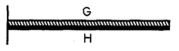
(Multiple Choice)
4.7/5 (89)
(89) 
Filters
- Essay(0)
- Multiple Choice(0)
- Short Answer(0)
- True False(0)
- Matching(0)