



 Chat with AI
Exam 17: Free Energy and Thermodynamics

Exam 1: Matter, Measurement, and Problem Solving120 Questions
Exam 2: Atoms and Elements116 Questions
Exam 3: Molecules, Compounds and Chemical Equations144 Questions
Exam 4: Chemical Quantities and Aqueous Reactions199 Questions
Exam 5: Gases157 Questions
Exam 6: Thermochemistry110 Questions
Exam 7: The Quantum-Mechanical Model of the Atom100 Questions
Exam 8: Periodic Properties of the Elements120 Questions
Exam 9: Chemical Bonding I: Lewis Theory125 Questions
Exam 10: Chemical Bonding II: Molecular Shapes, Valence Bond Theory, and109 Questions
Exam 11: Liquids, Solids, and Intermolecular Forces123 Questions
Exam 12: Solutions127 Questions
Exam 13: Chemical Kinetics125 Questions
Exam 14: Chemical Equilibrium112 Questions
Exam 15: Acids and Bases126 Questions
Exam 16: Aqueous Ionic Equilibrium148 Questions
Exam 17: Free Energy and Thermodynamics103 Questions
Exam 18: Electrochemistry115 Questions
Exam 19: Radioactivity and Nuclear Chemistry105 Questions
Select questions type


Calculate ΔGrxn at 298 K under the conditions shown below for the following reaction.
CaCO3(s)→ CaO(s)+ CO2(g)ΔG° = +131.1 kJ
P(CO2)= 0.033 atm
(Multiple Choice)
4.9/5  (88)
(88) What is the ΔSuniv for the following reaction at 25°C?
N2(g)+ 3H2(g)⇌ 2NH3(g)ΔSsys = -197 J/K;ΔHsys = -91.8 kJ
(Multiple Choice)
4.8/5 (68)
(68) Calculate ΔS°rxn for the following reaction.The S° for each species is shown below the reaction.
C2H2(g)+ 2 H2(g)→ C2H6(g)
S°(J/mol∙K)200.9 130.7 229.2
(Multiple Choice)
4.9/5 (89)
(89) Calculate ΔGrxn at 298 K under the conditions shown below for the following reaction.
SO3(g)+ H2O(g)→ H2SO4(l)ΔG°= -90.5 kJ
P(SO3)= 0.20 atm,P(H2O)= 0.88 atm
(Multiple Choice)
4.8/5 (90)
(90) Consider a reaction that has a negative ΔH and a positive ΔS.Which of the following statements is true?
(Multiple Choice)
5.0/5 (72)
(72) When solid NH4NO3 dissolves spontaneously in water,the resulting solution becomes cool.Which answer is consistent with this observation?
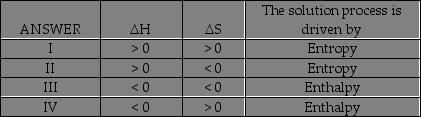
(Multiple Choice)
4.7/5 (74)
(74) What is the ΔG for the forward reaction at 100°C?
C2H4(g)+ H2(g)⇌ C2H6(g);ΔH= -137.5 kJ;ΔS = -120.5 J/K
(Multiple Choice)
4.9/5 (68)
(68) Use the free energies of formation given below to calculate the equilibrium constant (K)for the following reaction at 298 K.
2 HNO3(aq)+ NO(g)→ 3 NO2(g)+ H2O(l)K = ?
ΔG°f (kJ/mol)-110.9 87.6 51.3 -237.1
(Multiple Choice)
4.8/5 (95)
(95) Estimate ΔG°rxn for the following reaction at 387 K.
HCN(g)+ 2 H2(g)→ CH3NH2(g)ΔH° = -158.0 kJ;ΔS° = -219.9 J/K
(Multiple Choice)
4.9/5 (74)
(74) Which process results in the decrease of entropy of the universe?
(Multiple Choice)
4.9/5 (65)
(65) Calculate the ΔG°rxn using the following information.
2 H2S(g)+ 3 O2(g)→ 2 SO2(g)+ 2 H2O(g)ΔG°rxn = ?
ΔH°f (kJ/mol)-20.6 296.8 -241.8
S°(J/mol∙K)205.8 205.248.2 188.8
(Multiple Choice)
4.9/5 (85)
(85) Consider a reaction that has a negative ΔH and a negative ΔS.Which of the following statements is true?
(Multiple Choice)
4.8/5 (82)
(82) Below what temperature does the following reaction become nonspontaneous?
2 HNO3(aq)+ NO(g)→ 3 NO2(g)+ H2O(l)
ΔH = +136.5 kJ;ΔS = +287.5 J/K
(Multiple Choice)
4.8/5 (83)
(83) Determine ΔG°rxn using the following information.
H2(g)+ CO(g)→ CH2O(g)ΔH° = +1.9 kJ;ΔS° = -109.6 J/K
(Multiple Choice)
4.8/5 (76)
(76) 
Filters
- Essay(0)
- Multiple Choice(0)
- Short Answer(0)
- True False(0)
- Matching(0)