



 Chat with AI
Exam 11: Calculating the Cost of Capital

Exam 1: Introduction to Financial Management65 Questions
Exam 2: Reviewing Financial Statements115 Questions
Exam 3: Analyzing Financial Statements131 Questions
Exam 4: Time Value of Money 1: Analyzing Single Cash Flows143 Questions
Exam 5: Time Value of Money 2: Analyzing Annuity Cash Flows148 Questions
Exam 6: Understanding Financial Markets and Institutions104 Questions
Exam 7: Valuing Bonds131 Questions
Exam 8: Valuing Stocks118 Questions
Exam 9: Characterizing Risk and Return113 Questions
Exam 10: Estimating Risk and Return106 Questions
Exam 11: Calculating the Cost of Capital124 Questions
Exam 12: Estimating Cash Flows on Capital Budgeting Projects116 Questions
Exam 13: Weighing Net Present Value and Other Capital Budgeting Criteria121 Questions
Exam 14: Working Capital Management and Policies129 Questions
Exam 15: Financial Planning and Forecasting90 Questions
Exam 16: Assessing Long-Term Debt, Equity, and Capital Structure115 Questions
Exam 17: Sharing Firm Wealth: Dividends, Share Repurchases, and Other Payouts111 Questions
Exam 18: Issuing Capital and the Investment Banking Process119 Questions
Exam 19: International Corporate Finance122 Questions
Exam 20: Mergers and Acquisitions and Financial Distress109 Questions
Select questions type


An all-equity firm is considering the projects shown below. The T-bill rate is 3% and the market risk premium is 6%. If the firm uses its current WACC of 12% to evaluate these projects, which project(s), if any, will be incorrectly rejected? 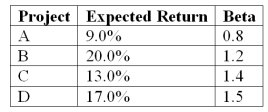
(Multiple Choice)
4.8/5  (75)
(75) JLP Industries has 6.5 million shares of common stock outstanding with a market price of $20.00 per share. The company also has outstanding preferred stock with a market value of $10 million, and 25,000 bonds outstanding, each with face value $1,000 and selling at 90% of par value. The cost of equity is 14%, the cost of preferred is 10%, and the cost of debt is 6.25%. If JLP's tax rate is 34%, what is the WACC?
(Multiple Choice)
4.9/5 (80)
(80) IVY has preferred stock selling for 98 percent of par that pays a 7 percent annual coupon. What would be IVY's component cost of preferred stock?
(Multiple Choice)
4.8/5 (75)
(75) FlavR Co stock has a beta of 2.0, the current risk-free rate is 2, and the expected return on the market is 9 percent. What is FlavR Co's cost of equity?
(Multiple Choice)
5.0/5 (93)
(93) Which of these makes this a true statement? When determining the appropriate weights used in calculating a WACC, it should reflect
(Multiple Choice)
4.7/5 (72)
(72) Which statement makes this a false statement? When a firm pays commissions to underwriting firms that float the issuance of new stock,
(Multiple Choice)
4.7/5 (78)
(78) A firm has 5,000,000 shares of common stock outstanding, each with a market price of $8.00 per share. It has 25,000 bonds outstanding, each selling for $1100 with a $1000 face value. The bonds mature in 12 years, have a coupon rate of 9%, and pay coupons semi-annually. The firm's equity has a beta of 1.4, and the expected market return is 15%. The tax rate is 35% and the WACC is 14%. Calculate the risk-free rate.
(Multiple Choice)
4.8/5 (65)
(65) JaiLai Cos. stock has a beta of 1.7, the current risk-free rate is 6.2%, and the expected return on the market is 11%. What is JaiLai's cost of equity?
(Multiple Choice)
4.8/5 (84)
(84) TJ Co stock has a beta of 1.45, the current risk-free rate is 5.75, and the expected return on the market is 14 percent. What is TJ Co's cost of equity?
(Multiple Choice)
4.9/5 (88)
(88) Which of these statements is true regarding divisional WACC?
(Multiple Choice)
5.0/5 (81)
(81) Which of these completes this statement to make it true? The constant growth model is
(Multiple Choice)
4.8/5 (83)
(83) A firm has 1,000,000 shares of common stock outstanding, each with a market price of $10.00 per share. It has 15,000 bonds outstanding, each selling for $900 (with a face value of $1,000). The bonds mature in 15 years, have a coupon rate of 10%, and pay coupons semi-annually. The firm's equity has a beta of 1.5, and the expected market return is 20%. The tax rate is 35% and the WACC is 16%. What is the risk-free rate?
(Multiple Choice)
4.9/5 (65)
(65) Solar Shades has 8 million shares of common stock outstanding, 4 million shares of preferred stock outstanding, and 10 thousand bonds. If the common shares are selling for $13 per share, the preferred shares are selling for $30 per share, and the bonds are selling for 105 percent of par, what would be the weight used for equity in the computation of Solar Shades' WACC?
(Multiple Choice)
4.8/5 (78)
(78) Suppose your firm has decided to use a divisional WACC approach to analyze projects. The firm currently has 4 divisions, A through D, with average betas for each division of 0.5, 1.0, 1.3 and 1.6, respectively. If all current and future projects will be financed with half debt and half equity, and if the current cost of equity (based on an average firm beta of 1.0 and a current risk-free rate of 7%) is 14% and the after-tax yield on the company's bonds is 8%, what are the WACCs for divisions A through D?
(Multiple Choice)
4.8/5 (83)
(83) Denote the impact that flotation costs have on capital budgeting decisions.
(Essay)
4.8/5 (72)
(72) PNB Industries has 20 million shares of common stock outstanding with a market price of $18.00 per share. The company also has outstanding preferred stock with a market value of $50 million, and 500,000 bonds outstanding, each with face value $1,000 and selling at 97% of par value. The cost of equity is 15%, the cost of preferred is 12%, and the cost of debt is 8.50%. If PNB's tax rate is 40%, what is the WACC?
(Multiple Choice)
4.9/5 (86)
(86) An objective approach to calculating divisional WACCs would be done by
(Multiple Choice)
4.9/5 (86)
(86) 
Filters
- Essay(0)
- Multiple Choice(0)
- Short Answer(0)
- True False(0)
- Matching(0)