



 Chat with AI
Exam 16: Fiscal Policy

Exam 1: Economics: Foundations and Models219 Questions
Exam 2: Trade-Offs, Comparative Advantage, and the Market System236 Questions
Exam 3: Where Prices Come From: The Interaction of Demand and Supply234 Questions
Exam 4: Economic Efficiency, Government Price Setting, and Taxes212 Questions
Exam 5: The Economics of Health Care166 Questions
Exam 6: Firms, the Stock Market, and Corporate Governance251 Questions
Exam 7: Comparative Advantage and the Gains From International Trade188 Questions
Exam 8: GDP: Measuring Total Production and Income260 Questions
Exam 9: Unemployment and Inflation289 Questions
Exam 10: Economic Growth, the Financial System, and Business Cycles251 Questions
Exam 11: Long-Run Economic Growth: Sources and Policies261 Questions
Exam 12: Aggregate Expenditure and Output in the Short Run304 Questions
Exam 13: Aggregate Demand and Aggregate Supply Analysis284 Questions
Exam 14: Money,Banks,and the Federal Reserve System276 Questions
Exam 15: Monetary Policy278 Questions
Exam 16: Fiscal Policy313 Questions
Exam 17: Inflation, Unemployment, and Federal Reserve Policy257 Questions
Exam 18: Macroeconomics in an Open Economy277 Questions
Exam 19: The International Financial System256 Questions
Select questions type


If policymakers implement an expansionary fiscal policy but do not take into account the potential for crowding out,the new equilibrium level of GDP is likely to
(Multiple Choice)
4.9/5  (76)
(76) Historically,the largest U.S.federal budget deficits as a percentage of GDP in the 20th century occurred during
(Multiple Choice)
4.8/5 (71)
(71) Calculate the government purchases multiplier if the marginal propensity to consume equals 0.75,the tax rate is 0.2,and the marginal propensity to import equals 0.3.
(Multiple Choice)
4.8/5 (69)
(69) Figure 16-1 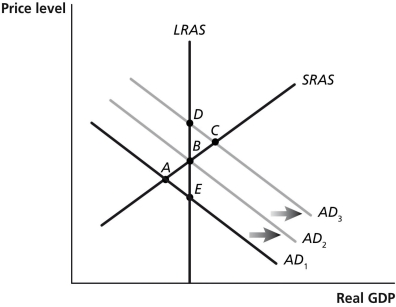 -Refer to Figure 16-1.Suppose the economy is in short-run equilibrium above potential GDP and wages and prices are rising.If contractionary policy is used to move the economy back to long run equilibrium,this would be depicted as a movement from ________ using the basic AD-AS model in the figure above.
 (Multiple Choice)
4.9/5 (72)
(72) What are the key differences between how we illustrate a contractionary fiscal policy in the basic aggregate demand and aggregate supply model and in the dynamic aggregate demand and aggregate supply model?
(Essay)
4.9/5 (76)
(76) An appropriate fiscal policy response when aggregate demand is growing at a slower rate than aggregate supply is to cut taxes.
(True/False)
4.9/5 (87)
(87) Suppose that the current equilibrium GDP is $14.5 trillion and that potential GDP is $14.3 trillion.Will decreasing government purchases by $200 billion,or raising taxes by $200 billion,restore the economy to potential GDP? Explain.
(Essay)
4.9/5 (76)
(76) How could the existence of an unemployment insurance system or other transfer programs have reduced the severity of the Great Depression?
(Essay)
4.9/5 (73)
(73) Prior to the 1930s,the majority of dollars spent by government was spent at the state and local levels.
(True/False)
4.8/5 (87)
(87) Social Security began as a "pay-as-you-go" system,meaning that payments to current retirees were paid
(Multiple Choice)
4.9/5 (76)
(76) To evaluate the size of the federal budget deficit or surplus over time,it would be best to look at the
(Multiple Choice)
4.9/5 (88)
(88) If the economy is slipping into a recession,which of the following would be an appropriate fiscal policy?
(Multiple Choice)
4.9/5 (70)
(70) In preparing their estimates of the stimulus package's effect on GDP,Obama administration economists estimated a government purchases multiplier of 1.57.This indicates that a ________ increase in government purchases would increase equilibrium real GDP by $157 billion
(Multiple Choice)
4.9/5 (82)
(82) Included in government expenditures are government purchases and transfer payments.
(True/False)
4.8/5 (84)
(84) What is the difference between federal purchases and federal expenditures?
(Essay)
4.8/5 (84)
(84) What is expansionary fiscal policy? What is contractionary fiscal policy?
(Essay)
4.8/5 (73)
(73) Suppose real GDP is $12.6 trillion and potential GDP is $12.4 trillion.To move the economy back to potential GDP,Congress should
(Multiple Choice)
4.8/5 (99)
(99) Assume a closed economy,that taxes are fixed,and the marginal propensity to consume is equal to 0.8.What is the government spending multiplier?
(Multiple Choice)
4.8/5 (94)
(94) 
Filters
- Essay(0)
- Multiple Choice(0)
- Short Answer(0)
- True False(0)
- Matching(0)