



 Chat with AI
Exam 16: Fiscal Policy

Exam 1: Economics: Foundations and Models219 Questions
Exam 2: Trade-Offs, Comparative Advantage, and the Market System236 Questions
Exam 3: Where Prices Come From: The Interaction of Demand and Supply234 Questions
Exam 4: Economic Efficiency, Government Price Setting, and Taxes212 Questions
Exam 5: The Economics of Health Care166 Questions
Exam 6: Firms, the Stock Market, and Corporate Governance251 Questions
Exam 7: Comparative Advantage and the Gains From International Trade188 Questions
Exam 8: GDP: Measuring Total Production and Income260 Questions
Exam 9: Unemployment and Inflation289 Questions
Exam 10: Economic Growth, the Financial System, and Business Cycles251 Questions
Exam 11: Long-Run Economic Growth: Sources and Policies261 Questions
Exam 12: Aggregate Expenditure and Output in the Short Run304 Questions
Exam 13: Aggregate Demand and Aggregate Supply Analysis284 Questions
Exam 14: Money,Banks,and the Federal Reserve System276 Questions
Exam 15: Monetary Policy278 Questions
Exam 16: Fiscal Policy313 Questions
Exam 17: Inflation, Unemployment, and Federal Reserve Policy257 Questions
Exam 18: Macroeconomics in an Open Economy277 Questions
Exam 19: The International Financial System256 Questions
Select questions type


The largest source of federal government revenue in 2016 was
(Multiple Choice)
4.9/5  (93)
(93) If real GDP is $300 billion below potential GDP and the tax multiplier equals -1.5,then how much would the government need to change taxes to bring the economy to equilibrium at potential?
(Essay)
4.8/5 (85)
(85) Give an example of an automatic stabilizer.Explain how automatic stabilizers work in the case of recession.
(Essay)
4.9/5 (83)
(83) What is the government purchases multiplier if the tax rate is 0.2 and the marginal propensity to consume is 0.8? Assume the economy is closed.
(Multiple Choice)
4.8/5 (73)
(73) Consider a tax cut which affects not only consumer disposable income,but also after-tax earnings from labor supplied to labor markets and from financial assets acquired through saving.In the long run we would expect this tax cut to
(Multiple Choice)
4.9/5 (74)
(74) In an open economy,the government purchases multiplier will be
(Multiple Choice)
4.8/5 (83)
(83) An increase in government spending lowers interest rates and increases the rate of investment in new capital.
(True/False)
5.0/5 (93)
(93) Which of the following statements about the Social Security,Medicare,and Medicaid programs is true?
(Multiple Choice)
4.8/5 (70)
(70) Article Summary
In November 2017,the House Ways and Means Committee announced a tax reform bill which includes hundreds of changes to the tax code.Overall,the tax plan represents a move in the direction of greater neutrality and global competitiveness.Following are eight of the most important provisions in the tax bill.
1.The corporate tax rate would be reduced to 20 percent.
2.Pass-through business income would be taxed at a maximum rate of 25 percent.
3.Some disincentives to investment would be rolled back.
4.The country would move to a territorial tax system.
5.Many itemized deductions would be eliminated.
6.The estate tax would be repealed.
7.The tax treatment of interest would change.
8.Tax expenditures would be curtailed.
Source: Jared Walczak and Amir El-Sibaie,"Eight Important Changes in the Tax Cuts and Jobs Act," taxfoundation.org,November 2,2017.
-Refer to the Article Summary.A reduction in the corporate tax rate to 20 percent would ________ the return corporations receive from new investments in equipment and factories,and this would ________ aggregate supply.
(Multiple Choice)
5.0/5 (70)
(70) The federal government debt as a percentage of GDP did not rise
(Multiple Choice)
4.9/5 (82)
(82) Assume a country is required by law to balance the budget every year.Suppose aggregate demand falls,causing a recession and a budget deficit.To balance the budget,what would the government need to do with the level of government spending and taxes? How would these changes in government spending and taxes affect aggregate demand and the economy?
(Essay)
4.9/5 (86)
(86) The larger the marginal propensity to import,the larger the government purchases multiplier.
(True/False)
4.9/5 (76)
(76) The tax multiplier is smaller in absolute value than the government purchases multiplier because some portion of the
(Multiple Choice)
4.9/5 (82)
(82) Assuming a fixed amount of taxes and a closed economy,calculate the value of the government purchases multiplier,the tax multiplier,and the balanced budget multiplier if the marginal propensity to consume equals 0.5.
(Essay)
4.9/5 (86)
(86) Which of the following would be most likely to induce Congress and the president to conduct expansionary fiscal policy? A significant
(Multiple Choice)
4.9/5 (74)
(74) Figure 16-7 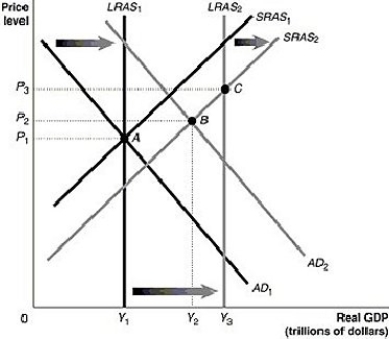 -Refer to Figure 16-7.Given that the economy has moved from A to B in the graph above,which of the following would be the appropriate fiscal policy to achieve potential GDP?
 (Multiple Choice)
4.9/5 (77)
(77) Forecasts by the Congressional Budget Office show spending on Social Security,Medicare,and Medicaid rising from 10.4 percent of GDP in 2017 to ________ percent of GDP in 2090,and by 2090 the federal government will be spending,as a fraction of GDP,________ on these three programs as it currently spends on all programs combined.
(Multiple Choice)
4.8/5 (72)
(72) A cut in tax rates effects equilibrium real GDP through two channels: ________ disposable income and consumer spending,and ________ the size of the multiplier effect.
(Multiple Choice)
4.9/5 (86)
(86) Lowering the individual income tax rate will increase household disposable income and consumption spending.
(True/False)
4.9/5 (70)
(70) Increases in government spending result in ________ in the short run,and permanent increases in government spending result in ________ in the long run.
(Multiple Choice)
4.9/5 (57)
(57) 
Filters
- Essay(0)
- Multiple Choice(0)
- Short Answer(0)
- True False(0)
- Matching(0)