



 Chat with AI
Exam 11: Long-Run Economic Growth: Sources and Policies

Exam 1: Economics: Foundations and Models219 Questions
Exam 2: Trade-Offs, Comparative Advantage, and the Market System236 Questions
Exam 3: Where Prices Come From: The Interaction of Demand and Supply234 Questions
Exam 4: Economic Efficiency, Government Price Setting, and Taxes212 Questions
Exam 5: The Economics of Health Care166 Questions
Exam 6: Firms, the Stock Market, and Corporate Governance251 Questions
Exam 7: Comparative Advantage and the Gains From International Trade188 Questions
Exam 8: GDP: Measuring Total Production and Income260 Questions
Exam 9: Unemployment and Inflation289 Questions
Exam 10: Economic Growth, the Financial System, and Business Cycles251 Questions
Exam 11: Long-Run Economic Growth: Sources and Policies261 Questions
Exam 12: Aggregate Expenditure and Output in the Short Run304 Questions
Exam 13: Aggregate Demand and Aggregate Supply Analysis284 Questions
Exam 14: Money,Banks,and the Federal Reserve System276 Questions
Exam 15: Monetary Policy278 Questions
Exam 16: Fiscal Policy313 Questions
Exam 17: Inflation, Unemployment, and Federal Reserve Policy257 Questions
Exam 18: Macroeconomics in an Open Economy277 Questions
Exam 19: The International Financial System256 Questions
Select questions type


One drawback of the patent system is that firms must disclose to the public information about the product or process.
(True/False)
4.7/5  (88)
(88) Because knowledge capital is nonexcludable and nonrival,firms have an incentive to ________ the research and development of other firms.
(Multiple Choice)
4.9/5 (78)
(78) How does government support of health and education programs foster economic growth?
(Essay)
4.8/5 (81)
(81) Of the following countries,which had the highest level of GDP per capita in 2016?
(Multiple Choice)
4.7/5 (71)
(71) Figure 11-2 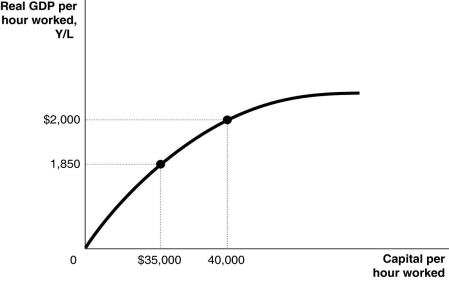 -Refer to Figure 11-2.Assuming no technological change,if the United States increases capital per hour worked by $40,000 every year between 2014 and 2018,we would expect to see
 (Multiple Choice)
4.8/5 (70)
(70) In the United States,the number of hours worked per person has decreased since 1800.How would growth rates since 1800 be different if they were calculated for real GDP per capita instead of GDP per hour worked?
(Essay)
4.9/5 (84)
(84) Table 11-2
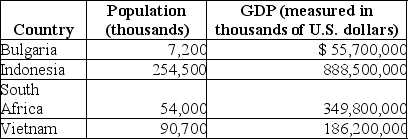 -Refer to Table 11-2.Calculate the GDP per capita for each country in the table.Which country has the highest standard of living? Why?
 (Essay)
4.8/5 (82)
(82) If the slope of the per-worker production function is 1/4 in a given range,how will a $10,000 increase in capital per hour worked affect real GDP per hour worked in the same given range?
(Multiple Choice)
4.8/5 (85)
(85) Productivity gains in the United States since 1990 have been ________ the productivity gains in other leading industrial nations.
(Multiple Choice)
5.0/5 (76)
(76) Foreign portfolio investment occurs when an individual or firm buys stock or bonds issued in another country.
(True/False)
4.9/5 (81)
(81) What is the difference between foreign direct investment and foreign portfolio investment?
(Multiple Choice)
4.9/5 (75)
(75) In the early 1900s,Henry Ford revolutionized the automotive manufacturing industry by instituting the assembly line.What impact did the assembly line method for producing automobiles have on the per-worker production function for Ford?
(Multiple Choice)
4.9/5 (83)
(83) High-income countries have ________ and ________ as compared to developing countries.
(Multiple Choice)
4.9/5 (89)
(89) Foreign direct investment occurs when a Chinese corporation
(Multiple Choice)
4.8/5 (71)
(71) Which of the following accurately describes growth rates in the United States from 1900 to the present?
(Multiple Choice)
4.8/5 (81)
(81) One reason why many low-income countries experience low rates of growth is because of low rates of saving and investment in those countries.
(True/False)
4.8/5 (77)
(77) 
Filters
- Essay(0)
- Multiple Choice(0)
- Short Answer(0)
- True False(0)
- Matching(0)