



 Chat with AI
Exam 11: Long-Run Economic Growth: Sources and Policies

Exam 1: Economics: Foundations and Models219 Questions
Exam 2: Trade-Offs, Comparative Advantage, and the Market System236 Questions
Exam 3: Where Prices Come From: The Interaction of Demand and Supply234 Questions
Exam 4: Economic Efficiency, Government Price Setting, and Taxes212 Questions
Exam 5: The Economics of Health Care166 Questions
Exam 6: Firms, the Stock Market, and Corporate Governance251 Questions
Exam 7: Comparative Advantage and the Gains From International Trade188 Questions
Exam 8: GDP: Measuring Total Production and Income260 Questions
Exam 9: Unemployment and Inflation289 Questions
Exam 10: Economic Growth, the Financial System, and Business Cycles251 Questions
Exam 11: Long-Run Economic Growth: Sources and Policies261 Questions
Exam 12: Aggregate Expenditure and Output in the Short Run304 Questions
Exam 13: Aggregate Demand and Aggregate Supply Analysis284 Questions
Exam 14: Money,Banks,and the Federal Reserve System276 Questions
Exam 15: Monetary Policy278 Questions
Exam 16: Fiscal Policy313 Questions
Exam 17: Inflation, Unemployment, and Federal Reserve Policy257 Questions
Exam 18: Macroeconomics in an Open Economy277 Questions
Exam 19: The International Financial System256 Questions
Select questions type


There has been catch-up among ________,but there has not been catch-up among ________.
(Multiple Choice)
4.9/5  (80)
(80) Significant economic growth did not begin in the world until
(Multiple Choice)
4.9/5 (64)
(64) The small group of East Asian countries that experienced high rates of growth in the 1980s and 1990s are referred to as
(Multiple Choice)
4.8/5 (72)
(72) According to Joseph Schumpeter,the theory of creative destruction describes a process by which
(Multiple Choice)
4.8/5 (69)
(69) By offering more generous unemployment insurance programs,European countries can expect
(Multiple Choice)
4.9/5 (82)
(82) Recent rapid economic growth in India and China has reduced the amount of "brain drain" in those countries.
(True/False)
4.9/5 (92)
(92) Disease,poor nutrition,and substandard health care in developing nations can reduce growth in an economy by
(Multiple Choice)
4.9/5 (90)
(90) Explain how advances in technology are critical to sustaining economic growth,even if capital per hour worked is consistently increasing.Provide a graph of a per-worker production function to illustrate how increases in capital per hour worked,without advances in technology,are not enough to sustain economic growth.
(Essay)
4.7/5 (86)
(86) Figure 11-4  -Refer to Figure 11-4.Within a country,the impact of wars and revolutions and their subsequent destruction of capital is reflected in the per-worker production function in the figure above by a movement from
 (Multiple Choice)
4.8/5 (82)
(82) Productivity growth in the United States has steadily increased since 1995.
(True/False)
4.9/5 (77)
(77) Which of the following policies would not help promote economic growth?
(Multiple Choice)
4.8/5 (72)
(72) Explain how market economies are generally better able to achieve technological progress than are centrally planned economies.
(Essay)
4.9/5 (88)
(88) Which of the following is an example of the way the financial markets in the United States can encourage technological progress more efficiently than other countries?
(Multiple Choice)
4.8/5 (64)
(64) In a small European country,it is estimated that a $10,000 increase in capital per hour worked will increase real GDP per hour worked by $300.Based on this information,what is the slope of the per-worker production function in this range?
(Multiple Choice)
4.8/5 (93)
(93) Table 11-6
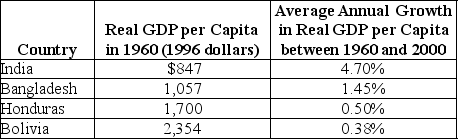 -Refer to Table 11-6.Consider the statistics in the table above in describing the developing countries.Are these consistent with the economic growth model? Briefly explain.
 (Essay)
4.8/5 (74)
(74) Most economic growth in the world occurred between 1,000,000 B.C.and 1300 A.D.
(True/False)
4.8/5 (78)
(78) Figure 11-4
-Refer to Figure 11-4.Which of the following combinations of points illustrates changes in the Soviet Union's economy from 1950 to 1980?
-Refer to Figure 11-4.Which of the following combinations of points illustrates changes in the Soviet Union's economy from 1950 to 1980? (Multiple Choice)
4.9/5 (84)
(84) One of the primary reasons that Mexico has had trouble attracting foreign investment and has therefore experienced relatively low rates of economic growth is
(Multiple Choice)
4.9/5 (64)
(64) 
Filters
- Essay(0)
- Multiple Choice(0)
- Short Answer(0)
- True False(0)
- Matching(0)