



 Chat with AI
Exam 9: Risk Analysis, Real Options, and Capital Budgeting

Exam 1: Introduction to Corporate Finance57 Questions
Exam 2: Financial Statements and Cash Flow85 Questions
Exam 3: Financial Statements Analysis and Financial Models88 Questions
Exam 4: Discounted Cash Flow Valuation101 Questions
Exam 5: Interest Rates and Bond Valuation91 Questions
Exam 6: Stock Valuation86 Questions
Exam 7: Net Present Value and Other Investment Rules80 Questions
Exam 8: Making Capital Investment Decisions81 Questions
Exam 9: Risk Analysis, Real Options, and Capital Budgeting80 Questions
Exam 10: Risk and Return: Lessons From Market History80 Questions
Exam 11: Return and Risk: The Capital Asset Pricing Model Capm89 Questions
Exam 12: Risk, Cost of Capital, and Valuation82 Questions
Exam 13: Efficient Capital Markets and Behavioral Challenges52 Questions
Exam 14: Capital Structure: Basic Concepts80 Questions
Exam 15: Capital Structure: Limits to the Use of Debt56 Questions
Exam 16: Dividends and Other Payouts79 Questions
Exam 17: Options and Corporate Finance80 Questions
Exam 18: Short-Term Finance and Planning79 Questions
Exam 19: Raising Capital75 Questions
Exam 20: International Corporate Finance79 Questions
Exam 21: Mergers and Acquisitions Web Only49 Questions
Select questions type


Which type of analysis is most dependent upon the use of a computer?
(Multiple Choice)
4.9/5  (79)
(79) Isabelle is reviewing a project with projected sales of 1,500 units a year,a cash flow of $38 a unit,and a project life of 4 years.The initial cost of the project is $87,000.The relevant discount rate is 12 percent.She has the option to abandon the project after 1 year at which time she feels she could sell the project for $50,000.At what level of sales should she be willing to abandon the project?
(Multiple Choice)
4.8/5 (76)
(76) ELK,Inc.has compiled this information for a proposed project: sales price = $89 ±3 percent; fixed costs = $21,800 ±1 percent; variable cost per unit = $42.90 ±3 percent; sales quantity = 1,500 units ±5 percent; tax rate = 34 percent; initial investment in fixed assets = $36,500; depreciation method = straight-line to a zero book value over the project's life; project life = 4 years; salvage value of fixed assets = $0; net working capital requirement = $4,800,which will be recouped at the end of the project; discount rate = 12 percent.What is the project's net present value for the pessimistic scenario?
(Multiple Choice)
4.8/5 (70)
(70) The project defined by the following decision tree has a required discount rate of 14 percent.
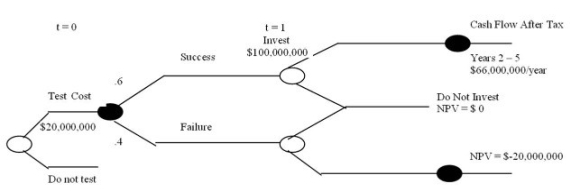 What is the Time 1 net present value of a successful investment?
 (Multiple Choice)
4.9/5 (72)
(72) Which one of the following statements is correct regarding the financial breakeven point of a project?
(Multiple Choice)
4.9/5 (84)
(84) Monte Carlo simulation is based on assigning a ________ and analyzing the results.
(Multiple Choice)
4.8/5 (84)
(84) The financial breakeven point determines which one of these values?
(Multiple Choice)
4.8/5 (79)
(79) A proposed project has fixed costs of $159,800,depreciation expense of $47,920,and a sales quantity of 6,750 units.Ignore taxes.What is the contribution margin if the projected level of sales is the accounting breakeven point?
(Multiple Choice)
4.7/5 (67)
(67) Miller Tools is considering a new project that requires an initial investment of $81,300 for fixed assets,which will be depreciated straight-line to zero over the project's 3-year life.The project is expected to have fixed costs of $37,600 a year,and a contribution margin of $18.40.The tax rate is 34 percent and the discount rate is 15 percent.What is the financial breakeven point?
(Multiple Choice)
4.9/5 (78)
(78) The Tall Stack expects to sell 3,000 units,±10 percent.The expected variable cost per unit is $7,±3 percent,and the expected fixed costs are $13,700,±1 percent.The depreciation expense is $6,870.The sale price is estimated at $16 a unit,±2 percent.The company is conducting a sensitivity analysis on the sales price using a sales price estimate of $15.What will be the earnings before interest and taxes?
(Multiple Choice)
4.9/5 (58)
(58) The accounting breakeven production quantity for a project is 7,209 units.The fixed costs are $34,780,and the contribution margin is $11.Assume a zero tax rate.What is the projected depreciation expense?
(Multiple Choice)
4.9/5 (76)
(76) To make a project accept/reject decision using a decision tree
(Multiple Choice)
4.9/5 (86)
(86) A project has earnings before interest and taxes of $7,318,fixed costs of $13,480,a selling price of $14 a unit,and a sales quantity of 7,500 units.Depreciation is $2,200.What is the variable cost per unit?
(Multiple Choice)
4.9/5 (92)
(92) Which one of these occurs at the financial breakeven point?
(Multiple Choice)
5.0/5 (83)
(83) A project requires an initial investment of $69,000 for equipment that will be depreciated using the straight-line method to zero over the project's 4-year life.The equipment can be sold for $15,000 at the end of the project.The project requires $8,700 in net working capital.The company expects to sell 31,000 units,±5 percent.The expected variable cost per unit is $12,and the expected fixed costs are $46,000.The fixed and variable cost estimates are considered accurate within a range of ±2 percent.The sales price is estimated at $19 a unit,±2 percent.The discount rate is 14 percent,and the tax rate is 34 percent.What is the operating cash flow for a sensitivity analysis using total fixed costs of $45,000?
(Multiple Choice)
4.8/5 (73)
(73) Last month,you introduced a new product to the market.Consumer demand has been overwhelming,and it appears that strong demand will exist over the long-term.Given this situation,management should consider the option to
(Multiple Choice)
4.8/5 (77)
(77) 
Filters
- Essay(0)
- Multiple Choice(0)
- Short Answer(0)
- True False(0)
- Matching(0)