



 Chat with AI
Exam 6: Cost-Volume-Profit Relationships

Exam 1: An Introduction to Managerial Accounting and Cost Concepts50 Questions
Exam 2: Systems Design: Job-Order Costing112 Questions
Exam 3: Systems Design: Activity-Based Costing114 Questions
Exam 4: Systems Design: Process Costing126 Questions
Exam 5: Cost Behavior: Analysis and Use103 Questions
Exam 6: Cost-Volume-Profit Relationships98 Questions
Exam 7: Profit Planning117 Questions
Exam 8: Standard Costs160 Questions
Exam 9: Flexible Budgets and Overhead Analysis145 Questions
Exam 10: Decentralization113 Questions
Exam 11: Relevant Costs for Decision Making163 Questions
Exam 12: Capital Budgeting Decisions96 Questions
Exam 13: How Well Am I Doing Statement of Cash Flows223 Questions
Exam 14: How Well Am I Doing Financial Statement Analysis34 Questions
Select questions type


Assuming that actual activity turns out to be the same as expected activity,the total amount of overhead cost allocated to Product X would be closest to:
(Multiple Choice)
4.8/5  (87)
(87) Suki Company uses activity-based costing to compute product costs for external reports.The company has three activity cost pools and applies overhead using predetermined overhead rates for each activity cost pool.Estimated costs and activities for the current year are presented below for the three activity cost pools: 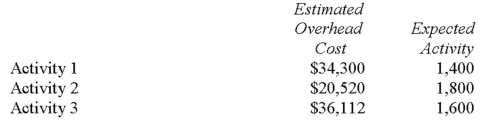 Actual activity for the current year was as follows:
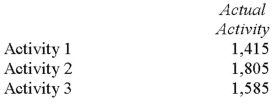 The amount of overhead applied for Activity 3 during the year was closest to
Actual activity for the current year was as follows: The amount of overhead applied for Activity 3 during the year was closest to (Multiple Choice)
4.8/5 (75)
(75) Which of the following is not a limitation of activity-based costing?
(Multiple Choice)
4.9/5 (98)
(98) Departmental overhead rates applied on the basis of a volume measure such as direct labour-hours or machine-hours will eliminate any distortions in unit costs due to product diversity.
(True/False)
4.8/5 (83)
(83) Matt Company uses activity-based costing.The company has two products: A andB.The annual production and sales of Product A are 8,000 units and of Product B are 6,000 units.There are three activity cost pools,with estimated total cost and expected activity as follows: 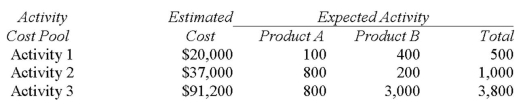 The cost per unit of Product A under activity-based costing is closest to:
 (Multiple Choice)
4.7/5 (88)
(88) The overhead cost per unit of Product S under activity-based costing is closest to:
(Multiple Choice)
4.8/5 (73)
(73) When there are batch-level or product-level costs,in comparison to a traditional cost system,an activity-based costing system ordinarily will shift costs from high-volume to low-volume products.
(True/False)
4.9/5 (75)
(75) The overhead cost per unit of Product B under the traditional costing system is closest to:
(Multiple Choice)
4.8/5 (86)
(86) Which of the following would be considered as a prevention cost?
(Multiple Choice)
4.9/5 (83)
(83) Batch-level activities are performed each time a batch is handled or processed,regardless of how many units are in the batch.
(True/False)
4.9/5 (87)
(87) Using activity-based costing is not useful in determining costs of quality.
(True/False)
4.8/5 (75)
(75) The overhead cost per unit of Product B under the activity-based costing system is closest to
(Multiple Choice)
4.9/5 (75)
(75) The activity rate computed at the beginning of the year for the batch setup activity cost pool is closest to:
(Multiple Choice)
4.9/5 (78)
(78) Facility-level costs can be easily and accurately allocated to different products using activity-based costing.
(True/False)
5.0/5 (64)
(64) Bridget Company uses activity-based costing.The company has two products: A andB.The annual production and sales of Product A are 2,000 units and of Product B are 3,000 units.There are three activity cost pools,with estimated total cost and expected activity as follows:  The cost per unit of Product A under activity-based costing is closest to:
 (Multiple Choice)
4.9/5 (91)
(91) 
Filters
- Essay(0)
- Multiple Choice(0)
- Short Answer(0)
- True False(0)
- Matching(0)