



 Chat with AI
Exam 2: Market Forces: Demand and Supply


Suppose you are an aide to a U.S.Senator who is concerned about the impact of a recently proposed excise tax on the welfare of her constituents.You explained to the Senator that one way of measuring the impact on her constituents is to determine how the tax change affects the level of consumer surplus enjoyed by the constituents.Based on your arguments, you are given the go-ahead to conduct a formal analysis, and obtain the following estimates of demand and supply:

 (85)
 Verified
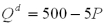 and
 .
a.Graph the supply and demand curves.
b.What are the equilibrium quantity and equilibrium price?
c.How much consumer surplus exists in this market?
d.If a $2 excise tax is levied on this good, what will happen to the equilibrium price and quantity?
e.What will the consumer surplus be after the tax?
a.See Figure 2-17. 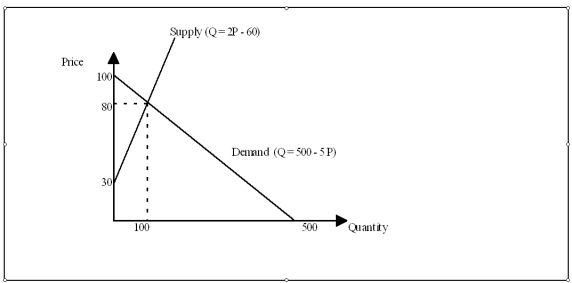 Figure 2-17
b.Equilibrium quantity and price are 100 units and $80, respectively.
c.Consumer surplus = 1/2(100 - 80) x (100) = $1,000.
d.Note that before the excise tax, the inverse supply function is P = 30 + .5Qs.A $2 excise tax shifts the inverse supply function up by the amount of the tax, so the inverse supply function after a $2 excise tax must be P = 32 + .5 Qs.This means that the supply function after the tax is Qs = 2P - 64 (Note that this expression is equivalent to Qs = 2 (P-2) - 60, since the producer must pay $2 to the government for each unit sold).The demand function remains unchanged at Qd = 500 - 5P.Setting Qs = Qd and solving for price, we obtain P = $80.57.Plug this price into either the demand or supply function yields the equilibrium quantity, Q = 97.14.
e.Consumer surplus (post tax) = 1/2(100 - 80.57) x (97.14) = $943.72.
Consider a market characterized by the following inverse demand and supply functions: PX = 10 - 2QX and PX = 2 + 2QX. An $8 per unit price floor will result in a
(83) VerifiedB
Demand shifters do not include the
(91) VerifiedA
If a shortage exists in a market, the natural tendency is for:
(77) In 1987 a 386 PC sold at a price of $6,995.Five years later, you could purchase essentially the same computer for $1,495.Today, you can purchase a faster Pentium for a fraction of the initial price of a slower 386 PC.
a.Why have computer prices fallen so dramatically?
b.What impact, if any, do you think the growing use of the Internet will have on the price of computers?
(74) Estimates suggest that the North American Free Trade Agreement (NAFTA) will ultimately result in tariff cuts averaging 38 percent globally.Assuming these estimates are correct, would you expect the price of the average imported goods to fall by 38 percent? Explain.
(84) Suppose the demand for X is given by Qxd = 100 - 2PX + 4PY + 10M + 2A, where PX represents the price of good X, PY is the price of good Y, M is income and A is the amount of advertising on good X.Good X is
(78) Suppose supply decreases and demand increases.What effect will this have on the quantity?
(74) You are an aide for the Senate Banking Committee Chairman.He comes to you with a bill that proposes setting limits on what ATM owners can charge nonaccount holders, over and above what banks charge their own customers.Currently, large banks charge noncustomers an average fee of $1.35 per transaction in addition to the fees the customer's own bank imposes.The Senator asks you to look at a proposal that would place a $0.50 cap on the fees ATM owners can charge noncustomer for accessing their money.If this legislation is enacted, what would be the likely effects?
B.Longer lines are likely to develop at ATM machines.Including the value of lost time, the full economic price paid for ATM usage will exceed the current price of $1.35 per transaction.The full economic price is denoted P* in Figure 2-4.Note that the actual magnitude of the shortage and full economic price will depend on the relative slopes of the demand and supply curves.
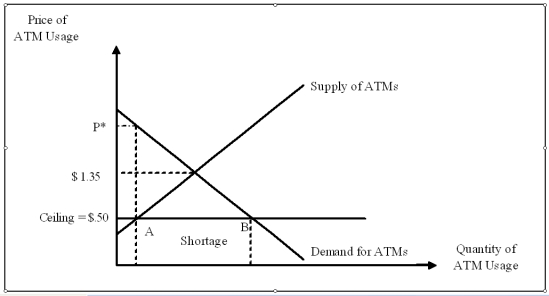 Figure 2-4
 (67) Firms advertise in order to cause the demand for their products to
(68) Suppose the demand for good X is given by Qdx = 10 + axPx + ayPy + aMM.If aM is negative, then good y is:
(83) Suppose the market demand for good X is given by QXd = 20 - 2PX.If the equilibrium price of X is $5 per unit then consumer surplus is
(91) Consider a market characterized by the following inverse demand and supply functions: PX = 10 - 2QX and PX = 2 + 2QX. Compute the surplus producers receive when an $8 per unit price floor is imposed on the market.
(88) 
Filters
- Essay(0)
- Multiple Choice(0)
- Short Answer(0)
- True False(0)
- Matching(0)