



 Chat with AI
Exam 31: Environmental Economics

Exam 1: The Nature of Economics347 Questions
Exam 2: Scarcity and the World of Trade-Offs412 Questions
Exam 3: Demand and Supply448 Questions
Exam 4: Extensions of Demand and Supply Analysis399 Questions
Exam 5: Public Spending and Public Choice359 Questions
Exam 6: Funding the Public Sector202 Questions
Exam 7: The Macroeconomy: Unemployment, Inflation, and Deflation412 Questions
Exam 8: Measuring the Economys Performance413 Questions
Exam 9: Global Economic Growth and Development282 Questions
Exam 10: Real GDP and the Price Level in the Long Run290 Questions
Exam 11: Classical and Keynesian Macro Analyses365 Questions
Exam 12: Consumption, Real GDP, and the Multiplier445 Questions
Exam 13: Fiscal Policy273 Questions
Exam 14: Deficit Spending and the Public Debt145 Questions
Exam 15: Money, Banking, and Central Banking517 Questions
Exam 16: Domestic and International Dimensions of Monetary Policy357 Questions
Exam 17: Stabilization in an Integrated World Economy306 Questions
Exam 18: Policies and Prospects for Global Economic Growth216 Questions
Exam 19: Demand and Supply Elasticity413 Questions
Exam 20: Consumer Choice458 Questions
Exam 21: Rents, Profits, and the Financial Environment of Business445 Questions
Exam 22: The Firm: Cost and Output Determination387 Questions
Exam 23: Perfect Competition431 Questions
Exam 24: Monopoly386 Questions
Exam 25: Monopolistic Competition309 Questions
Exam 26: Oligopoly and Strategic Behavior306 Questions
Exam 27: Regulation and Antitrust Policy in a Globalized Economy309 Questions
Exam 28: The Labor Market: Demand, Supply and Outsourcing376 Questions
Exam 29: Unions and Labor Market Monopoly Power318 Questions
Exam 30: Income, Poverty, and Health Care302 Questions
Exam 31: Environmental Economics300 Questions
Exam 32: Comparative Advantage and the Open Economy314 Questions
Exam 33: Exchange Rates and the Balance of Payments300 Questions
Select questions type


All of the following are choices for the polluter when faced with additional costs to abate the externality EXCEPT
(Multiple Choice)
4.9/5  (82)
(82) Which of the following statements best defines private costs?
(Multiple Choice)
4.8/5 (75)
(75) When property rights are clearly defined, there is generally a
(Multiple Choice)
4.9/5 (70)
(70)  -Refer to the above figure. The marginal cost of pollution abatement is curve
 (Multiple Choice)
4.9/5 (72)
(72) In a market for emission permits, firms that emit over their allowed limits
(Multiple Choice)
5.0/5 (92)
(92) Voluntary agreements may not be a feasible method to internalize an externality when
(Multiple Choice)
4.9/5 (73)
(73) 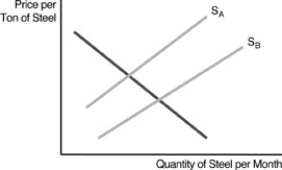 -Refer to the above figure. It represents supply and demand for The Black Ash Steel Company's output. The firm's plant belches large quantities of smelly fumes and black ash into the air. Residents in the surrounding area have higher medical bills as a result. If the firm is forced to pay the full social cost of its production, what will occur?
 (Multiple Choice)
4.7/5 (82)
(82) A social cost that is not fully paid by the individual using an automobile is
(Multiple Choice)
4.8/5 (74)
(74) A large farm uses fertilizer that nearby landowners complain may contaminate their water. Tests are conducted and contaminants are found. The costs resulting from this decision are referred to as
(Multiple Choice)
4.8/5 (66)
(66) The idea that it takes 90 percent of your time to clean up the last 10 percent of your house illustrates that
(Multiple Choice)
4.8/5 (85)
(85)  -Use the above table. What will the output level be when external costs are internalized with a tax?
 (Multiple Choice)
4.8/5 (76)
(76) Participating nations in the 1997 Kyoto Protocol agreed to reduce overall greenhouse gases emission
(Multiple Choice)
4.9/5 (73)
(73) If a firm is not forced to pay for external costs, it will
(Multiple Choice)
4.9/5 (94)
(94) 
Filters
- Essay(0)
- Multiple Choice(0)
- Short Answer(0)
- True False(0)
- Matching(0)