



 Chat with AI
Exam 15: Money, Banking, and Central Banking

Exam 1: The Nature of Economics347 Questions
Exam 2: Scarcity and the World of Trade-Offs412 Questions
Exam 3: Demand and Supply448 Questions
Exam 4: Extensions of Demand and Supply Analysis399 Questions
Exam 5: Public Spending and Public Choice359 Questions
Exam 6: Funding the Public Sector202 Questions
Exam 7: The Macroeconomy: Unemployment, Inflation, and Deflation412 Questions
Exam 8: Measuring the Economys Performance413 Questions
Exam 9: Global Economic Growth and Development282 Questions
Exam 10: Real GDP and the Price Level in the Long Run290 Questions
Exam 11: Classical and Keynesian Macro Analyses365 Questions
Exam 12: Consumption, Real GDP, and the Multiplier445 Questions
Exam 13: Fiscal Policy273 Questions
Exam 14: Deficit Spending and the Public Debt145 Questions
Exam 15: Money, Banking, and Central Banking517 Questions
Exam 16: Domestic and International Dimensions of Monetary Policy357 Questions
Exam 17: Stabilization in an Integrated World Economy306 Questions
Exam 18: Policies and Prospects for Global Economic Growth216 Questions
Exam 19: Demand and Supply Elasticity413 Questions
Exam 20: Consumer Choice458 Questions
Exam 21: Rents, Profits, and the Financial Environment of Business445 Questions
Exam 22: The Firm: Cost and Output Determination387 Questions
Exam 23: Perfect Competition431 Questions
Exam 24: Monopoly386 Questions
Exam 25: Monopolistic Competition309 Questions
Exam 26: Oligopoly and Strategic Behavior306 Questions
Exam 27: Regulation and Antitrust Policy in a Globalized Economy309 Questions
Exam 28: The Labor Market: Demand, Supply and Outsourcing376 Questions
Exam 29: Unions and Labor Market Monopoly Power318 Questions
Exam 30: Income, Poverty, and Health Care302 Questions
Exam 31: Environmental Economics300 Questions
Exam 32: Comparative Advantage and the Open Economy314 Questions
Exam 33: Exchange Rates and the Balance of Payments300 Questions
Select questions type


The term "fiduciary" comes from the Latin fiducia, which means
(Multiple Choice)
4.9/5  (89)
(89) The reserve ratio is 10 percent and all loan proceeds are deposited in transactions accounts. A bond dealer has $100 million in deposits, $8 million in vault cash, and $7 million in deposits at the Fed. The Fed sells $1 million in securities to the bond dealer. As a result, of this transaction alone,
(Multiple Choice)
4.9/5 (78)
(78) 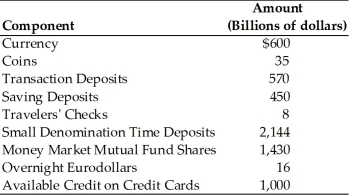 -According to the above table, the value of M1 is
In a fiduciary monetary system, the value of the money issued by a government is based on
(Multiple Choice)
4.7/5 (63)
(63) What is a fractional reserve banking system? How long has the fractional reserve banking system been in existence?
(Essay)
4.9/5 (93)
(93) Bank X had a reputation for asking few questions when it provided loans. Five years later, the majority of the loans were not repaid. This is because the bank had failed to address the
(Multiple Choice)
4.7/5 (70)
(70) If a check written on one bank is deposited in another bank
(Multiple Choice)
4.8/5 (85)
(85) Which of the following actions has no effect on the total money supply?
(Multiple Choice)
4.8/5 (77)
(77)  -The potential money multiplier for the banking system in the above table is
 (Multiple Choice)
4.8/5 (83)
(83) Perishable goods such as milk or fruit are never used as money, because they cannot function as a
(Multiple Choice)
4.9/5 (81)
(81) The reserve ratio equals 20 percent. The Fed buys $1 million in U.S. government securities. The most the money supply can increase is
(Multiple Choice)
4.8/5 (80)
(80) Following a new deposit of $500, the loans of a commercial bank increase by $400. In this situation, the reserve ratio is most likely
(Multiple Choice)
4.8/5 (83)
(83) 
Filters
- Essay(0)
- Multiple Choice(0)
- Short Answer(0)
- True False(0)
- Matching(0)