



 Chat with AI
Exam 10: Real GDP and the Price Level in the Long Run

Exam 1: The Nature of Economics347 Questions
Exam 2: Scarcity and the World of Trade-Offs412 Questions
Exam 3: Demand and Supply448 Questions
Exam 4: Extensions of Demand and Supply Analysis399 Questions
Exam 5: Public Spending and Public Choice359 Questions
Exam 6: Funding the Public Sector202 Questions
Exam 7: The Macroeconomy: Unemployment, Inflation, and Deflation412 Questions
Exam 8: Measuring the Economys Performance413 Questions
Exam 9: Global Economic Growth and Development282 Questions
Exam 10: Real GDP and the Price Level in the Long Run290 Questions
Exam 11: Classical and Keynesian Macro Analyses365 Questions
Exam 12: Consumption, Real GDP, and the Multiplier445 Questions
Exam 13: Fiscal Policy273 Questions
Exam 14: Deficit Spending and the Public Debt145 Questions
Exam 15: Money, Banking, and Central Banking517 Questions
Exam 16: Domestic and International Dimensions of Monetary Policy357 Questions
Exam 17: Stabilization in an Integrated World Economy306 Questions
Exam 18: Policies and Prospects for Global Economic Growth216 Questions
Exam 19: Demand and Supply Elasticity413 Questions
Exam 20: Consumer Choice458 Questions
Exam 21: Rents, Profits, and the Financial Environment of Business445 Questions
Exam 22: The Firm: Cost and Output Determination387 Questions
Exam 23: Perfect Competition431 Questions
Exam 24: Monopoly386 Questions
Exam 25: Monopolistic Competition309 Questions
Exam 26: Oligopoly and Strategic Behavior306 Questions
Exam 27: Regulation and Antitrust Policy in a Globalized Economy309 Questions
Exam 28: The Labor Market: Demand, Supply and Outsourcing376 Questions
Exam 29: Unions and Labor Market Monopoly Power318 Questions
Exam 30: Income, Poverty, and Health Care302 Questions
Exam 31: Environmental Economics300 Questions
Exam 32: Comparative Advantage and the Open Economy314 Questions
Exam 33: Exchange Rates and the Balance of Payments300 Questions
Select questions type


The interest rate effect that helps explain the slope of the aggregate demand curve arises because
(Multiple Choice)
4.8/5  (80)
(80) Which of the following statements is correct? I. When economists derive the aggregate demand curve, they are looking at the effect of the price level on one commodity only.
II) Any non-price-level change that increases total planned real spending on domestic goods shifts the AD curve to the right.
(Multiple Choice)
4.8/5 (73)
(73) When the price level increases, total planned real expenditures on goods and services falls. All of the following are responsible EXCEPT
(Multiple Choice)
4.7/5 (70)
(70) Supply-side inflation could be caused by which of the following?
(Multiple Choice)
4.9/5 (86)
(86) All of the following are components of aggregate demand EXCEPT
(Multiple Choice)
4.7/5 (95)
(95) 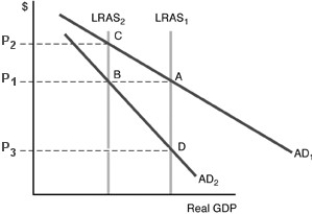 -Refer to the above figure. Suppose the economy's initial equilibrium is represented by the intersection of LRAS1 and AD1. Suppose there is a persistent reduction in labor force participation, which reduces total planned production at any given price level. The resulting change in the economy's long-run equilibrium position would be represented by a
 (Multiple Choice)
5.0/5 (78)
(78) If the current price level is lower than the equilibrium price level, then it must be true that total planned
(Multiple Choice)
4.9/5 (87)
(87) The aggregate demand curve shows the relationship between planned purchases of
(Multiple Choice)
4.9/5 (89)
(89) The long-run aggregate supply curve is determined by all of the following EXCEPT
(Multiple Choice)
4.8/5 (83)
(83) Which of the following is the most likely explanation for inflation in the United States?
(Multiple Choice)
4.7/5 (85)
(85) According to the real-balance effect, an increase in the price level will
(Multiple Choice)
4.8/5 (76)
(76) 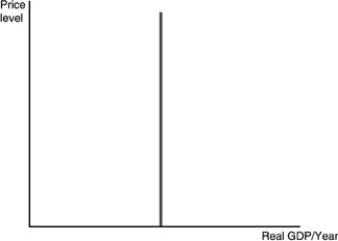 -The above figure shows a
Which of the following would cause the long-run aggregate supply curve to shift to the right?
(Multiple Choice)
4.8/5 (92)
(92) In the long run, an increase in government spending, other things equal, generates
(Multiple Choice)
4.9/5 (75)
(75) 
Filters
- Essay(0)
- Multiple Choice(0)
- Short Answer(0)
- True False(0)
- Matching(0)