



 Chat with AI
Exam 7: Production and Growth

Exam 1: Ten Principles of Economics205 Questions
Exam 2: Thinking Like an Economist230 Questions
Exam 3: Interdependence and the Gains From Trade200 Questions
Exam 4: The Market Forces of Supply and Demand303 Questions
Exam 5: Measuring a Nations Income168 Questions
Exam 6: Measuring the Cost of Living176 Questions
Exam 7: Production and Growth185 Questions
Exam 8: Saving, Investment, and the Financial System208 Questions
Exam 9: Unemployment and Its Natural Rate186 Questions
Exam 10: The Monetary System196 Questions
Exam 11: Money Growth and Inflation193 Questions
Exam 12: Open-Economy Macroeconomics: Basic Concepts215 Questions
Exam 13: A Macroeconomic Theory of the Open Economy184 Questions
Exam 14: Aggregate Demand and Aggregate Supply241 Questions
Exam 15: The Influence of Monetary and Fiscal Policy on Aggregate Demand219 Questions
Exam 16: The Short-Run Tradeoff Between Inflation and Unemployment203 Questions
Exam 17: Five Debates Over Macroeconomic Policy118 Questions
Select questions type


Which of the following best describes the relationship between productivity and standard of living?
(Multiple Choice)
4.8/5  (69)
(69) Over the past century in Canada, by how much has real GDP per person grown?
(Multiple Choice)
4.9/5 (82)
(82) In the country of Krypton, the price of lead increased from $20 per kilogram to $22 per kilogram during a time when the overall price level increased by 8 percent. During this period, what happened to the real price of lead?
(Multiple Choice)
4.9/5 (73)
(73) The dictator of Turan has recently begun to arbitrarily seize farms belonging to his political opponents, and he has given the farms to his friends. His friends don't know much about farming. The courts in Turan have ruled that the seizures are illegal, but the dictator has ignored the rulings. Other things equal, what would we expect to happen to the growth rate in Turan?
(Multiple Choice)
4.9/5 (82)
(82) Suppose an economy uses only two inputs in production, capital and labour. The following table describes a production function, where y stands for output per worker and k is capital per worker.
a.Draw approximately this production function with y on the vertical axis.
b.Show that this production function exhibits diminishing returns to scale.
c.Suppose there are two countries, A and B. The economies of the two countries can be described by this production function. If Country A has initially a capital-labour ratio k = 0.167 and Country B has k = 0.412, show that an equal increase in capital produces more extra output in country A than in Country B. 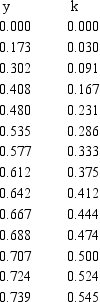
(Essay)
4.8/5 (80)
(80) Which of the following statements best explains the importance of real GDP per person?
(Multiple Choice)
4.9/5 (76)
(76) Suppose a country were to increase its saving rate. In the long run, which of the following would also increase?
(Multiple Choice)
4.8/5 (71)
(71) Which of the following is an example of the "brain drain"?
(Multiple Choice)
4.8/5 (79)
(79) Real GDP per person is $25 000 in Aquilonia, $10 000 in Nemedia, $15 000 in Shem, and $20 000 in Zexa. Saving per person is $2000 in all three countries. Other things equal, what would we expect?
(Multiple Choice)
4.9/5 (80)
(80) Other things the same, if a country increased its saving rate, in 40 years which of the following would that country likely have?
(Multiple Choice)
4.8/5 (69)
(69) If the number of workers in an economy doubled, all other inputs stayed the same, and there were constant returns to scale, what would happen to productivity?
(Multiple Choice)
4.8/5 (83)
(83) How does income per person in Canada compare with income per person in China and India?
(Multiple Choice)
4.7/5 (72)
(72) If a production function has constant returns to scale, how can output be doubled?
(Multiple Choice)
4.8/5 (85)
(85) Which of the following would we expect to happen with prices or quantities of natural resources if they were becoming scarcer?
(Multiple Choice)
4.7/5 (83)
(83) Which of the following is a correct way to measure productivity?
(Multiple Choice)
4.9/5 (72)
(72) Investment in both human and physical capital has opportunity costs.
(True/False)
4.9/5 (78)
(78) According to an economist, what kind of goods are national defence and knowledge?
(Multiple Choice)
4.7/5 (72)
(72) How large were the growth rates of Japan and Brazil over the past 100 years?
(Multiple Choice)
4.8/5 (74)
(74) Which of the following best defines proprietary technology?
(Multiple Choice)
4.8/5 (77)
(77) 
Filters
- Essay(0)
- Multiple Choice(0)
- Short Answer(0)
- True False(0)
- Matching(0)