



 Chat with AI
Exam 7: Production and Growth

Exam 1: Ten Principles of Economics205 Questions
Exam 2: Thinking Like an Economist230 Questions
Exam 3: Interdependence and the Gains From Trade200 Questions
Exam 4: The Market Forces of Supply and Demand303 Questions
Exam 5: Measuring a Nations Income168 Questions
Exam 6: Measuring the Cost of Living176 Questions
Exam 7: Production and Growth185 Questions
Exam 8: Saving, Investment, and the Financial System208 Questions
Exam 9: Unemployment and Its Natural Rate186 Questions
Exam 10: The Monetary System196 Questions
Exam 11: Money Growth and Inflation193 Questions
Exam 12: Open-Economy Macroeconomics: Basic Concepts215 Questions
Exam 13: A Macroeconomic Theory of the Open Economy184 Questions
Exam 14: Aggregate Demand and Aggregate Supply241 Questions
Exam 15: The Influence of Monetary and Fiscal Policy on Aggregate Demand219 Questions
Exam 16: The Short-Run Tradeoff Between Inflation and Unemployment203 Questions
Exam 17: Five Debates Over Macroeconomic Policy118 Questions
Select questions type


According to the traditional view, in what direction is the slope of the production function, with capital per worker on the horizontal axis and output per worker on the vertical axis?
(Multiple Choice)
4.9/5  (79)
(79) In how many years will real GDP per person in Canada double, given its average growth rate during the past century?
(Multiple Choice)
4.9/5 (74)
(74) In Canada, approximately how much higher is GDP per person today than it was a century ago?
(Multiple Choice)
5.0/5 (74)
(74) Which of the following would increase productivity, everything else being the same?
(Multiple Choice)
4.8/5 (91)
(91) If one wants to know how the material well-being of the average person has changed over time in a given country, which of the following should one look at?
(Multiple Choice)
4.8/5 (60)
(60) The following table shows real GDP per person in a few countries over a period of about one century. 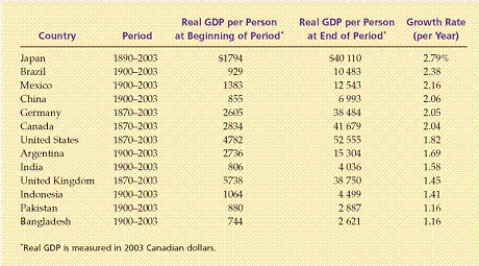 a.Does this data support the catch-up theory of economic growth? Explain your answer.
b.What additional information would be necessary when testing the catch-up theory?
a.Does this data support the catch-up theory of economic growth? Explain your answer.
b.What additional information would be necessary when testing the catch-up theory? (Essay)
4.9/5 (77)
(77) Which of the following is one of the consequences of accumulating capital?
(Multiple Choice)
4.8/5 (81)
(81) If the productivity slowdown had not occurred in 1973, the income of the average Canadian today would be about 70 percent higher.
(True/False)
4.8/5 (88)
(88) Cedar Valley Furniture uses 5 workers working 8 hours to produce 80 rocking chairs. What is the productivity of these workers?
(Multiple Choice)
4.8/5 (92)
(92) Other things the same, countries with low income are likely to increase their income more by adding another unit of capital than are countries that have high income.
(True/False)
4.9/5 (75)
(75) How does income in developing countries like Pakistan and Bangladesh compare with that in Japan and Canada?
(Multiple Choice)
4.8/5 (84)
(84) Which of the following best explains how investment and growth rates related across countries?
(Multiple Choice)
4.8/5 (76)
(76) What would an economist call the saws, lathes, and drill presses that woodworkers at Cedar Valley Furniture use to produce chests and cabinets?
(Multiple Choice)
4.8/5 (77)
(77) In medieval Europe an important technological advance was the use of the padded horse collar for ploughing. Once this idea was thought of, other people used it. What does this example illustrate about knowledge?
(Multiple Choice)
4.8/5 (84)
(84) Suppose that there are diminishing returns to capital. Suppose also that two countries are the same except one has less capital and so less real GDP per person than the other. Suppose that the saving rate in both countries increases from 5 percent to 6 percent. Which of the following would we expect over the next ten years?
(Multiple Choice)
4.9/5 (73)
(73) Suppose Mexico increases its saving rate. Which of the following will happen in the long run?
(Multiple Choice)
4.8/5 (76)
(76) What do economists call the inputs used to produce goods and services?
(Multiple Choice)
4.8/5 (87)
(87) In Canada real GDP per person is about $42 000, while in poor countries real GDP per person may be less than $5000.
(True/False)
4.9/5 (82)
(82) Which of the following would be considered physical capital?
(Multiple Choice)
4.9/5 (73)
(73) Which of the following would NOT be considered physical capital?
(Multiple Choice)
4.9/5 (60)
(60) 
Filters
- Essay(0)
- Multiple Choice(0)
- Short Answer(0)
- True False(0)
- Matching(0)