



 Chat with AI
Exam 2: Thinking Like an Economist

Exam 1: Ten Principles of Economics205 Questions
Exam 2: Thinking Like an Economist230 Questions
Exam 3: Interdependence and the Gains From Trade200 Questions
Exam 4: The Market Forces of Supply and Demand303 Questions
Exam 5: Measuring a Nations Income168 Questions
Exam 6: Measuring the Cost of Living176 Questions
Exam 7: Production and Growth185 Questions
Exam 8: Saving, Investment, and the Financial System208 Questions
Exam 9: Unemployment and Its Natural Rate186 Questions
Exam 10: The Monetary System196 Questions
Exam 11: Money Growth and Inflation193 Questions
Exam 12: Open-Economy Macroeconomics: Basic Concepts215 Questions
Exam 13: A Macroeconomic Theory of the Open Economy184 Questions
Exam 14: Aggregate Demand and Aggregate Supply241 Questions
Exam 15: The Influence of Monetary and Fiscal Policy on Aggregate Demand219 Questions
Exam 16: The Short-Run Tradeoff Between Inflation and Unemployment203 Questions
Exam 17: Five Debates Over Macroeconomic Policy118 Questions
Select questions type


Which of the following is an example of a positive statement?
(Multiple Choice)
4.8/5  (85)
(85) Into which two broad subfields is the field of economics traditionally divided?
(Multiple Choice)
4.7/5 (96)
(96) Table 2-1
Production Possibilities for Toyland
 -Refer to Table 2-1. What is the opportunity cost to Toyland of increasing the production of dolls from 300 to 400?
 (Multiple Choice)
4.9/5 (70)
(70) Figure 2-2 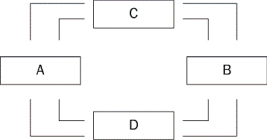 -Refer to Figure 2-2. What does the outer loop represent?
 (Multiple Choice)
4.8/5 (85)
(85) Suppose there are two countries, Freedonia and Sylvania, which have identical amounts of resources, identical technologies, and identical populations. Both produce two types of goods, consumer goods and capital goods, and they both always operate on their production possibilities frontiers. The only difference is that this year Sylvania chooses to produce relatively more consumer goods than Freedonia. What will happen as a result?
(Multiple Choice)
4.9/5 (73)
(73) Use the following demand curve to answer the following questions.
a.How would point A be represented as an ordered pair?
b.What type of curve is this?
c.Does this curve show a positive or negative correlation between price and quantity?
d.Compute the slope of D1 between points A and C.
e.What is the slope of D1 between points C and E? Why would you not have to calculate this answer?
f. What is it called if we move from 1 to 2?
g. How do you know that the slope of 2 is the same as the slope of 1?
(Essay)
5.0/5 (76)
(76) Table 2-1
Production Possibilities for Toyland
-Refer to Table 2-1. What is the opportunity cost to Toyland of increasing the production of dolls from 0 to 100?
-Refer to Table 2-1. What is the opportunity cost to Toyland of increasing the production of dolls from 0 to 100? (Multiple Choice)
4.8/5 (70)
(70) In a simple circular-flow diagram, the two types of markets in which households and firms interact are the markets for goods and services and the markets for factors of production.
(True/False)
4.8/5 (83)
(83) Figure 2-9  -Refer to Figure 2-9. What is the graph shown known as?
 (Multiple Choice)
4.8/5 (61)
(61) Figure 2-10 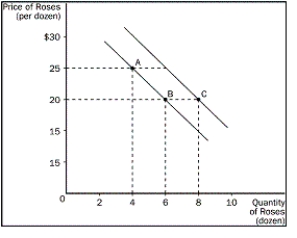 -Refer to Figure 2-10. What could have caused the movement from point B to point C?
 (Multiple Choice)
4.8/5 (72)
(72) Figure 2-9
-Refer to Figure 2-9. What are the curves shown?
-Refer to Figure 2-9. What are the curves shown? (Multiple Choice)
4.9/5 (76)
(76) In the simple circular-flow diagram, who are the decision makers?
(Multiple Choice)
4.9/5 (87)
(87) The prairie dog has always been considered a problem for Canadian cattle ranchers. They dig holes that cattle and horses can step in and they eat grass necessary for cattle. Recently, ranchers have discovered that there is a demand for prairie dogs as pets. In some areas, prairie dogs can sell for as high as $150. Cattlemen are now fencing off prairie dog towns on their land so these towns will not be disturbed by their cattle.
Draw a production possibilities frontier showing a rancher's production option between cattle production and prairie dog production showing increasing opportunity cost and show what would happen in each of the following situations. (Use a separate graph for each situation.)
a.The outcome is efficient, with ranchers choosing to produce equal numbers of cattle and prairie dogs.
b.As a protest against the government introducing the gray wolf back into the wild in their province, ranchers decide not to use 25% of the available grassland for grazing.
c.The price of prairie dogs increases to $200 each, so ranchers decide to allot additional land for prairie dogs.
d.The government grants new leases to ranchers, giving them 10,000 new acres of grassland each for grazing.
e.A drought destroys most of the available grass for grazing of cattle, but not prairie dogs since they also eat plant roots.
(Essay)
4.8/5 (91)
(91) What are the four sectors in a more complex circular-flow diagram?
(Multiple Choice)
4.7/5 (66)
(66) All scientific models, including economic models, simplify reality in order to improve our understanding of it.
(True/False)
4.9/5 (79)
(79) Figure 2-9
-What happens when 2 variables have a negative correlation?
-What happens when 2 variables have a negative correlation? (Multiple Choice)
4.9/5 (77)
(77) 
Filters
- Essay(0)
- Multiple Choice(0)
- Short Answer(0)
- True False(0)
- Matching(0)