



 Chat with AI
Exam 13: Risk, Cost of Capital, and Valuation

Exam 1: Introduction to Corporate Finance67 Questions
Exam 2: Financial Statements and Cash Flow94 Questions
Exam 3: Financial Statements Analysis and Financial Models120 Questions
Exam 4: Discounted Cash Flow Valuation134 Questions
Exam 5: Net Present Value and Other Investment Rules105 Questions
Exam 6: Making Capital Investment Decisions101 Questions
Exam 7: Risk Analysis, Real Options, and Capital Budgeting99 Questions
Exam 8: Interest Rates and Bond Valuation69 Questions
Exam 9: Stock Valuation77 Questions
Exam 10: Risk and Return: Lessons From Market History84 Questions
Exam 11: Return and Risk: the Capital Asset Pricing Model Capm136 Questions
Exam 12: An Alternative View of Risk and Return: The Arbitrage Pricing Theory51 Questions
Exam 13: Risk, Cost of Capital, and Valuation59 Questions
Exam 14: Efficient Capital Markets and Behavioral Challenges65 Questions
Exam 15: Long-Term Financing46 Questions
Exam 16: Capital Structure: Basic Concepts91 Questions
Exam 17: Capital Structure: Limits to the Use of Debt74 Questions
Exam 18: Valuation and Capital Budgeting for the Levered Firm57 Questions
Exam 19: Dividends and Other Payouts90 Questions
Exam 20: Raising Capital73 Questions
Exam 21: Leasing55 Questions
Exam 22: Options and Corporate Finance95 Questions
Exam 23: Options and Corporate Finance: Extensions and Applications46 Questions
Exam 24: Warrants and Convertibles58 Questions
Exam 25: Derivatives and Hedging Risk66 Questions
Exam 26: Short-Term Finance and Planning124 Questions
Exam 27: Cash Management59 Questions
Exam 28: Credit and Inventory Management61 Questions
Exam 29: Mergers, Acquisitions, and Divestitures83 Questions
Exam 30: Financial Distress52 Questions
Exam 31: International Corporate Finance95 Questions
Select questions type


The Hold-n-Trade Co. is an all-equity financed firm. The beta is .9,the market risk premium is 7% and the risk-free rate is 5%. What is the expected return of Hold-n-Trade?
(Multiple Choice)
4.8/5  (77)
(77) Phil's Carvings,Inc. wants to have a weighted average cost of capital of 9%. The firm has an after-tax cost of debt of 5% and a cost of equity of 11%. What debt-equity ratio is needed for the firm to achieve its targeted weighted average cost of capital?
(Multiple Choice)
4.8/5 (64)
(64) Using the CAPM to calculate the cost of capital for a risky project assumes that:
(Multiple Choice)
4.9/5 (86)
(86) For the levered firm the equity beta is __________ the asset beta.
(Multiple Choice)
4.7/5 (94)
(94) When valuing a firm with debt and equity,the cash flows during the non-constant growth period should be:
(Multiple Choice)
4.9/5 (89)
(89) The cost of equity for Ryan Corporation is 8.4%. If the expected return on the market is 10% and the risk-free rate is 5%,then the equity beta is ___.
(Multiple Choice)
4.8/5 (80)
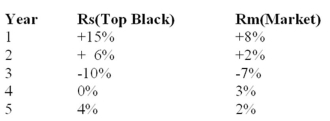
(80) Given the sample of returns of the Top Black Asphalt Company and the S&P 500 index,calculate Top Black's covariance and beta.
(Essay)
4.8/5 (85)
(85) The following are methods to estimate the market risk premium:
(Multiple Choice)
4.7/5 (81)
(81) Assuming the CAPM or one-factor model holds,what is the cost of equity for a firm if the firm's equity has a beta of 1.2,the risk-free rate of return is 4%,the expected return on the market is 10%,and the return to the company's debt is 7%?
(Multiple Choice)
4.8/5 (75)
(75) If a firm has low fixed costs relative to all other firms in the same industry,a large change in sales volume (either up or down) would have:
(Multiple Choice)
4.8/5 (76)
(76) The problem of using the overall firm's beta in discounting projects of different risk is the:
(Multiple Choice)
4.9/5 (87)
(87) The cost of equity for Burgess Corporation is 9.4%. If the expected return on the market is 12% and the risk-free rate is 4%,then the equity beta is ___.
(Multiple Choice)
4.8/5 (88)
(88) Two stock market based costs of liquidity that affects the cost of capital are the:
(Multiple Choice)
5.0/5 (81)
(81) The beta of a firm is more likely to be high under what two conditions?
(Multiple Choice)
4.8/5 (92)
(92) The WACC is used to _______ the expected cash flows when the firm has _______.
(Multiple Choice)
4.9/5 (93)
(93) Slippery Slope Roof's net cash flows are as follows:  After year 3,net cash flows grew at a constant rate of 3%. The weighted average cost of capital is 9%. What is the value of the firm?
 (Multiple Choice)
4.7/5 (69)
(69) 
Filters
- Essay(0)
- Multiple Choice(0)
- Short Answer(0)
- True False(0)
- Matching(0)