



 Chat with AI
Exam 22: Options and Corporate Finance

Exam 1: Introduction to Corporate Finance67 Questions
Exam 2: Financial Statements and Cash Flow94 Questions
Exam 3: Financial Statements Analysis and Financial Models120 Questions
Exam 4: Discounted Cash Flow Valuation134 Questions
Exam 5: Net Present Value and Other Investment Rules105 Questions
Exam 6: Making Capital Investment Decisions101 Questions
Exam 7: Risk Analysis, Real Options, and Capital Budgeting99 Questions
Exam 8: Interest Rates and Bond Valuation69 Questions
Exam 9: Stock Valuation77 Questions
Exam 10: Risk and Return: Lessons From Market History84 Questions
Exam 11: Return and Risk: the Capital Asset Pricing Model Capm136 Questions
Exam 12: An Alternative View of Risk and Return: The Arbitrage Pricing Theory51 Questions
Exam 13: Risk, Cost of Capital, and Valuation59 Questions
Exam 14: Efficient Capital Markets and Behavioral Challenges65 Questions
Exam 15: Long-Term Financing46 Questions
Exam 16: Capital Structure: Basic Concepts91 Questions
Exam 17: Capital Structure: Limits to the Use of Debt74 Questions
Exam 18: Valuation and Capital Budgeting for the Levered Firm57 Questions
Exam 19: Dividends and Other Payouts90 Questions
Exam 20: Raising Capital73 Questions
Exam 21: Leasing55 Questions
Exam 22: Options and Corporate Finance95 Questions
Exam 23: Options and Corporate Finance: Extensions and Applications46 Questions
Exam 24: Warrants and Convertibles58 Questions
Exam 25: Derivatives and Hedging Risk66 Questions
Exam 26: Short-Term Finance and Planning124 Questions
Exam 27: Cash Management59 Questions
Exam 28: Credit and Inventory Management61 Questions
Exam 29: Mergers, Acquisitions, and Divestitures83 Questions
Exam 30: Financial Distress52 Questions
Exam 31: International Corporate Finance95 Questions
Select questions type


Suppose XYZ is priced at $125 a share,has a call with an exercise price of $150,has two months to expiration,and costs $0.125 per contract. Why do you suppose investors would be willing to purchase a call that is so far out of the money?
(Essay)
4.9/5  (87)
(87) Suppose your wealthy Aunt Minnie has asked you to manage her large stock portfolio. You would like to buy and/or sell options on many of the stocks she owns. Describe the types of options you would buy or sell,as well as your rationale,given the following circumstances:
a. Aunt Minnie owns 10,000 shares of IBM common stock. You believe it is going to fall in price,but she won't let you sell it because her late husband told her never to let it go. How do you protect her from the impending price decline?
b. Your analysis suggests that the common stock of Jet-Electro is poised to increase in value sharply over the next year. Aunt Minnie doesn't want to buy any of the stock,but does want you to use options to profit if the price rises. What do you do?
c. Although Aunt Minnie doesn't want you to sell any of the stocks she owns,she would like you to use options to generate a little extra income. How might you do this?
Looking at each option,we see:
(Essay)
4.9/5 (80)
(80) The value of a call increases when: I. the time to expiration increases.
II) the stock price increases.
III) the risk-free rate of return increases.
IV) the volatility of the price of the underlying stock increases.
(Multiple Choice)
4.7/5 (91)
(91) If a call has a positive intrinsic value at expiration the call is said to be:
(Multiple Choice)
4.8/5 (94)
(94) You wrote ten call option contracts on JIG stock with a strike price of $41 and an option price of $.60. What is your net gain or loss on this investment if the price of JIG is $46.05 on the option expiration date?
(Multiple Choice)
4.8/5 (68)
(68) 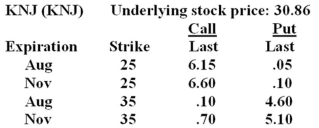
You can realize the same value as that derived from stock ownership if you:
(Multiple Choice)
4.7/5 (89)
(89) You sold ten put option contracts on PLT stock with an exercise price of $31.20 and an option price of $1.20. Today,the option expires and the underlying stock is selling for $33 a share. Ignoring trading costs and taxes,what is your total profit or loss on this investment?
(Multiple Choice)
4.8/5 (78)
(78) You purchased six TJH call option contracts with a strike price of $40 when the option was quoted at $2. The option expires today when the value of TJH stock is $43. Ignoring trading costs and taxes,what is your total profit or loss on your investment?
(Multiple Choice)
4.7/5 (62)
(62) GS,Inc. stock is selling for $28 a share. A 3-month call on GS stock with a strike price of $30 is priced at $1.50. Risk-free assets are currently returning 0.3% per month. What is the price of a 3-month put on GS stock with a strike price of $30?
(Multiple Choice)
4.7/5 (85)
(85) Shareholders in a leveraged firm might wish to accept a negative net present value project if:
(Multiple Choice)
4.9/5 (87)
(87) The market price of ABC stock has been very volatile and you think this volatility will continue for a few weeks. Thus,you decide to purchase a one-month call option contract on ABC stock with a strike price of $25 and an option price of $1.50. You also purchase a one-month put option on ABC stock with a strike price of $25 and an option price of $.70. What will be your total profit or loss on these option positions if the stock price is $24.60 on the day the options expire?
(Multiple Choice)
4.9/5 (86)
(86) What are the upper and lower bounds for an American call option?
Explain what would happen in each case if the bound was violated.
(Essay)
4.9/5 (83)
(83) 
Filters
- Essay(0)
- Multiple Choice(0)
- Short Answer(0)
- True False(0)
- Matching(0)