



 Chat with AI
Exam 19: Economic Inequality

Exam 1: What Is Economics479 Questions
Exam 2: The Economic Problem440 Questions
Exam 3: Demand and Supply515 Questions
Exam 4: Elasticity533 Questions
Exam 5: Efficiency and Equity450 Questions
Exam 6: Government Actions in Markets412 Questions
Exam 7: Global Markets in Action200 Questions
Exam 8: Utility and Demand364 Questions
Exam 9: Possibilities, Preferences, and Choices459 Questions
Exam 10: Organizing Production385 Questions
Exam 11: Output and Costs493 Questions
Exam 12: Perfect Competition487 Questions
Exam 13: Monopoly599 Questions
Exam 14: Monopolistic Competition319 Questions
Exam 15: Oligopoly276 Questions
Exam 16: Public Choices, Public Goods, and Healthcare205 Questions
Exam 17: Externalities437 Questions
Exam 18: Markets for Factors of Production382 Questions
Exam 19: Economic Inequality353 Questions
Exam 20: Uncertainty and Information233 Questions
Select questions type


The table shows the distributions of market income and money income in the United States in 2007.  -According to the table above, ________ percent of total income is redistributed to the lowest income group.
 (Multiple Choice)
4.8/5  (77)
(77) Customer discrimination against female realtors ________ the number of female realtors and ________ their perceived value of marginal product.
(Multiple Choice)
4.9/5 (83)
(83) The higher the cost of acquiring skills, the ________ are the high-skilled and low-skilled labor ________ curves.
(Multiple Choice)
4.8/5 (72)
(72) Of the approximate total population of 300 million people in America, about how many have incomes below the official poverty level?
(Multiple Choice)
4.7/5 (74)
(74) In the U.S. in 2012 the percentage of the Americans living below the poverty line was about
(Multiple Choice)
4.7/5 (83)
(83) What is meant by the term "assortative mating" and how does it affect the distribution of wealth?
(Essay)
5.0/5 (80)
(80) In the United States, the median household income is ________ than the mean income, which means there are ________ households with low incomes than with high incomes.
(Multiple Choice)
4.8/5 (93)
(93) In the United States the poorest 20 percent of households receive about ________ of total income.
(Multiple Choice)
4.8/5 (73)
(73) Joe earns $100,000 per year. He pays a tax rate of 28 percent on the first $60,000 of income and a tax rate of 15 percent on income above $60,000. This tax system is an example of a
(Multiple Choice)
4.8/5 (68)
(68) What are the three ways that the government redistributes income in the United States? Briefly discuss each.
(Essay)
4.9/5 (83)
(83) The measured distribution of ________ is a more accurate indicator of the degree of economic inequality than the measured distribution of ________ because ________ data does not include ________.
(Multiple Choice)
4.7/5 (84)
(84) 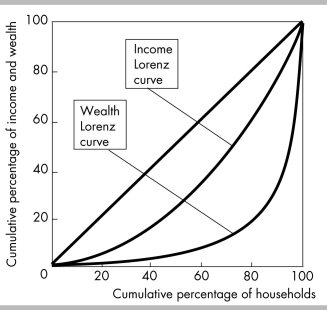 -The Lorenz curves in the above figure imply that
The U.S. tax system at both the federal and state levels is ________.
(Multiple Choice)
4.8/5 (81)
(81) In the country of Konswano there are 4 people. Each person lives for 40 years. In their first 10 years, they earn no income. In the next 20 years, they earn $40,000 per year and in the last 10 years they earn no income. Each year their consumption is $20,000. If everyone in Konswano is 25 years old, then the Lorenz curve for income is ________.
(Multiple Choice)
4.9/5 (96)
(96) 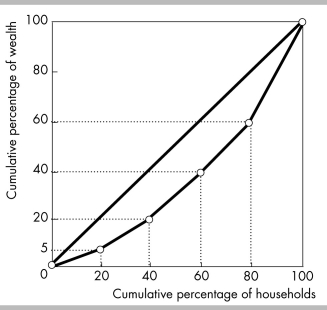 -The above figure shows the Lorenz curve for wealth for the nation of Rusha. What percent of wealth is owned by the poorest quintile?
 (Multiple Choice)
4.8/5 (86)
(86) According to an Asian Development Bank report in 2007, China's Gini coefficient, a statistical measure of wealth distribution in society, soared to 47.3 in 2004 from 40.7 in 1993, putting the country at a level more typical of Latin America. China experienced ________.
(Multiple Choice)
4.8/5 (74)
(74) 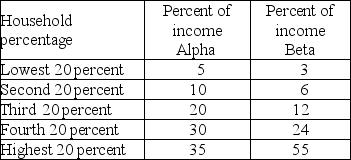
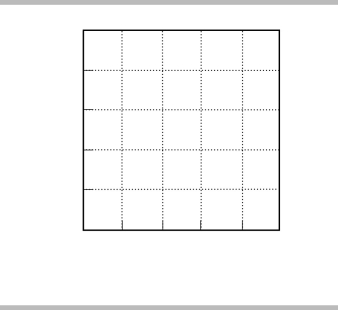 -The above table shows the distribution of income in two imaginary countries, Alpha and Beta.
a) In the figure above, draw the Lorenz curves for Alpha and Beta.
b) Compare the distribution of income in Alpha with that in Beta. Which distribution is more unequal?
c) What would be the distribution of income in a country with perfect income equality?
-The above table shows the distribution of income in two imaginary countries, Alpha and Beta.
a) In the figure above, draw the Lorenz curves for Alpha and Beta.
b) Compare the distribution of income in Alpha with that in Beta. Which distribution is more unequal?
c) What would be the distribution of income in a country with perfect income equality? (Essay)
4.7/5 (65)
(65) 
Filters
- Essay(0)
- Multiple Choice(0)
- Short Answer(0)
- True False(0)
- Matching(0)