



 Chat with AI
Exam 19: Economic Inequality

Exam 1: What Is Economics479 Questions
Exam 2: The Economic Problem440 Questions
Exam 3: Demand and Supply515 Questions
Exam 4: Elasticity533 Questions
Exam 5: Efficiency and Equity450 Questions
Exam 6: Government Actions in Markets412 Questions
Exam 7: Global Markets in Action200 Questions
Exam 8: Utility and Demand364 Questions
Exam 9: Possibilities, Preferences, and Choices459 Questions
Exam 10: Organizing Production385 Questions
Exam 11: Output and Costs493 Questions
Exam 12: Perfect Competition487 Questions
Exam 13: Monopoly599 Questions
Exam 14: Monopolistic Competition319 Questions
Exam 15: Oligopoly276 Questions
Exam 16: Public Choices, Public Goods, and Healthcare205 Questions
Exam 17: Externalities437 Questions
Exam 18: Markets for Factors of Production382 Questions
Exam 19: Economic Inequality353 Questions
Exam 20: Uncertainty and Information233 Questions
Select questions type


Lee earns more than does Pat. Which of the following can explain why?
(Multiple Choice)
4.8/5  (86)
(86) 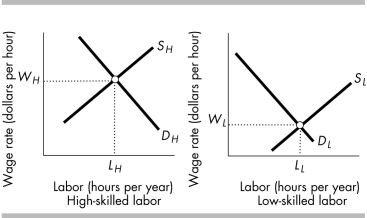 -In the above figure, the long-run effect of providing university education at no charge to all qualified applicants would be to shift the curve SH
 (Multiple Choice)
4.9/5 (75)
(75) 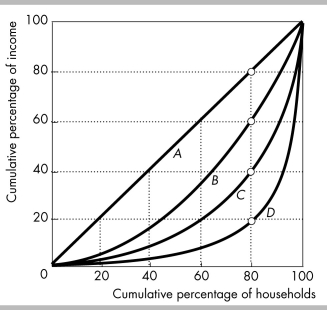 -In the figure above, the Lorenz curve that shows the richest 20 percent of households receiving 80 percent of all income is
 (Multiple Choice)
4.7/5 (74)
(74) If a Lorenz curve for a country's income bows more rightward over time, then the country's
(Multiple Choice)
4.9/5 (80)
(80) Since 1970, the world Gini ratio has ________ indicating that the world distribution of income has ________.
(Multiple Choice)
4.8/5 (66)
(66) The demand curve for high-skilled labor lies to the right of the demand curve for low-skilled labor because
(Multiple Choice)
5.0/5 (85)
(85) 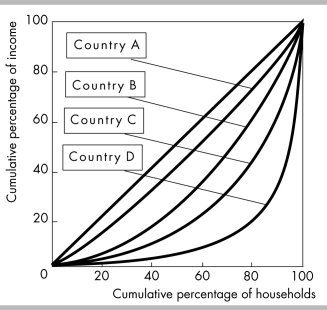 -The above figure shows the Lorenz curves for four different countries. If country C implemented a policy of redistribution from rich to poor, its Lorenz curve would
 (Multiple Choice)
4.9/5 (79)
(79) An income tax system in which the average tax rate decreases with the level of income is called a
(Multiple Choice)
4.9/5 (85)
(85) If human capital was included in the measurement of wealth, the measurement of wealth would be
(Multiple Choice)
4.8/5 (91)
(91) "The Big Tradeoff" refers to the effect of redistribution on efficiency.
(True/False)
5.0/5 (70)
(70) Sue has human capital worth $500,000 and nonhuman capital of $100,000. Todd has human capital worth $10,000 and nonhuman capital of $50,000. The return on each type of capital is 10 percent a year. According to the Census Bureau in the national wealth and income survey, Sue is ________.
(Multiple Choice)
4.8/5 (79)
(79) A firm that discriminates has ________ a nonprejudiced firm and ________.
(Multiple Choice)
4.7/5 (97)
(97) What is the main reason that the distribution of measured wealth is more unequal than the distribution of income?
(Essay)
4.7/5 (67)
(67) 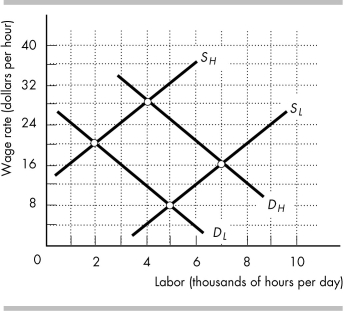 -In the figure above, the difference in wage rate between low-skilled and high-skilled labor is
 (Multiple Choice)
4.8/5 (74)
(74) The table shows the distributions of market income and money income in the United States in 2007.  -According to the table above, ________ percent of total income is redistributed from the highest income group.
 (Multiple Choice)
4.8/5 (73)
(73) Measured distributions of wealth that do not consider the role of human capital
(Multiple Choice)
4.9/5 (75)
(75) Over the past decade, the incomes of the top 1 percent have increased while the incomes of the middle class declined. These changes mean that the Lorenz curve moved ________ the 45 degree line and the Gini ratio has ________.
(Multiple Choice)
4.8/5 (88)
(88) 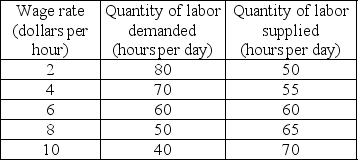 -The table above shows the demand for labor and supply of labor schedules for low-skilled labor. If the labor market is competitive, what is the wage rate of low-skilled labor and what is the quantity of low-skilled labor employed?
 (Multiple Choice)
4.9/5 (71)
(71) 
Filters
- Essay(0)
- Multiple Choice(0)
- Short Answer(0)
- True False(0)
- Matching(0)