



 Chat with AI
Exam 17: Externalities

Exam 1: What Is Economics479 Questions
Exam 2: The Economic Problem440 Questions
Exam 3: Demand and Supply515 Questions
Exam 4: Elasticity533 Questions
Exam 5: Efficiency and Equity450 Questions
Exam 6: Government Actions in Markets412 Questions
Exam 7: Global Markets in Action200 Questions
Exam 8: Utility and Demand364 Questions
Exam 9: Possibilities, Preferences, and Choices459 Questions
Exam 10: Organizing Production385 Questions
Exam 11: Output and Costs493 Questions
Exam 12: Perfect Competition487 Questions
Exam 13: Monopoly599 Questions
Exam 14: Monopolistic Competition319 Questions
Exam 15: Oligopoly276 Questions
Exam 16: Public Choices, Public Goods, and Healthcare205 Questions
Exam 17: Externalities437 Questions
Exam 18: Markets for Factors of Production382 Questions
Exam 19: Economic Inequality353 Questions
Exam 20: Uncertainty and Information233 Questions
Select questions type


 -The table above shows the marginal costs and marginal benefits of college education. The marginal private cost of college education at the efficient quantity of enrollment is
 (Multiple Choice)
4.8/5  (80)
(80)  -The above figure shows the marginal benefits and marginal costs of a college education. The efficient number of students is
 (Multiple Choice)
4.8/5 (90)
(90)  -In the above figure, if a subsidy is granted to producers that generates an efficient allocation of resources, then producers will receive a total amount (price plus subsidy) equal to
 (Multiple Choice)
4.9/5 (78)
(78)  -The figure above illustrates the problem of overcrowding and external costs experienced during the summer months in the state park. An efficient allocation of resources occurs at
 (Multiple Choice)
4.8/5 (90)
(90)  -In the above figure, in order to achieve efficiency, a tax of ________ per unit is needed.
 (Multiple Choice)
4.9/5 (81)
(81) 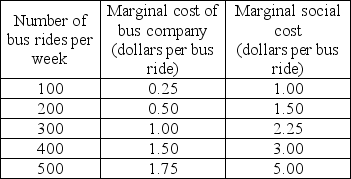 -The demand for bus service is perfectly elastic at a price of $1.25 a ride. The table above shows the bus company's marginal cost and the marginal social cost of the bus service. If the government levies a tax on bus rides so that the bus company takes into account the marginal social cost, the tax will be ________ a ride.
 (Multiple Choice)
4.8/5 (67)
(67) The Coase Theorem states that externalities can always be eliminated by the market as long as property rights exist, the number of parties involved is small, and transactions costs are low.
(True/False)
4.9/5 (92)
(92) Generating electricity creates air pollution. This industry, if left unregulated, will produce
(Multiple Choice)
4.7/5 (68)
(68)
-In the above figure, if the market is competitive and unregulated
-In the above figure, if the market is competitive and unregulated (Multiple Choice)
4.9/5 (85)
(85)  -The above table shows the marginal benefits and costs from production of fertilizer. There are no external benefits. If the market is perfectly competitive and unregulated, at the equilibrium output, the
 (Multiple Choice)
4.8/5 (68)
(68) Consider the production of some industrial good that involves air pollution. The table below gives the marginal social cost (MSC), the marginal cost (MC), and the marginal social benefit (MSB) for each level of output (Q). 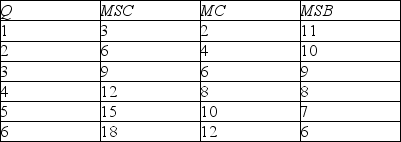 To arrive at the efficient market equilibrium the government could impose a tax of
 (Multiple Choice)
4.8/5 (78)
(78) In the case of an external benefit generated by an activity, such as education, a private subsidy for that activity can achieve an efficient outcome.
(True/False)
4.7/5 (78)
(78)
-The above figure shows the marginal benefits and marginal costs of a college education. If a subsidy of $5,000 is paid to the colleges, then colleges charge tuition of
-The above figure shows the marginal benefits and marginal costs of a college education. If a subsidy of $5,000 is paid to the colleges, then colleges charge tuition of (Multiple Choice)
4.8/5 (76)
(76) "If production of a good creates an external cost, then, when production is such that the marginal private costs are equal to the marginal private benefits, the market outcome will be inefficient." Explain whether this assertion is correct or incorrect.
(Essay)
4.8/5 (85)
(85) How does the government determine the quota amount that will produce an efficient use of a common resource?
(Essay)
4.8/5 (89)
(89)  The figure shows the unregulated market for a pesticide, where S is the supply curve and D is the demand curve. The demand curve is the same as the MSB curve. When factories produce the pesticide, they also create waste, which they dump into a lake on the outskirts of the town. The marginal external cost of the dumped waste is equal to the marginal private cost of producing the pesticide.
-In the figure above, if no one owns the lake, what is the quantity of pesticide produced?
The figure shows the unregulated market for a pesticide, where S is the supply curve and D is the demand curve. The demand curve is the same as the MSB curve. When factories produce the pesticide, they also create waste, which they dump into a lake on the outskirts of the town. The marginal external cost of the dumped waste is equal to the marginal private cost of producing the pesticide.
-In the figure above, if no one owns the lake, what is the quantity of pesticide produced? (Multiple Choice)
4.8/5 (68)
(68) 
Filters
- Essay(0)
- Multiple Choice(0)
- Short Answer(0)
- True False(0)
- Matching(0)