



 Chat with AI
Exam 17: Externalities

Exam 1: What Is Economics479 Questions
Exam 2: The Economic Problem440 Questions
Exam 3: Demand and Supply515 Questions
Exam 4: Elasticity533 Questions
Exam 5: Efficiency and Equity450 Questions
Exam 6: Government Actions in Markets412 Questions
Exam 7: Global Markets in Action200 Questions
Exam 8: Utility and Demand364 Questions
Exam 9: Possibilities, Preferences, and Choices459 Questions
Exam 10: Organizing Production385 Questions
Exam 11: Output and Costs493 Questions
Exam 12: Perfect Competition487 Questions
Exam 13: Monopoly599 Questions
Exam 14: Monopolistic Competition319 Questions
Exam 15: Oligopoly276 Questions
Exam 16: Public Choices, Public Goods, and Healthcare205 Questions
Exam 17: Externalities437 Questions
Exam 18: Markets for Factors of Production382 Questions
Exam 19: Economic Inequality353 Questions
Exam 20: Uncertainty and Information233 Questions
Select questions type


Mandating clean technology, cap-and-trade, and taxes are tools that government can use to limit pollution.
(True/False)
4.8/5  (74)
(74) Individuals making decisions about how much to purchase of a product with an external benefit base their decisions on which of the following?
(Multiple Choice)
4.7/5 (69)
(69) 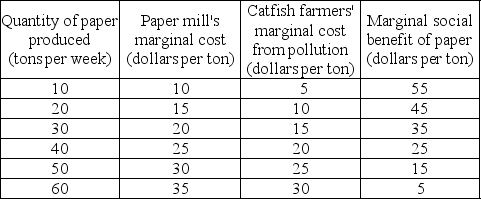 -A paper mill dumps waste into a lake used by a catfish farmer. The table above shows costs and benefits arising from the production of paper.
a) Draw the paper mill's marginal private cost curve, the marginal social cost curve, and the marginal social benefit of paper curve.
b) What is the efficient level of paper production? If no one owns the lake and there is no regulation of pollution, what is the quantity of paper produced per week? Illustrate the deadweight loss in your figure.
c) If the government introduces a Pigovian tax, what is the tax per ton of paper produced that achieves an efficient outcome? What is the amount of the tax?
d) If the catfish farmer owns the lake, how much paper is produced per week and what does the paper mill pay the farmer per ton? Explain you answer.
e) If the paper mill owns the lake, how much paper is produced per week? Explain.
f) Compare the quantities of paper produced in (c) and (d) and explain the relationship between these quantities.
-A paper mill dumps waste into a lake used by a catfish farmer. The table above shows costs and benefits arising from the production of paper.
a) Draw the paper mill's marginal private cost curve, the marginal social cost curve, and the marginal social benefit of paper curve.
b) What is the efficient level of paper production? If no one owns the lake and there is no regulation of pollution, what is the quantity of paper produced per week? Illustrate the deadweight loss in your figure.
c) If the government introduces a Pigovian tax, what is the tax per ton of paper produced that achieves an efficient outcome? What is the amount of the tax?
d) If the catfish farmer owns the lake, how much paper is produced per week and what does the paper mill pay the farmer per ton? Explain you answer.
e) If the paper mill owns the lake, how much paper is produced per week? Explain.
f) Compare the quantities of paper produced in (c) and (d) and explain the relationship between these quantities. (Essay)
4.9/5 (82)
(82) ________ is the benefit that a consumer of a good or service receives.
(Multiple Choice)
4.7/5 (72)
(72)  -In the above table, if the market is perfectly competitive and unregulated, at the equilibrium level of output, the marginal external benefit per unit is
 (Multiple Choice)
4.9/5 (90)
(90)  -The figure above shows the marginal social costs (MSC), marginal private benefits (MB), and marginal social benefits (MSB) of college education in Inland. If Inland's government does not intervene, and the colleges are competitive, the deadweight loss is
 (Multiple Choice)
4.7/5 (71)
(71) In an unregulated competitive market, the presence of marginal external cost of a good or service results in overproduction.
(True/False)
4.9/5 (75)
(75) Public universities, by charging tuition ________ the marginal cost of education, ________ the number of students.
(Multiple Choice)
4.8/5 (85)
(85) A voucher can eliminate the deadweight loss and lead to an efficient outcome if the value of the voucher equals the ________ of the good.
(Multiple Choice)
4.8/5 (92)
(92) If this pollution occurs, the marginal social cost equals the
(Multiple Choice)
4.8/5 (88)
(88)  -In the above figure, in order to promote an efficient allocation of resources, the government could grant a subsidy equal to
 (Multiple Choice)
4.7/5 (82)
(82) What is the Coase theorem? What conditions need to be present for this theorem to work?
(Essay)
4.9/5 (83)
(83) When the production of a good creates an external cost, to achieve the efficient quantity governments can set taxes (T) such that ________.
(Multiple Choice)
4.7/5 (70)
(70) When external costs are present and government imposes a tax equal to the external marginal cost, then efficiency can be achieved.
(True/False)
4.7/5 (78)
(78)  -The table above shows the marginal costs and marginal benefits of college education. If the market for college education is perfectly competitive and unregulated, at the equilibrium quantity, the marginal social benefit is
 (Multiple Choice)
4.9/5 (82)
(82) Consider an industry that produces an output Q with marginal private cost (MC) and marginal social cost (MSC) as given in the table:  Which of the following is TRUE?
 (Multiple Choice)
4.9/5 (101)
(101) Scientists have said for years cod was so seriously overfished in European Union waters that there was a risk of extinction due to stock collapse. In October 2008, they called for the EU to set the 2008 number of days fishermen are allowed to fish at less than half of 2006 levels. This policy is most like
(Multiple Choice)
4.9/5 (66)
(66)  -The table above shows the marginal private benefit, marginal social benefit, and marginal cost of education at the College of Epsilon. What subsidy per student will the college require to take in the efficient number of students?
 (Multiple Choice)
4.8/5 (75)
(75) 
 -The tables above show the marginal costs and benefits from production of paper. If the market is perfectly competitive and unregulated, at the equilibrium level of output, the marginal external cost is
 (Multiple Choice)
4.8/5 (83)
(83) 
Filters
- Essay(0)
- Multiple Choice(0)
- Short Answer(0)
- True False(0)
- Matching(0)