



 Chat with AI
Exam 9: Possibilities, Preferences, and Choices

Exam 1: What Is Economics479 Questions
Exam 2: The Economic Problem440 Questions
Exam 3: Demand and Supply515 Questions
Exam 4: Elasticity533 Questions
Exam 5: Efficiency and Equity450 Questions
Exam 6: Government Actions in Markets412 Questions
Exam 7: Global Markets in Action200 Questions
Exam 8: Utility and Demand364 Questions
Exam 9: Possibilities, Preferences, and Choices459 Questions
Exam 10: Organizing Production385 Questions
Exam 11: Output and Costs493 Questions
Exam 12: Perfect Competition487 Questions
Exam 13: Monopoly599 Questions
Exam 14: Monopolistic Competition319 Questions
Exam 15: Oligopoly276 Questions
Exam 16: Public Choices, Public Goods, and Healthcare205 Questions
Exam 17: Externalities437 Questions
Exam 18: Markets for Factors of Production382 Questions
Exam 19: Economic Inequality353 Questions
Exam 20: Uncertainty and Information233 Questions
Select questions type


If an indifference curve is a straight line it will not show which of the following?
(Multiple Choice)
4.8/5  (83)
(83) 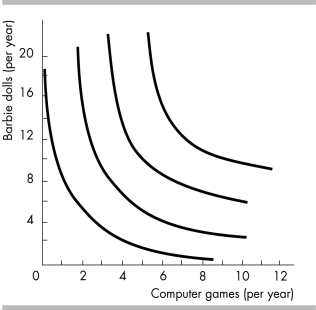 -Nadya spends $200 a year to buy computer games and Barbie dolls. The price of a computer game is $20 and the price of a Barbie doll is $10. The figure above illustrates Nadya's preferences. What combination of computer games and Barbie dolls does Nadya buy?
 (Essay)
5.0/5 (75)
(75) In order to draw an individual's budget line, we must know
(Multiple Choice)
4.8/5 (76)
(76)  -In the above figure, which of the following statements is TRUE? I. The consumer maximizes utility by consuming at point A.
II) The marginal rate of substitution at point B and point A are equal because they are on the same budget line.
-In the above figure, which of the following statements is TRUE? I. The consumer maximizes utility by consuming at point A.
II) The marginal rate of substitution at point B and point A are equal because they are on the same budget line. (Multiple Choice)
4.9/5 (72)
(72) 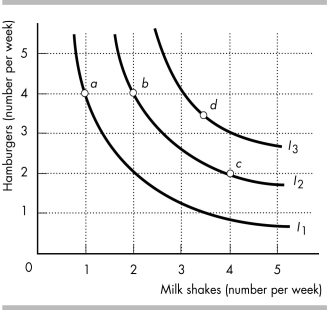 -The figure above shows a preference map for Sarah, who likes hamburgers and milk shakes.
a) Which two combinations contain the same amount of hamburgers but different quantities of shakes?
b) Which combination(s) does Sarah most prefer? Why?
c) Which combination(s) does Sarah least prefer? Why?
d) Between which combinations is Sarah indifferent? Why?
-The figure above shows a preference map for Sarah, who likes hamburgers and milk shakes.
a) Which two combinations contain the same amount of hamburgers but different quantities of shakes?
b) Which combination(s) does Sarah most prefer? Why?
c) Which combination(s) does Sarah least prefer? Why?
d) Between which combinations is Sarah indifferent? Why? (Essay)
4.9/5 (84)
(84) The magnitude of the slope of the budget line is equal to the ________ or ________ of the good plotted on the ________ in terms of the other good.
(Multiple Choice)
4.9/5 (80)
(80) In an indifference curve/budget line framework, how does a consumer decide which of all possible combinations of goods to purchase?
(Essay)
4.8/5 (92)
(92)  -Lizzie's budget line is shown in the figure above. If the price of a magazine rises, Lizzie's real income in terms of magazines books ________ and her real income in terms of cookies ________.
 (Multiple Choice)
4.7/5 (74)
(74)  -Lizzie's preferences are shown in the figure above. Lizzie definitely prefers consuming ________ to consuming ________.
 (Multiple Choice)
4.7/5 (76)
(76) A household's consumption choices cannot exceed limits created by
(Multiple Choice)
4.8/5 (83)
(83)  -Jane spends her monthly dining-out budget of $300.00 on either steak or lobster dinners. Using the above figure, what is the price of a steak dinner?
 (Multiple Choice)
4.9/5 (82)
(82)  -Consider the indifference maps shown above. If eyeglass frames and eyeglass lenses were perfect complements, your indifference curves between them would look like those in
 (Multiple Choice)
4.9/5 (81)
(81)
-The above figure shows Jane's budget line and two of her indifference curves. If the price of a lobster dinner falls so that Jane can now purchase the combination represented by Point B, Jane would experience
-The above figure shows Jane's budget line and two of her indifference curves. If the price of a lobster dinner falls so that Jane can now purchase the combination represented by Point B, Jane would experience (Multiple Choice)
4.8/5 (77)
(77) 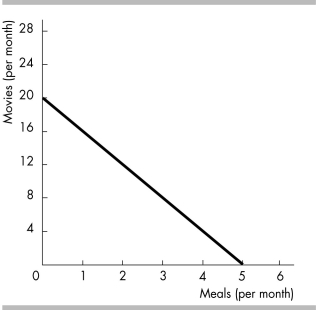 -The above figure shows Katie's consumption possibilities. The relative price of a movie ticket is
 (Multiple Choice)
4.8/5 (75)
(75)
-The above figure shows Jane's budget line and two of her indifference curves. Which of the following happens to Jane's budget line if there were an increase in her monthly dining-out budget?
-The above figure shows Jane's budget line and two of her indifference curves. Which of the following happens to Jane's budget line if there were an increase in her monthly dining-out budget? (Multiple Choice)
4.8/5 (88)
(88)  -In the above figure, if the budget line shifts from RT to RS, the substitution effect is illustrated by the move from
 (Multiple Choice)
4.8/5 (70)
(70) 
Filters
- Essay(0)
- Multiple Choice(0)
- Short Answer(0)
- True False(0)
- Matching(0)