



 Chat with AI
Exam 2: The Economic Problem

Exam 1: What Is Economics479 Questions
Exam 2: The Economic Problem440 Questions
Exam 3: Demand and Supply515 Questions
Exam 4: Elasticity533 Questions
Exam 5: Efficiency and Equity450 Questions
Exam 6: Government Actions in Markets412 Questions
Exam 7: Global Markets in Action200 Questions
Exam 8: Utility and Demand364 Questions
Exam 9: Possibilities, Preferences, and Choices459 Questions
Exam 10: Organizing Production385 Questions
Exam 11: Output and Costs493 Questions
Exam 12: Perfect Competition487 Questions
Exam 13: Monopoly599 Questions
Exam 14: Monopolistic Competition319 Questions
Exam 15: Oligopoly276 Questions
Exam 16: Public Choices, Public Goods, and Healthcare205 Questions
Exam 17: Externalities437 Questions
Exam 18: Markets for Factors of Production382 Questions
Exam 19: Economic Inequality353 Questions
Exam 20: Uncertainty and Information233 Questions
Select questions type


 -If the United States can increase its production of automobiles without decreasing its production of any other good, the United States must have been producing at a point
 (Multiple Choice)
4.9/5  (72)
(72) We are using resources efficiently if we can produce more of one good without producing less of some other good that we value more highly.
(True/False)
4.9/5 (74)
(74) 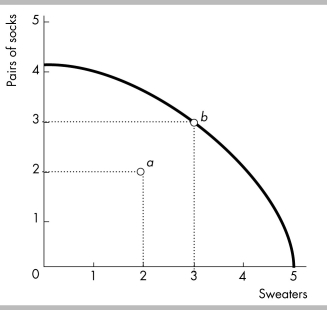 -The opportunity cost of moving from point a to point b in the above figure is ________.
 (Multiple Choice)
4.9/5 (77)
(77)  -The figure above shows Roger's production possibilities frontier. Point a is an ________ point and at that point production is ________.
 (Multiple Choice)
4.7/5 (73)
(73) The social arrangements that govern the ownership, use, and disposal of property are referred to as
(Multiple Choice)
4.9/5 (84)
(84) At one point along a PPF 40 tons of wheat are produced while 80 tons of rice are produced. At another point along the same PPF, 41 tons of wheat are produced while 70 tons of rice are produced. The opportunity cost of producing a ton of wheat between these points is ________ per ton of wheat.
(Multiple Choice)
4.9/5 (85)
(85)  -Agnes can produce either 1 unit of X or 1 unit of Y in an hour, while Brenda can produce either 2 units of X or 4 units of Y in an hour. The opportunity cost of producing a unit of X is
 (Multiple Choice)
4.8/5 (79)
(79) An economy produces only food and shelter. There are two individuals in the economy: Bill and Mary. Mary's opportunity cost of producing 1 unit of shelter is 2 units of food. Bill's opportunity cost of producing 1 unit of shelter is 4 units of food.
(Multiple Choice)
4.9/5 (73)
(73)  -In the figure above, if 4 million computers are produced per year then the ________ should be produced to achieve the allocatively efficient use of resources.
 (Multiple Choice)
4.8/5 (75)
(75) Economic growth can be pictured in a production possibilities frontier diagram by
(Multiple Choice)
4.9/5 (89)
(89)  -The above table shows production combinations on a country's production possibilities frontier. The opportunity cost of increasing the production of Y from 16 to 28 units is ________ units of good X per unit of good Y.
 (Multiple Choice)
4.9/5 (84)
(84) 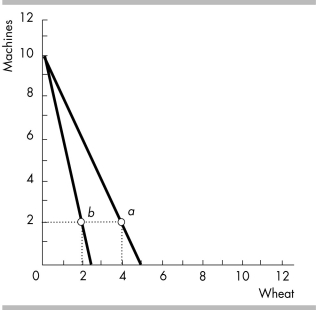 -An economy produces at point a on the PPF shown in the above figure. A drought reduces the amount of wheat produced and the economy produces at point b. The opportunity cost of a unit of wheat ________.
 (Multiple Choice)
4.8/5 (64)
(64) 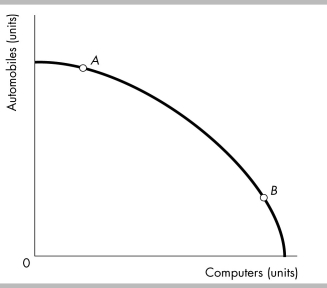 -According to the figure above, the opportunity cost of producing another computer is
 (Multiple Choice)
4.7/5 (87)
(87) Resource use is allocatively efficient when marginal benefit is
(Multiple Choice)
4.8/5 (76)
(76)  -According to the diagram in the figure above, an allocatively efficient use of resources requires that production and consumption of gasoline be
 (Multiple Choice)
4.8/5 (71)
(71) Which of the following statements can used to describe efficiency? I. Efficiently using resources means that producers make the highest profits possible.
II) Using resources efficiently means that we cannot produce more of one good without producing less of another good that has a higher value.
III) Resource use is efficient when we produce goods and services that people value most highly.
(Multiple Choice)
4.7/5 (79)
(79) Blue Violet's Orange Rose'sproduction possibilities production possibilities 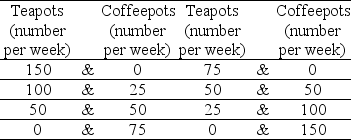 -Two countries, Blue Violet and Orange Rose, produce only two goods: teapots and coffeepots. The table above gives their production possibilities. ________ has a comparative advantage in teapots and ________ has a comparative advantage in coffeepots.
 (Multiple Choice)
5.0/5 (92)
(92) 
Filters
- Essay(0)
- Multiple Choice(0)
- Short Answer(0)
- True False(0)
- Matching(0)