



 Chat with AI
Exam 2: The Economic Problem

Exam 1: What Is Economics479 Questions
Exam 2: The Economic Problem440 Questions
Exam 3: Demand and Supply515 Questions
Exam 4: Elasticity533 Questions
Exam 5: Efficiency and Equity450 Questions
Exam 6: Government Actions in Markets412 Questions
Exam 7: Global Markets in Action200 Questions
Exam 8: Utility and Demand364 Questions
Exam 9: Possibilities, Preferences, and Choices459 Questions
Exam 10: Organizing Production385 Questions
Exam 11: Output and Costs493 Questions
Exam 12: Perfect Competition487 Questions
Exam 13: Monopoly599 Questions
Exam 14: Monopolistic Competition319 Questions
Exam 15: Oligopoly276 Questions
Exam 16: Public Choices, Public Goods, and Healthcare205 Questions
Exam 17: Externalities437 Questions
Exam 18: Markets for Factors of Production382 Questions
Exam 19: Economic Inequality353 Questions
Exam 20: Uncertainty and Information233 Questions
Select questions type


Abe can catch 10 pounds of fish an hour or pick 10 pounds of fruit. Zeb can catch 30 pounds of fish an hour or pick 20 pounds of fruit. The opportunity cost of fish is ________ for Abe than for Zeb, and the opportunity cost of fruit is ________ for Abe than for Zeb.
(Multiple Choice)
4.9/5  (79)
(79) When economists state that the opportunity cost of a product increases as more of it is produced, what do they mean? What is the opportunity cost?
(Essay)
4.9/5 (66)
(66)  -Agnes can produce either 1 unit of X or 1 unit of Y in an hour, while Brenda can produce either 2 units of X or 4 units of Y in an hour.
 (Multiple Choice)
4.9/5 (93)
(93) According to the principle of comparative advantage, if a rich country trades with a poor country, then
(Multiple Choice)
4.8/5 (102)
(102) At one point along a PPF, 10 pizzas and 7 sandwiches can be produced. At another point along the same PPF, 9 pizzas and 10 sandwiches can be produced. The opportunity cost of a pizza between these points is ________ per pizza.
(Multiple Choice)
4.9/5 (74)
(74)  -In the figure above, the allocatively efficient output of computers is
 (Multiple Choice)
4.8/5 (83)
(83)  -According to the diagram in the figure above, what is the marginal cost of producing the 3 millionth gallon of gasoline per month?
 (Multiple Choice)
4.9/5 (72)
(72) If a country operates on its PPF, it achieves production efficiency.
(True/False)
4.9/5 (82)
(82) Suppose that the government is trying to decide between allocating its resources to build more dams or to build more freeways. In terms of forgone dams, as more freeways are constructed, the marginal benefit of additional freeways ________ and the marginal cost of additional freeways ________.
(Multiple Choice)
4.9/5 (72)
(72) The production possibilities frontier bows outward because
(Multiple Choice)
4.9/5 (91)
(91) Suppose Joe can prepare 20 sandwiches or 10 pizzas in an hour and Beth can produce 36 sandwiches or 27 pizzas. The concept of comparative advantage concludes that
(Multiple Choice)
4.9/5 (78)
(78) At the current point of production on a nation's production possibilities frontier, the marginal benefit of a slice of pizza is 500 tacos per slice of pizza while the marginal cost of producing a slice of pizza is 750 tacos per slice of pizza. To be allocatively efficient, what should be done?
(Essay)
4.9/5 (91)
(91)  -In the figure above, both Joe and Jill initially produce at point A. If Joe and Jill realize that they each possess a comparative advantage, which outcome can we expect?
 (Multiple Choice)
4.7/5 (69)
(69) 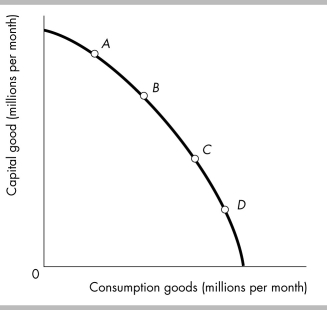 -In the figure above, an economy would grow fastest if it produces at point
 (Multiple Choice)
4.9/5 (90)
(90) If the marginal benefit from another computer exceeds the marginal cost of the computer, then to use resources allocatively efficiently
(Multiple Choice)
4.8/5 (79)
(79) Draw a production possibilities frontier between beans and peas. Label the unattainable points, the attainable points with fully employed resources, and the attainable points with unemployed resources.
(Essay)
4.8/5 (74)
(74)  -In the figure above, the point labeled C in the production possibilities frontier
 (Multiple Choice)
4.8/5 (85)
(85) Betty and Ann live on a desert island. With a day's labor, Ann can produce 8 fish or 4 coconuts; Betty can produce 6 fish or 2 coconuts. Ann's opportunity cost of producing 1 coconut is ________ and she should specialize in the production of ________.
(Multiple Choice)
4.9/5 (69)
(69) 
Filters
- Essay(0)
- Multiple Choice(0)
- Short Answer(0)
- True False(0)
- Matching(0)