



 Chat with AI
Exam 19: Short-Term Financial Planning

Exam 1: Goals and Governance of the Firm99 Questions
Exam 2: Financial Markets and Institutions65 Questions
Exam 3: Accounting and Finance124 Questions
Exam 4: Measuring Corporate Performance123 Questions
Exam 5: The Time Value of Money129 Questions
Exam 6: Valuing Bonds130 Questions
Exam 7: Valuing Stocks145 Questions
Exam 8: Net Present Value and Other Investment Criteria130 Questions
Exam 9: Using Discounted Cash-Flow Analysis to Make Investment Decisions127 Questions
Exam 10: Project Analysis 130 Questions
Exam 11: Introduction to Risk, Return, and the Opportunity Cost of Capital127 Questions
Exam 12: Risk, Return, and Capital Budgeting123 Questions
Exam 13: The Weighted-Average Cost of Capital and Company Valuation131 Questions
Exam 14: Introduction to Corporate Financing and Governance122 Questions
Exam 15: Venture Capital, Ipos, and Seasoned Offerings127 Questions
Exam 16: Debt Policy123 Questions
Exam 17: Payout Policy110 Questions
Exam 18: Long-Term Financial Planning129 Questions
Exam 19: Short-Term Financial Planning132 Questions
Exam 20: Working Capital Management140 Questions
Exam 21: Mergers, Acquisitions, and Corporate Control120 Questions
Exam 22: International Financial Management100 Questions
Exam 23: Options122 Questions
Exam 24: Risk Management125 Questions
Exam 25: Conclusion127 Questions
Exam 26: What We Do and Do Not Know About Finance122 Questions
Select questions type


The observation that additions to fixed assets are "lumpier" than additions to current assets indicates that:
(Multiple Choice)
4.7/5  (84)
(84) Why is it uncommon to expect assets to change proportionately with sales?
(Essay)
4.8/5 (87)
(87) What are the contents and uses of a financial plan?
B.In fact, planners must be constantly on guard against the fascination of detail, because giving in to it means slighting crucial issues like investment strategy, debt policy, and the choice of a target dividend payout ratio.
(Essay)
4.8/5 (84)
(84) What is the sustainable growth rate for a firm with net income of $2.5 million, cash dividends of $1.5 million, and return on equity of 18%?
(Multiple Choice)
4.9/5 (84)
(84) If a firm with an asset base of $3 million recently added $150,000 to retained earnings after a dividend payment of $100,000, then its internal growth rate is:
(Multiple Choice)
4.9/5 (73)
(73) Why do current or fixed assets often not vary proportionately with sales?
(Essay)
4.8/5 (63)
(63) Managers sometimes state a target growth rate for sales or earnings per share.Do you think that either makes sense as a corporate goal? If not, why do you think that managers focus on them?
(Essay)
4.9/5 (74)
(74) Prove that "sustainable growth rate = plowback ratio x return on equity."
(Essay)
4.7/5 (83)
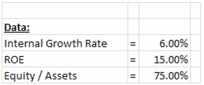
(83) 
The decision to acquire fixed assets is unrelated to the current level of excess capacity.
(True/False)
4.8/5 (79)
(79) What is the sustainable growth rate for a firm with $250,000 in net income, $20,000 in preferred stock dividends, $80,000 in common stock dividends, and an average equity balance of $1 million?
(Multiple Choice)
4.8/5 (71)
(71) Calculate the rate at which the firm can grow without changing its leverage if its payout ratio is 70%, equity outstanding at the beginning of the year is $900,000, and its net income for the year is $150,000:
(Multiple Choice)
4.8/5 (93)
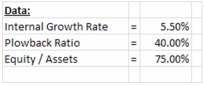
(93) 
Financial planning is a process of deciding which risks to take.
(True/False)
4.7/5 (85)
(85) Planners have determined that sales will increase by 20% next year, and that the profit margin will remain at 10% of sales.Which of the following statements is correct?
(Multiple Choice)
4.9/5 (92)
(92) Which of the following is not typically included among the three major requirements for effective planning?
(Multiple Choice)
4.8/5 (77)
(77) 
Filters
- Essay(0)
- Multiple Choice(0)
- Short Answer(0)
- True False(0)
- Matching(0)