



 Chat with AI
Exam 19: Short-Term Financial Planning

Exam 1: Goals and Governance of the Firm99 Questions
Exam 2: Financial Markets and Institutions65 Questions
Exam 3: Accounting and Finance124 Questions
Exam 4: Measuring Corporate Performance123 Questions
Exam 5: The Time Value of Money129 Questions
Exam 6: Valuing Bonds130 Questions
Exam 7: Valuing Stocks145 Questions
Exam 8: Net Present Value and Other Investment Criteria130 Questions
Exam 9: Using Discounted Cash-Flow Analysis to Make Investment Decisions127 Questions
Exam 10: Project Analysis 130 Questions
Exam 11: Introduction to Risk, Return, and the Opportunity Cost of Capital127 Questions
Exam 12: Risk, Return, and Capital Budgeting123 Questions
Exam 13: The Weighted-Average Cost of Capital and Company Valuation131 Questions
Exam 14: Introduction to Corporate Financing and Governance122 Questions
Exam 15: Venture Capital, Ipos, and Seasoned Offerings127 Questions
Exam 16: Debt Policy123 Questions
Exam 17: Payout Policy110 Questions
Exam 18: Long-Term Financial Planning129 Questions
Exam 19: Short-Term Financial Planning132 Questions
Exam 20: Working Capital Management140 Questions
Exam 21: Mergers, Acquisitions, and Corporate Control120 Questions
Exam 22: International Financial Management100 Questions
Exam 23: Options122 Questions
Exam 24: Risk Management125 Questions
Exam 25: Conclusion127 Questions
Exam 26: What We Do and Do Not Know About Finance122 Questions
Select questions type


Financial plans covering a short planning horizon rarely extend beyond:
(Multiple Choice)
4.7/5  (79)
(79) A potential downfall of using dividends as the plug item is that:
(Multiple Choice)
4.8/5 (62)
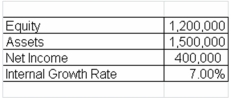
(62) 
Describe the role of a balancing item or "plug" in financial planning.
(Essay)
4.8/5 (83)
(83) Calculate the plowback ratio given the following information: 
(Multiple Choice)
4.8/5 (77)
(77) Which of the following is not a reason for building financial plans?
(Multiple Choice)
4.8/5 (87)
(87) List and briefly describe the components of a financial planning model.
(Essay)
4.8/5 (81)
(81) The phrase, "Forecasts do not develop in a vacuum," is a reminder that:
(Multiple Choice)
4.9/5 (86)
(86) In long-range or strategic planning, the planning horizon is usually five years or more.Explain.
B.In fact, planners must be constantly on guard against the fascination of detail, because giving in to it means slighting crucial issues like investment strategy, debt policy, and the choice of a target dividend payout ratio.
(Essay)
4.9/5 (80)
(80) Which of the following statements is correct for a firm that has a sustainable growth rate that exceeds its projected growth rate in assets?
(Multiple Choice)
4.9/5 (67)
(67) What is the difference between the internal and sustainable growth rates, both in definition and in calculation? In what case are the rates equal?
(Essay)
4.9/5 (94)
(94) Dividend policy is determined by all of the following except:
(Multiple Choice)
4.9/5 (69)
(69) What is the required asset turnover for a firm with a 12% profit margin, 50% equity, and a 40% dividend payout that wishes to grow at 6% using only internal funding?
(Multiple Choice)
4.8/5 (75)
(75) 84.Executives at Fruit Corporation forecast increased sales of 10% over the next year.$2,000,000 of assets will change in constant proportion to sales.If the addition to retained earnings is estimated to be $50,000, determine the required external financing.
(Multiple Choice)
4.8/5 (67)
(67) A major difference between financial planning and forecasting is that financial planning:
(Multiple Choice)
4.9/5 (78)
(78) The final variable to have its value determined in a financial plan is often referred to as the:
(Multiple Choice)
4.8/5 (78)
(78) 
Filters
- Essay(0)
- Multiple Choice(0)
- Short Answer(0)
- True False(0)
- Matching(0)