



 Chat with AI
Exam 22: Photosynthesis

Exam 1: Biochemistry and the Organization of Cells69 Questions
Exam 2: Water: The Solvent for Biochemical Reactions79 Questions
Exam 3: Amino Acids and Peptides77 Questions
Exam 4: The Three-Dimensional Structure of Proteins77 Questions
Exam 5: Protein Purification and Characterization Techniques58 Questions
Exam 6: The Behavior of Proteins: Enzymes78 Questions
Exam 7: The Behavior of Proteins: Enzymes, Mechanisms, and Control77 Questions
Exam 8: Lipids and Proteins Are Associated in Biological Membranes90 Questions
Exam 9: Nucleic Acids: How Structure Conveys Information60 Questions
Exam 10: Biosynthesis of Nucleic Acids: Replication79 Questions
Exam 11: Transcription of the Genetic Code: Biosynthesis of Rna93 Questions
Exam 12: Protein Synthesis: Translation of the Genetic Message80 Questions
Exam 13: Nucleic Acid Biotechnology Techniques89 Questions
Exam 14: Viruses, Cancer, and Immunology35 Questions
Exam 15: The Importance of Energy Changes and Electron Transfer in Metabolism56 Questions
Exam 16: Carbohydrates88 Questions
Exam 17: Glycolysis63 Questions
Exam 18: Storage Mechanisms and Control in Carbohydrate Metabolism79 Questions
Exam 19: The Citric Acid Cycle77 Questions
Exam 20: Electron Transport and Oxidative Phosphorylation70 Questions
Exam 21: Lipid Metabolism86 Questions
Exam 22: Photosynthesis74 Questions
Exam 23: The Metabolism of Nitrogen78 Questions
Exam 24: Integration of Metabolism: Cellular Signaling60 Questions
Select questions type


The transfer of electrons from water to NADP+ to produce oxygen and NADPH is a highly exergonic process.
(True/False)
4.8/5  (77)
(77) The first CO2 fixing reaction of the Hatch-Slack pathway is:
(Multiple Choice)
4.9/5 (75)
(75) It is believed that the ratio of cyclic electron transport to Z-scheme photosynthesis changes in response to metabolic demands.If a plant were actively engaged in a large amount of reductive biosynthesis,requiring NADPH,how would it alter these processes compared to a plant just performing the Calvin cycle to produce glucose?
(Multiple Choice)
4.9/5 (87)
(87) The reactions during the light phase of photosynthesis include the following: 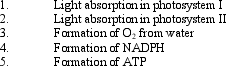 The order of the reactions is as follows:
 (Multiple Choice)
4.7/5 (94)
(94) The actual CO2 fixation process in photosynthesis is the addition of CO2 into a 5 carbon compound to yield
(Multiple Choice)
4.9/5 (74)
(74) Light with short wavelengths has less energy than light with long wavelengths.
(True/False)
4.9/5 (83)
(83) The earliest photosynthetic organisms most likely used water as an electron source.
(True/False)
4.9/5 (78)
(78) For the net synthesis of one six-carbon sugar from CO2 in photosynthesis there is a requirement for
(Multiple Choice)
4.8/5 (88)
(88) Which of the following is not true regarding the C4 pathway?
(Multiple Choice)
4.9/5 (76)
(76) 
Filters
- Essay(0)
- Multiple Choice(0)
- Short Answer(0)
- True False(0)
- Matching(0)