



 Chat with AI
Exam 6: The Behavior of Proteins: Enzymes

Exam 1: Biochemistry and the Organization of Cells69 Questions
Exam 2: Water: The Solvent for Biochemical Reactions79 Questions
Exam 3: Amino Acids and Peptides77 Questions
Exam 4: The Three-Dimensional Structure of Proteins77 Questions
Exam 5: Protein Purification and Characterization Techniques58 Questions
Exam 6: The Behavior of Proteins: Enzymes78 Questions
Exam 7: The Behavior of Proteins: Enzymes, Mechanisms, and Control77 Questions
Exam 8: Lipids and Proteins Are Associated in Biological Membranes90 Questions
Exam 9: Nucleic Acids: How Structure Conveys Information60 Questions
Exam 10: Biosynthesis of Nucleic Acids: Replication79 Questions
Exam 11: Transcription of the Genetic Code: Biosynthesis of Rna93 Questions
Exam 12: Protein Synthesis: Translation of the Genetic Message80 Questions
Exam 13: Nucleic Acid Biotechnology Techniques89 Questions
Exam 14: Viruses, Cancer, and Immunology35 Questions
Exam 15: The Importance of Energy Changes and Electron Transfer in Metabolism56 Questions
Exam 16: Carbohydrates88 Questions
Exam 17: Glycolysis63 Questions
Exam 18: Storage Mechanisms and Control in Carbohydrate Metabolism79 Questions
Exam 19: The Citric Acid Cycle77 Questions
Exam 20: Electron Transport and Oxidative Phosphorylation70 Questions
Exam 21: Lipid Metabolism86 Questions
Exam 22: Photosynthesis74 Questions
Exam 23: The Metabolism of Nitrogen78 Questions
Exam 24: Integration of Metabolism: Cellular Signaling60 Questions
Select questions type


If an inhibitor changes the slope of the Lineweaver-Burk graph,but not the x-intercept,it is this type of inhibition:
(Multiple Choice)
4.8/5  (74)
(74) All catalysts work by lowering the activation energy for a reaction.
(True/False)
4.9/5 (90)
(90) Exhibit 6A This is a reaction going on in your muscle cells right this very minute:
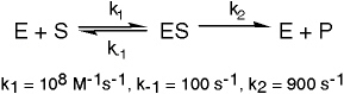
 The enzyme triose phosphate isomerase catalyzes this reaction in the forward direction as part of the glycolytic pathway.It follows simple Michaelis-Menten kinetics:
 Typical cellular concentrations: triose phosphate isomerase = 0.1 nM
Dihydroxyacetone phosphate = 5 µM glyceraldehyde-3-phosphate = 2 µM
Refer to Exhibit 6A."Restrainin" is an inhibitor of triose phosphate isomerase.When it is added to cells at a concentration of 0.4 nM,the enzyme's apparent KM for the substrate is altered to 100 µM,but the Vmax is unchanged.
The enzyme triose phosphate isomerase catalyzes this reaction in the forward direction as part of the glycolytic pathway.It follows simple Michaelis-Menten kinetics:
Typical cellular concentrations: triose phosphate isomerase = 0.1 nM
Dihydroxyacetone phosphate = 5 µM glyceraldehyde-3-phosphate = 2 µM
Refer to Exhibit 6A."Restrainin" is an inhibitor of triose phosphate isomerase.When it is added to cells at a concentration of 0.4 nM,the enzyme's apparent KM for the substrate is altered to 100 µM,but the Vmax is unchanged. (Multiple Choice)
4.9/5 (76)
(76) The KM of hexokinase for glucose = 0.15 mM and for fructose,KM = 1.5 mM.Which is the preferred substrate?
(Multiple Choice)
4.9/5 (61)
(61) Exhibit 6A This is a reaction going on in your muscle cells right this very minute:
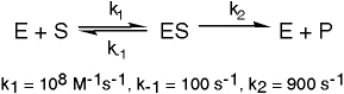
 The enzyme triose phosphate isomerase catalyzes this reaction in the forward direction as part of the glycolytic pathway.It follows simple Michaelis-Menten kinetics:
 Typical cellular concentrations: triose phosphate isomerase = 0.1 nM
Dihydroxyacetone phosphate = 5 µM glyceraldehyde-3-phosphate = 2 µM
Refer to Exhibit 6A.What is the equilibrium constant for the uncatalyzed reaction?
The enzyme triose phosphate isomerase catalyzes this reaction in the forward direction as part of the glycolytic pathway.It follows simple Michaelis-Menten kinetics:
Typical cellular concentrations: triose phosphate isomerase = 0.1 nM
Dihydroxyacetone phosphate = 5 µM glyceraldehyde-3-phosphate = 2 µM
Refer to Exhibit 6A.What is the equilibrium constant for the uncatalyzed reaction? (Multiple Choice)
4.7/5 (64)
(64) What effect is seen on a Lineweaver-Burk graph when a competitive inhibitor is added?
(Multiple Choice)
4.7/5 (93)
(93) If the y-intercept of a Lineweaver-Burk plot = 1.91 (sec/millimole) and the slope = 75.3 L/sec,KM equals:
(Multiple Choice)
4.8/5 (62)
(62) The substrate will only bind to the enzyme when the shapes fit together rigidly.
(True/False)
4.7/5 (86)
(86) Most enzyme reactions display first order kinetics for the individual substrates when the substrate concentration is low.
(True/False)
5.0/5 (74)
(74) The E-S complex often shows as a slight depression in the energy profile for the reaction.
(True/False)
5.0/5 (70)
(70) Exhibit 6A This is a reaction going on in your muscle cells right this very minute:
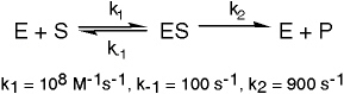
 The enzyme triose phosphate isomerase catalyzes this reaction in the forward direction as part of the glycolytic pathway.It follows simple Michaelis-Menten kinetics:
 Typical cellular concentrations: triose phosphate isomerase = 0.1 nM
Dihydroxyacetone phosphate = 5 µM glyceraldehyde-3-phosphate = 2 µM
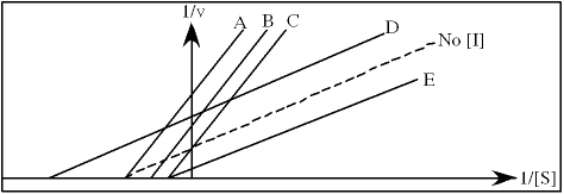
Refer to Exhibit 6A."Hindrate" is an inhibitor of triose phosphate isomerase.When it is added to cells at a concentration of 0.1 nM,the enzyme's KM for the substrate is unchanged,but the apparent Vmax is altered to 50 nM/sec.
In the following graph,which line best represents the Lineweaver-Burk plot obtained in the presence of hindrate?
The enzyme triose phosphate isomerase catalyzes this reaction in the forward direction as part of the glycolytic pathway.It follows simple Michaelis-Menten kinetics:
Typical cellular concentrations: triose phosphate isomerase = 0.1 nM
Dihydroxyacetone phosphate = 5 µM glyceraldehyde-3-phosphate = 2 µM
Refer to Exhibit 6A."Hindrate" is an inhibitor of triose phosphate isomerase.When it is added to cells at a concentration of 0.1 nM,the enzyme's KM for the substrate is unchanged,but the apparent Vmax is altered to 50 nM/sec.
In the following graph,which line best represents the Lineweaver-Burk plot obtained in the presence of hindrate?
(Multiple Choice)
4.7/5 (78)
(78) 
Filters
- Essay(0)
- Multiple Choice(0)
- Short Answer(0)
- True False(0)
- Matching(0)