



 Chat with AI
Exam 12: Fiscal Policy

Exam 1: Economics: Foundations and Models148 Questions
Exam 2: Trade-Offs, Comparative Advantage, and the Market System314 Questions
Exam 3: Where Prices Come From: The Interaction of Supply and Demand314 Questions
Exam 4: GDP: Measuring Total Production and Income277 Questions
Exam 5: Unemployment and Inflation300 Questions
Exam 6: Economic Growth, The Financial System, and Business Cycles262 Questions
Exam 7: Long-Run Economic Growth: Sources and Policies280 Questions
Exam 8: Aggregate Expenditure and Output in the Short Run315 Questions
Exam 9: Aggregate Demand and Aggregate Supply Analysis246 Questions
Exam 10: Money, Banks, and the Bank of Canada285 Questions
Exam 11: Monetary Policy281 Questions
Exam 12: Fiscal Policy303 Questions
Exam 13: Inflation, Unemployment, and Bank of Canada Policy265 Questions
Exam 14: Macroeconomics in an Open Economy280 Questions
Exam 15: The International Financial System228 Questions
Select questions type


If the economy is slipping into a recession, which of the following would be an appropriate fiscal policy?
(Multiple Choice)
4.8/5  (88)
(88) The aggregate demand curve will shift to the right ________ the initial increase in government purchases.
(Multiple Choice)
4.8/5 (85)
(85) Poorly timed discretionary policy can do more harm than good.Getting the timing right with fiscal policy is generally
(Multiple Choice)
5.0/5 (79)
(79) The largest source of federal government revenue in 2015 was
(Multiple Choice)
4.8/5 (86)
(86) An increase in government spending lowers interest rates and increases the rate of investment in new capital.
(True/False)
4.8/5 (82)
(82) The federal government debt as a percentage of GDP did not rise
(Multiple Choice)
4.8/5 (80)
(80) Provincial health care systems receive no support from the federal government.
(True/False)
4.8/5 (85)
(85) Suppose real GDP is $1.8 trillion and potential real GDP is $1.85 trillion.If the federal government increases government purchases by $50 billion, then the economy will be brought to equilibrium at potential real GDP.
(True/False)
5.0/5 (74)
(74) If the federal government's expenditures are less than its tax revenues, then
(Multiple Choice)
4.9/5 (68)
(68) If real GDP is $300 billion below potential GDP and the tax multiplier equals -1.5, then how much would the government need to change taxes to bring the economy to equilibrium at potential?
(Essay)
4.9/5 (87)
(87) Explain why the timing of fiscal policy may be more difficult than the timing of monetary policy.
(Essay)
4.9/5 (90)
(90) The austerity plan required of the Greek government is a(n)________ policy, when normally a recession would suggest ________ policy.
(Multiple Choice)
4.9/5 (78)
(78) Calculate the value of the government purchases multiplier if the marginal propensity to consume equals 0.8, the tax rate equals 0.2, and the marginal propensity to import equals 0.05.
(Essay)
4.8/5 (74)
(74) Figure 12.1 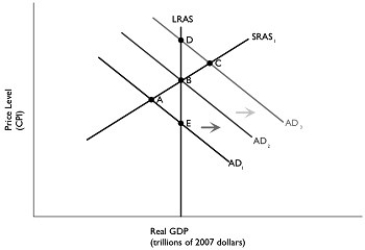 Alt text for Figure 12.1: In figure 12.1, a graph comparing real GDP and price level.
Long description for Figure 12.1: The x-axis is labelled, real GDP (trillions of 2007 dollars)and the y-axis is labelled, price level (CPI).5 lines are shown; AD1, AD2, AD3, LRAS, and SRAS1.Line AD1 begins in the top left corner and slopes down to the end of the x-axis.Line AD2 follows the same slope, but is plotted to the right.Similarly, line AD3 also has the same slope and is plotted to the right of AD2.Line SRAS1 begins close to the vertex and slopes up to the top right corner.Line LRAS is perpendicular to the x-axis, passing through points D, B, and E.Lines AD1 and SRAS1 intersect at point A.Lines AD2, LRAS, and SRAS1 intersect at point B.Lines AD3 and SRAS1 intersect at point C.Lines AD1 and LRAS intersect at point E.Lines AD3 and LRAS intersect at point D.The area between lines AD1 and AD2 is indicated by a right pointing arrow.The area between lines AD2 and AD3 is indicated by a right pointing arrow.
-Refer to Figure 12.1.Suppose the economy is in short-run equilibrium below potential GDP and Parliament and the prime minister lower taxes to move the economy back to long-run equilibrium.Using the static AD-AS model in the figure above, this would be depicted as a movement from
Alt text for Figure 12.1: In figure 12.1, a graph comparing real GDP and price level.
Long description for Figure 12.1: The x-axis is labelled, real GDP (trillions of 2007 dollars)and the y-axis is labelled, price level (CPI).5 lines are shown; AD1, AD2, AD3, LRAS, and SRAS1.Line AD1 begins in the top left corner and slopes down to the end of the x-axis.Line AD2 follows the same slope, but is plotted to the right.Similarly, line AD3 also has the same slope and is plotted to the right of AD2.Line SRAS1 begins close to the vertex and slopes up to the top right corner.Line LRAS is perpendicular to the x-axis, passing through points D, B, and E.Lines AD1 and SRAS1 intersect at point A.Lines AD2, LRAS, and SRAS1 intersect at point B.Lines AD3 and SRAS1 intersect at point C.Lines AD1 and LRAS intersect at point E.Lines AD3 and LRAS intersect at point D.The area between lines AD1 and AD2 is indicated by a right pointing arrow.The area between lines AD2 and AD3 is indicated by a right pointing arrow.
-Refer to Figure 12.1.Suppose the economy is in short-run equilibrium below potential GDP and Parliament and the prime minister lower taxes to move the economy back to long-run equilibrium.Using the static AD-AS model in the figure above, this would be depicted as a movement from (Multiple Choice)
4.9/5 (83)
(83) Fiscal policy is defined as changes in federal ________ and ________ to achieve macroeconomic objectives such as price stability, high rates of economic growth, and high employment.
(Multiple Choice)
4.8/5 (77)
(77) A decrease in which of the following would decrease the tax wedge?
(Multiple Choice)
4.8/5 (73)
(73) Which of the following is considered expansionary fiscal policy?
(Multiple Choice)
4.8/5 (84)
(84) Calculate the impact of a $96 billion increase in government spending on equilibrium GDP when the marginal propensity to consume is 0.8, the marginal tax rate is15% and the marginal propensity to import is 0.15.
(Multiple Choice)
4.9/5 (83)
(83) 
Filters
- Essay(0)
- Multiple Choice(0)
- Short Answer(0)
- True False(0)
- Matching(0)