



 Chat with AI
Exam 12: Fiscal Policy

Exam 1: Economics: Foundations and Models148 Questions
Exam 2: Trade-Offs, Comparative Advantage, and the Market System314 Questions
Exam 3: Where Prices Come From: The Interaction of Supply and Demand314 Questions
Exam 4: GDP: Measuring Total Production and Income277 Questions
Exam 5: Unemployment and Inflation300 Questions
Exam 6: Economic Growth, The Financial System, and Business Cycles262 Questions
Exam 7: Long-Run Economic Growth: Sources and Policies280 Questions
Exam 8: Aggregate Expenditure and Output in the Short Run315 Questions
Exam 9: Aggregate Demand and Aggregate Supply Analysis246 Questions
Exam 10: Money, Banks, and the Bank of Canada285 Questions
Exam 11: Monetary Policy281 Questions
Exam 12: Fiscal Policy303 Questions
Exam 13: Inflation, Unemployment, and Bank of Canada Policy265 Questions
Exam 14: Macroeconomics in an Open Economy280 Questions
Exam 15: The International Financial System228 Questions
Select questions type


Expansionary fiscal policy to prevent real GDP from falling below potential real GDP would cause the inflation rate to be ________ and real GDP to be ________.
(Multiple Choice)
4.9/5  (71)
(71) Give an example of an automatic stabilizer.Explain how automatic stabilizers work in the case of recession.
(Essay)
4.9/5 (69)
(69) Suppose the federal government increased spending by $10 billion and raised taxes by $10 billion to keep the budget balanced.What will happen to real equilibrium GDP?
(Multiple Choice)
4.9/5 (84)
(84) Fiscal policy actions that are intended to have long-run effects on real GDP attempt to increase ________ through changing ________.
(Multiple Choice)
4.8/5 (73)
(73) Assuming a fixed amount of taxes and a closed economy, calculate the value of the government purchases multiplier, the tax multiplier, and the balanced budget multiplier if the marginal propensity to consume equals 0.5.
(Essay)
4.8/5 (75)
(75) When does the Government of Canada borrow? Why would the government have to borrow more than it estimated? When would the government repay what it borrowed, and who is it repaying?
(Essay)
4.9/5 (75)
(75) An increase in government spending may expedite recovery from a recession in the short run, but in the long run, this policy may
(Multiple Choice)
4.8/5 (85)
(85) Consider a tax cut that affects not only consumer disposable income, but also after-tax earnings from labour supplied to labour markets and from financial assets acquired through saving.In the long run, we would expect this tax cut to
(Multiple Choice)
4.8/5 (76)
(76) Three categories of federal government expenditures, in addition to government operations, are
(Multiple Choice)
4.9/5 (84)
(84) If policy makers implement an expansionary fiscal policy but do not take into account the potential for crowding out, the new equilibrium level of GDP is likely to
(Multiple Choice)
4.7/5 (86)
(86) If policymakers are concerned that the economy is in danger of rising inflation because aggregate demand is increasing faster than aggregate supply, the appropriate fiscal policy response is to
(Multiple Choice)
4.8/5 (80)
(80) Which of the following would be most likely to induce the federal government to conduct contractionary fiscal policy?
(Multiple Choice)
4.8/5 (78)
(78) Increases in government spending result in ________ in the short run, and permanent increases in government spending result in ________ in the long run.
(Multiple Choice)
4.8/5 (74)
(74) If the federal budget goes from a budget deficit in Year 1 to a budget surplus in Year 2, does it follow that the federal government acted to raise taxes or cut government spending in Year 2?
(Essay)
4.8/5 (85)
(85) Figure 12.5 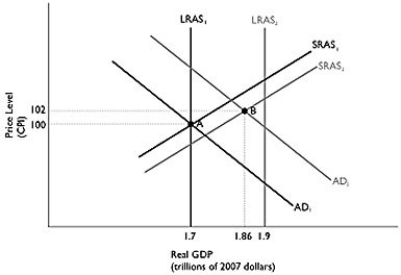 Alt text for Figure 12.5: In figure 12.5, a dynamic model of AD-AS.
Long description for Figure 12.5: The x-axis is labelled, real GDP (trillions of 2007 dollars).The y-axis is labelled, price level (CPI).6 lines are shown; SRAS1, SRAS2, AD1, AD2, LRAS1, and LRAS2.Line SRAS1 begins in the bottom left corner and slopes up to the top right corner.Line SRAS2 follows the same slope as line SRAS1, but is plotted to the right.Line AD1 begins at the top left corner and slopes down to the bottom center.Line AD2 follows the same slope as line AD1, but is plotted to the right.Line LRAS1 is perpendicular to the x-axis, and begins from the x-axis value 1.7.Line LRAS2 is perpendicular to the x-axis, and begins from x-axis value 1.9.Line LRAS1 intersects lines AD1 and SRAS1 at point A (1.7, 100).Lines AD2 and SRAS2 intersect at point B (1.86, 102).Points A and B are connected to their respective coordinates on the x and y-axes with dotted lines.Line LRAS2 intersects the lines SRAS1 and SRAS2 near the top end of these lines.Line LRAS2 intersects the lines AD1 and AD2 near the bottom end of these lines.
-Refer to Figure 12.5.In the dynamic model of AD-AS in the figure above, if the economy is at point A in year 1 and is expected to go to point B in year 2, and no fiscal or monetary policy is pursued, then at point B
Alt text for Figure 12.5: In figure 12.5, a dynamic model of AD-AS.
Long description for Figure 12.5: The x-axis is labelled, real GDP (trillions of 2007 dollars).The y-axis is labelled, price level (CPI).6 lines are shown; SRAS1, SRAS2, AD1, AD2, LRAS1, and LRAS2.Line SRAS1 begins in the bottom left corner and slopes up to the top right corner.Line SRAS2 follows the same slope as line SRAS1, but is plotted to the right.Line AD1 begins at the top left corner and slopes down to the bottom center.Line AD2 follows the same slope as line AD1, but is plotted to the right.Line LRAS1 is perpendicular to the x-axis, and begins from the x-axis value 1.7.Line LRAS2 is perpendicular to the x-axis, and begins from x-axis value 1.9.Line LRAS1 intersects lines AD1 and SRAS1 at point A (1.7, 100).Lines AD2 and SRAS2 intersect at point B (1.86, 102).Points A and B are connected to their respective coordinates on the x and y-axes with dotted lines.Line LRAS2 intersects the lines SRAS1 and SRAS2 near the top end of these lines.Line LRAS2 intersects the lines AD1 and AD2 near the bottom end of these lines.
-Refer to Figure 12.5.In the dynamic model of AD-AS in the figure above, if the economy is at point A in year 1 and is expected to go to point B in year 2, and no fiscal or monetary policy is pursued, then at point B (Multiple Choice)
4.8/5 (73)
(73) As a percentage of GDP, government expenditures ________ from 1960 to the early 1990s, ________ from 1992 to 2008, and have ________ since 2008.
(Multiple Choice)
4.8/5 (75)
(75) 
Filters
- Essay(0)
- Multiple Choice(0)
- Short Answer(0)
- True False(0)
- Matching(0)