



 Chat with AI
Exam 19: A Macroeconomic Theory of the Open Economy

Exam 1: Ten Principles of Economics347 Questions
Exam 2: Thinking Like an Economist535 Questions
Exam 3: Interdependence and the Gains From Trade442 Questions
Exam 4: The Market Forces of Supply and Demand569 Questions
Exam 5: Elasticity and Its Application503 Questions
Exam 6: Supply, Demand, and Government Policies556 Questions
Exam 7: Consumers, Producers, and the Efficiency of Markets460 Questions
Exam 8: Application: The Costs of Taxation422 Questions
Exam 9: Application: International Trade409 Questions
Exam 10: Measuring a Nations Income428 Questions
Exam 11: Measuring the Cost of Living436 Questions
Exam 12: Production and Growth417 Questions
Exam 13: Saving, Investment, and the Financial System473 Questions
Exam 14: The Basic Tools of Finance419 Questions
Exam 15: Unemployment571 Questions
Exam 16: The Monetary System423 Questions
Exam 17: Money Growth and Inflation388 Questions
Exam 18: Open-Economy Macroeconomic Models448 Questions
Exam 19: A Macroeconomic Theory of the Open Economy374 Questions
Exam 20: Aggregate Demand and Aggregate Supply471 Questions
Exam 21: The Influence of Monetary and Fiscal Policy on Aggregate Demand416 Questions
Exam 22: The Short-Run Trade-Off Between Inflation and Unemployment400 Questions
Exam 23: Six Debates Over Macroeconomic Policy235 Questions
Select questions type


Explain how the relation between the real exchange rate and net exports explains the downward slope of the demand for foreign-currency exchange curve.
(Essay)
4.9/5  (77)
(77) Other things the same, a decrease in the U.S. real interest rate induces
(Multiple Choice)
4.9/5 (83)
(83) If the risk of buying U.S. assets rises because it is discovered that lending institutions had not carefully evaluated borrowers prior to lending them funds, then
(Multiple Choice)
5.0/5 (83)
(83) How are the identities S = NCO + I and NCO = NX related to the foreign currency exchange market and the loanable funds market?
(Essay)
4.9/5 (80)
(80) At the equilibrium real interest rate in the open-economy macroeconomic model
(Multiple Choice)
4.9/5 (74)
(74) In the open-economy macroeconomic model, if there is currently a surplus in the foreign exchange market, the quantity of desired net exports will increase as the market moves to equilibrium.
(True/False)
4.7/5 (76)
(76) In the open-economy macroeconomic model, the real exchange rate does not affect net capital outflow.
(True/False)
5.0/5 (76)
(76) Suppose that U.S. citizens start saving more. What does this imply about the supply of loanable funds and the equilibrium real interest rate? What happens to the real exchange rate?
(Essay)
4.8/5 (84)
(84) According to the open-economy macroeconomic model, if the U.S. government budget deficit decreases, then both U.S. domestic investment and net capital outflow increase.
(True/False)
5.0/5 (68)
(68) In the open-economy macroeconomic model, a higher domestic interest rate reduces the quantity of loanable funds demanded
(True/False)
4.8/5 (78)
(78) An increase in the government budget deficit shifts the supply of loanable funds to the left.
(True/False)
4.7/5 (69)
(69) In the open-economy macroeconomic model, if a country's interest rate falls, then its
(Multiple Choice)
5.0/5 (81)
(81) If a government of a country with a zero trade balance increases its budget deficit, then the real exchange rate
(Multiple Choice)
4.7/5 (81)
(81) If U.S. citizens decide to save a smaller fraction of their incomes, U.S. domestic investment
(Multiple Choice)
4.8/5 (70)
(70) In the open-economy macroeconomic model, the supply of dollars in the market for foreign-currency exchange is upward sloping.
(True/False)
4.8/5 (81)
(81) Figure 19-1 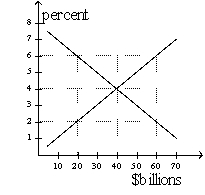 -Refer to Figure 19-1. The loanable funds market is in equilibrium at
 (Multiple Choice)
4.8/5 (77)
(77) 
Filters
- Essay(0)
- Multiple Choice(0)
- Short Answer(0)
- True False(0)
- Matching(0)