



 Chat with AI
Exam 19: A Macroeconomic Theory of the Open Economy

Exam 1: Ten Principles of Economics347 Questions
Exam 2: Thinking Like an Economist535 Questions
Exam 3: Interdependence and the Gains From Trade442 Questions
Exam 4: The Market Forces of Supply and Demand569 Questions
Exam 5: Elasticity and Its Application503 Questions
Exam 6: Supply, Demand, and Government Policies556 Questions
Exam 7: Consumers, Producers, and the Efficiency of Markets460 Questions
Exam 8: Application: The Costs of Taxation422 Questions
Exam 9: Application: International Trade409 Questions
Exam 10: Measuring a Nations Income428 Questions
Exam 11: Measuring the Cost of Living436 Questions
Exam 12: Production and Growth417 Questions
Exam 13: Saving, Investment, and the Financial System473 Questions
Exam 14: The Basic Tools of Finance419 Questions
Exam 15: Unemployment571 Questions
Exam 16: The Monetary System423 Questions
Exam 17: Money Growth and Inflation388 Questions
Exam 18: Open-Economy Macroeconomic Models448 Questions
Exam 19: A Macroeconomic Theory of the Open Economy374 Questions
Exam 20: Aggregate Demand and Aggregate Supply471 Questions
Exam 21: The Influence of Monetary and Fiscal Policy on Aggregate Demand416 Questions
Exam 22: The Short-Run Trade-Off Between Inflation and Unemployment400 Questions
Exam 23: Six Debates Over Macroeconomic Policy235 Questions
Select questions type


Which of the following is considered part of the supply of U.S. dollars in the market for foreign-currency exchange in the open-economy macroeconomic model?
(Multiple Choice)
4.9/5  (76)
(76) In the open-economy macroeconomic model, if a country's interest rate rises, then its
(Multiple Choice)
4.8/5 (76)
(76) If the real interest rate were above the equilibrium rate, there would be a shortage of loanable funds.
(True/False)
4.7/5 (74)
(74) Which of the following is the most likely result from an increase in a country's government budget surplus?
(Multiple Choice)
4.9/5 (85)
(85) The slope of the supply of loanable funds is based on an increase in
(Multiple Choice)
5.0/5 (84)
(84) In the open-economy macroeconomic model, if the U.S. interest rate rises, then its
(Multiple Choice)
4.8/5 (79)
(79) A tax credit for purchases of capital goods causes the interest rate to increase and the exchange rate to appreciate.
(True/False)
4.8/5 (69)
(69) From 2001 to 2004, the U.S. government went from a budget surplus to a budget deficit. According to the open-economy macroeconomic model, this should have decreased
(Multiple Choice)
4.9/5 (86)
(86) In 1998 the Russian government defaulted on its bonds. According to the open-economy macroeconomic model, this should have
(Multiple Choice)
4.8/5 (70)
(70) Which of the following is the correct way to show the effects of a newly imposed import quota?
(Multiple Choice)
4.7/5 (68)
(68) In the open-economy macroeconomic model, the key determinant of net capital outflow is
(Multiple Choice)
4.8/5 (80)
(80) According to the open-economy macroeconomic model, if the U.S. government budget deficit increases, then both U.S. domestic investment and U.S. net capital outflow decrease.
(True/False)
4.9/5 (89)
(89) In the open-economy macroeconomic model, if the supply of loanable funds increases, net capital outflow
(Multiple Choice)
4.8/5 (88)
(88) Which of the following would make the equilibrium real interest rate decrease and the equilibrium quantity of loanable funds increase?
(Multiple Choice)
4.9/5 (84)
(84) The diagram below represents the market for loanable funds and the market for foreign-currency exchange in Mexico. Use the diagram to answer the following questions.Figure 19-7 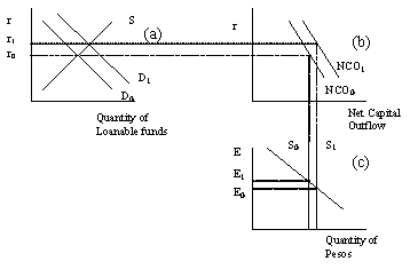 -Refer to Figure 19-7. Supposing that the Mexican economy starts at r0 and E1. Which of the following is consistent with the effects of capital flight?
 (Multiple Choice)
4.9/5 (66)
(66) 
Filters
- Essay(0)
- Multiple Choice(0)
- Short Answer(0)
- True False(0)
- Matching(0)