



 Chat with AI
Exam 4: The Market Forces of Supply and Demand

Exam 1: Ten Principles of Economics347 Questions
Exam 2: Thinking Like an Economist535 Questions
Exam 3: Interdependence and the Gains From Trade442 Questions
Exam 4: The Market Forces of Supply and Demand569 Questions
Exam 5: Elasticity and Its Application503 Questions
Exam 6: Supply, Demand, and Government Policies556 Questions
Exam 7: Consumers, Producers, and the Efficiency of Markets460 Questions
Exam 8: Application: The Costs of Taxation422 Questions
Exam 9: Application: International Trade409 Questions
Exam 10: Measuring a Nations Income428 Questions
Exam 11: Measuring the Cost of Living436 Questions
Exam 12: Production and Growth417 Questions
Exam 13: Saving, Investment, and the Financial System473 Questions
Exam 14: The Basic Tools of Finance419 Questions
Exam 15: Unemployment571 Questions
Exam 16: The Monetary System423 Questions
Exam 17: Money Growth and Inflation388 Questions
Exam 18: Open-Economy Macroeconomic Models448 Questions
Exam 19: A Macroeconomic Theory of the Open Economy374 Questions
Exam 20: Aggregate Demand and Aggregate Supply471 Questions
Exam 21: The Influence of Monetary and Fiscal Policy on Aggregate Demand416 Questions
Exam 22: The Short-Run Trade-Off Between Inflation and Unemployment400 Questions
Exam 23: Six Debates Over Macroeconomic Policy235 Questions
Select questions type


The market for diamond rings is closely linked to the market for high-quality diamonds. If a large quantity of high-quality diamonds enters the market, then the
(Multiple Choice)
4.7/5  (84)
(84) In a market economy, supply and demand are important because they
(Multiple Choice)
4.7/5 (81)
(81) Figure 4-21  -Refer to Figure 4-21. Which of the following movements would illustrate the effect in the market for bread of an increase in the price of flour?
 (Multiple Choice)
4.7/5 (91)
(91) Figure 4-11
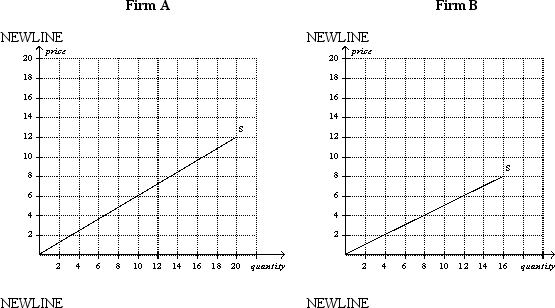 -Refer to Figure 4-11. If these are the only two sellers in the market, then the market quantity supplied at a price of $8 is
 (Multiple Choice)
4.8/5 (78)
(78) A decrease in income will shift the demand curve for an inferior good to the right.
(True/False)
4.8/5 (75)
(75) A market supply curve shows how the total quantity supplied of a good varies as
(Multiple Choice)
4.8/5 (85)
(85) The following table contains a supply schedule for a good. Price Quantit Supplied \ 10 100 \ 20 Q1 If the law of supply applies to this good, then Q1 could be
(Multiple Choice)
4.8/5 (82)
(82) In a competitive market, there are so few buyers and so few sellers that each has a significant impact on the market price.
(True/False)
4.9/5 (82)
(82) The market supply curve shows how the total quantity supplied of a good varies as input prices vary, holding constant all the other factors that influence producers' decisions about how much to sell.
(True/False)
4.7/5 (97)
(97) A decrease in the price of peanut butter will increase both the equilibrium price and quantity in the market for jelly.
(True/False)
5.0/5 (76)
(76) Table 4-9
The demand schedule below pertains to sandwiches demanded per week. Price Harry's Quantity Demanded Darby's Quantity Denanded Jake's Quantity Denanded \ 3 3 4 3 \ 5 1 2 x
-Refer to Table 4-9. Suppose x = 1. Then the slope of the market demand curve is
(Multiple Choice)
4.9/5 (87)
(87) If the supply of a product decreases, then we would expect equilibrium price
(Multiple Choice)
4.8/5 (88)
(88) When quantity supplied exceeds quantity demanded at the current market price, the market has a surplus, and market price will likely rise in the future to eliminate the surplus.
(True/False)
4.8/5 (74)
(74) In competitive markets, which of the following is not correct?
(Multiple Choice)
4.9/5 (81)
(81) Today's demand curve for gasoline could shift in response to a change in
(Multiple Choice)
4.9/5 (68)
(68) The following table contains a demand schedule for a good. Price Quantit Demanded \ 10 100 \ 20 Q1 If the law of demand applies to this good, then Q1 could be
(Multiple Choice)
4.9/5 (89)
(89) Figure 4-13  -Refer to Figure 4-13. The shift from S' to S in the market for chocolate cake could be caused by a(n)
 (Multiple Choice)
4.9/5 (81)
(81) All goods and services are sold in perfectly competitive markets.
(True/False)
4.8/5 (82)
(82) 
Filters
- Essay(0)
- Multiple Choice(0)
- Short Answer(0)
- True False(0)
- Matching(0)