



 Chat with AI
Exam 4: The Market Forces of Supply and Demand

Exam 1: Ten Principles of Economics347 Questions
Exam 2: Thinking Like an Economist535 Questions
Exam 3: Interdependence and the Gains From Trade442 Questions
Exam 4: The Market Forces of Supply and Demand569 Questions
Exam 5: Elasticity and Its Application503 Questions
Exam 6: Supply, Demand, and Government Policies556 Questions
Exam 7: Consumers, Producers, and the Efficiency of Markets460 Questions
Exam 8: Application: The Costs of Taxation422 Questions
Exam 9: Application: International Trade409 Questions
Exam 10: Measuring a Nations Income428 Questions
Exam 11: Measuring the Cost of Living436 Questions
Exam 12: Production and Growth417 Questions
Exam 13: Saving, Investment, and the Financial System473 Questions
Exam 14: The Basic Tools of Finance419 Questions
Exam 15: Unemployment571 Questions
Exam 16: The Monetary System423 Questions
Exam 17: Money Growth and Inflation388 Questions
Exam 18: Open-Economy Macroeconomic Models448 Questions
Exam 19: A Macroeconomic Theory of the Open Economy374 Questions
Exam 20: Aggregate Demand and Aggregate Supply471 Questions
Exam 21: The Influence of Monetary and Fiscal Policy on Aggregate Demand416 Questions
Exam 22: The Short-Run Trade-Off Between Inflation and Unemployment400 Questions
Exam 23: Six Debates Over Macroeconomic Policy235 Questions
Select questions type


Figure 4-20
The graph below pertains to the supply of paper to colleges and universities.  -Refer to Figure 4-20. All else equal, an increase in the price of the pulp used in the paper production process would cause a move from
 (Multiple Choice)
4.9/5  (84)
(84) If the demand for movies increases at the same time as the movie industry adopts labor-saving technology for producing movies, the equilibrium price for movies will increase, but the effect on the equilibrium quantity of movies is ambiguous.
(True/False)
4.8/5 (87)
(87) If orange juice and apple juice are substitutes, an increase in the price of orange juice will shift the demand curve for apple juice to the left.
(True/False)
4.9/5 (65)
(65) If, at the current price, there is a shortage of a good, then
(Multiple Choice)
4.9/5 (72)
(72) Suppose that a decrease in the price of good X results in fewer units of good Y being demanded. This implies that X and Y are
(Multiple Choice)
5.0/5 (65)
(65) Table 4-1
Price Qurantit; Demanded by Michelle Qurintity Demtanded by Laura Quantity Damanded by Hillary \ 5 5 4 11 \ 4 6 6 13 \ 3 7 8 15 \ 2 8 10 17 1 9 12 19 \ 0 10 14 21
-Refer to Table 4-1. Which of the following illustrates the market demand curve?
(Multiple Choice)
4.8/5 (73)
(73) If a good is inferior, then an increase in income will result in
(Multiple Choice)
4.7/5 (81)
(81) The difference between a supply schedule and a supply curve is that a supply schedule
(Multiple Choice)
4.8/5 (79)
(79) Figure 4-18  -Refer to Figure 4-18. What is the equilibrium quantity in this market?
 (Multiple Choice)
4.9/5 (74)
(74) Figure 4-11
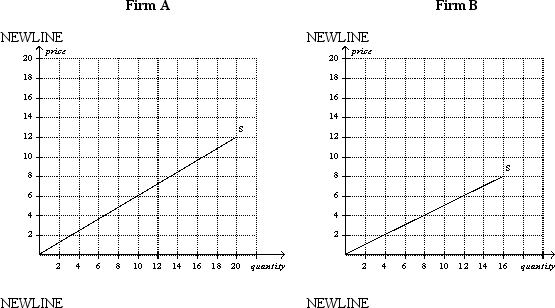 -Refer to Figure 4-11. If these are the only two sellers in the market, then the market quantity supplied at a price of $4 is
 (Multiple Choice)
4.8/5 (82)
(82) An increase in the number of college scholarships issued by private foundations would
(Multiple Choice)
4.9/5 (78)
(78) Figure 4-6  -Refer to Figure 4-6. The movement from D' to D could be caused by
 (Multiple Choice)
4.8/5 (82)
(82) Suppose you make jewelry. If the price of gold falls, then we would expect you to
(Multiple Choice)
4.8/5 (71)
(71) A group of buyers and sellers of a particular good or service is called a(n)
(Multiple Choice)
4.8/5 (76)
(76) When quantity demanded has increased at every price, it might be because
(Multiple Choice)
4.9/5 (90)
(90) When the market price is below the equilibrium price, suppliers are unable to sell all they want to sell.
(True/False)
4.9/5 (75)
(75) A table that shows the relationship between the price of a good and the quantity demanded of that good is called a
(Multiple Choice)
4.8/5 (76)
(76) 
Filters
- Essay(0)
- Multiple Choice(0)
- Short Answer(0)
- True False(0)
- Matching(0)