



 Chat with AI
Exam 13: Oligopoly and Monopolistic Competition

Exam 1: Introduction60 Questions
Exam 2: Supply and Demand151 Questions
Exam 3: Applying the Supply-And-Demand Model124 Questions
Exam 4: Consumer Choice125 Questions
Exam 5: Applying Consumer Theory118 Questions
Exam 6: Firms and Production128 Questions
Exam 7: Costs124 Questions
Exam 8: Competitive Firms and Markets127 Questions
Exam 9: Applying the Competitive Model156 Questions
Exam 10: General Equilibrium and Economic Welfare122 Questions
Exam 11: Monopoly147 Questions
Exam 12: Pricing and Advertising135 Questions
Exam 13: Oligopoly and Monopolistic Competition128 Questions
Exam 14: Game Theory109 Questions
Exam 15: Factor Markets103 Questions
Exam 16: Interest Rates, Investments, and Capital Markets120 Questions
Exam 17: Uncertainty122 Questions
Exam 18: Externalities, Open-Access, and Public Goods123 Questions
Exam 19: Asymmetric Information119 Questions
Exam 20: Contracts and Moral Hazards107 Questions
Select questions type


Monopolistic competition and perfect competition differ because
(Multiple Choice)
4.8/5  (67)
(67) Explain how long-run economic profits are linked to entry in monopolistic competition and perfect competition.
(Essay)
4.9/5 (86)
(86) Which of the following market structures have market power?
(Multiple Choice)
4.7/5 (70)
(70) Oligopoly differs from monopolistic competition in that an oligopoly includes
(Multiple Choice)
4.8/5 (72)
(72) The profitability of the second mover in a Stackelberg model is
(Multiple Choice)
4.8/5 (79)
(79) In the Cournot model,the output that a firm chooses to produce increases as
(Multiple Choice)
4.9/5 (81)
(81) Suppose Cournot duopolist firms operate with each having a cost of 30qi (i = 1,2)so that each firm's marginal cost is 30.The inverse market demand curve is P = 120 - Q where Q = q1 + q2.Suppose there were no barriers to entry and firms continued to enter so long as there were positive economic profits.At the Nash-Cournot equilibrium,the price,P,is
(Multiple Choice)
4.9/5 (96)
(96)  -The above figure shows the reaction functions for two pizza shops in a small isolated town.Collusion would result in
 (Multiple Choice)
4.9/5 (76)
(76) In a Bertrand duopoly with product differentiation,explain how a change in one firm's marginal cost can have an effect on the price charged by the other firm.
(Essay)
4.8/5 (71)
(71) 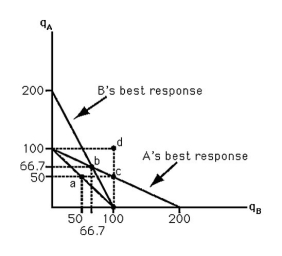 -The above figure shows the reaction functions for two pizza shops in a small isolated town.Compare the Cournot,Stackelberg,cartel,and competitive equilibria in terms of total output and welfare.
 (Essay)
4.9/5 (83)
(83) Brand loyalty in monopolistically competitive markets manifests itself as
(Multiple Choice)
4.7/5 (91)
(91) Suppose Cournot duopolist firms operate with each having a cost of 30qi (i = 1,2)so that each firm's marginal cost is 30.The inverse market demand curve is P = 120 - Q where Q = q1 + q2.Suppose there were no barriers to entry and firms continued to enter so long as there were positive economic profits.At the Nash-Cournot equilibrium,the total output,Q,is
(Multiple Choice)
4.9/5 (98)
(98) Suppose a market with a Cournot structure has five firms and a market price elasticity of demand equal to -2.What is a Cournot firm's Lerner Index?
(Multiple Choice)
4.9/5 (80)
(80) Requiring government agencies to report which company had the lowest bid for a government contract and the level of the bid,
(Multiple Choice)
4.8/5 (83)
(83) There are only two firms in an industry with demand curves q1 = 30 - P and q2 = 30 - P.Both have no fixed costs and each has a marginal cost of 10 per unit produced.If they behave as profit-maximizing price takers,each produces 20 units and sells them at a price of 10 so that each firm makes zero economic profits.If they formed a cartel and split the production of the output evenly,the economic profit of each firm would be
(Multiple Choice)
4.9/5 (87)
(87) Is it true that in the long run,a monopolistically competitive firm has market power but earns no profit? Explain.
(Essay)
5.0/5 (93)
(93) Suppose Cournot duopolists firms face the same market demand curve,but have differing costs.At the Nash-Cournot equilibrium,the firm with the lower cost will
(Multiple Choice)
4.8/5 (70)
(70) Firms in all types of market structures pay attention to current rival firms' behavior.
(True/False)
4.9/5 (97)
(97) 
Filters
- Essay(0)
- Multiple Choice(0)
- Short Answer(0)
- True False(0)
- Matching(0)