



 Chat with AI
Exam 11: Monopoly

Exam 1: Introduction60 Questions
Exam 2: Supply and Demand151 Questions
Exam 3: Applying the Supply-And-Demand Model124 Questions
Exam 4: Consumer Choice125 Questions
Exam 5: Applying Consumer Theory118 Questions
Exam 6: Firms and Production128 Questions
Exam 7: Costs124 Questions
Exam 8: Competitive Firms and Markets127 Questions
Exam 9: Applying the Competitive Model156 Questions
Exam 10: General Equilibrium and Economic Welfare122 Questions
Exam 11: Monopoly147 Questions
Exam 12: Pricing and Advertising135 Questions
Exam 13: Oligopoly and Monopolistic Competition128 Questions
Exam 14: Game Theory109 Questions
Exam 15: Factor Markets103 Questions
Exam 16: Interest Rates, Investments, and Capital Markets120 Questions
Exam 17: Uncertainty122 Questions
Exam 18: Externalities, Open-Access, and Public Goods123 Questions
Exam 19: Asymmetric Information119 Questions
Exam 20: Contracts and Moral Hazards107 Questions
Select questions type


The less elastic is the demand for a firm's product,the greater is that firm's market power.
(True/False)
4.7/5  (95)
(95) The average cost for a typical electric-power-production firm is AC = 100 - 10Q + Q2 where Q is measured in billion kilowatt hours per day.At the current regulated price,consumers demand 4 billion kilowatt hours per day.Is this market a natural monopoly? If demand increases to 10 billion kilowatt hours,is this market a natural monopoly? Explain.
(Essay)
5.0/5 (81)
(81)  -The above figure shows the demand and cost curves facing a monopolist.This profit-maximizing monopoly has a revenue equal to
 (Multiple Choice)
4.9/5 (92)
(92) The situation where one person's demand for a good depends on the consumption of the good by others is called a
(Multiple Choice)
4.8/5 (71)
(71) A monopoly sets a price of $50 per unit for an item that has a marginal cost of $10.Assuming profit maximization,the implicit demand elasticity is
(Multiple Choice)
4.8/5 (87)
(87)  -The above figure shows the demand and cost curves facing a monopoly.At the profit-maximizing price,the elasticity of demand equals
 (Multiple Choice)
4.8/5 (75)
(75) Suppose a monopolist has TC = 40 + 10Q + Q2,and the demand curve it faces is p = 130 - 2Q.What is the Lerner index of this profit-maximizing monopolist?
(Multiple Choice)
4.8/5 (81)
(81) If the inverse demand curve a monopoly faces is p = 100 - 2Q,and MC is constant at 16,then the deadweight loss from monopoly equals
(Multiple Choice)
4.9/5 (58)
(58) If the government's goal is to generate a certain amount of tax revenue,a specific tax and an ad valorem tax on a monopoly have the same impact on social welfare.
(True/False)
4.7/5 (73)
(73) 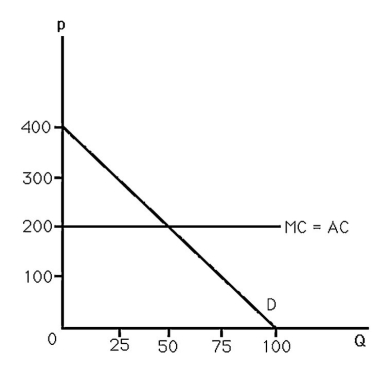 -The above figure shows the demand and cost curves facing a monopoly.In order to maximize its profit,the monopolist produces ________ less units than the competitive market level of output.
 (Multiple Choice)
4.8/5 (82)
(82) Suppose a patent is granted for a product that has the linear demand curve P = a - b Q.The constant marginal cost of producing this product is $50 per unit,a unit sells for $150,and consumers purchase 100 units of the good at that price.If the monopoly is maximizing profit,the deadweight loss is
(Multiple Choice)
4.9/5 (75)
(75) A flour mill holding exclusive contracts to 95% of the wheat in a large geographic area may operate as a flour-producing monopoly locally because
(Multiple Choice)
4.9/5 (66)
(66) Limited government licenses that create a monopoly do so because
(Multiple Choice)
4.8/5 (85)
(85) If the monopoly's demand curve intersects the AVC curve at minimum AVC,the firm will shut down.
(True/False)
4.9/5 (66)
(66) An exclusive right to sell a new and useful product,process,substance,or design for a fixed period of time is called a
(Multiple Choice)
4.9/5 (81)
(81) If the demand for a monopoly's output shifts rightward,the change in quantity produced is
(Multiple Choice)
4.9/5 (84)
(84) If the government sets a specific tax and an ad valorem tax so that they raise the same amount of tax revenue,why does the ad valorem tax reduce output less than the specific tax?
(Essay)
4.7/5 (93)
(93) If the inverse demand curve a monopoly faces is p = 100 - 2Q,and MC is constant at 16,then maximum profit
(Multiple Choice)
4.8/5 (74)
(74) If the demand curve a monopolist faces is perfectly elastic,then the ratio of the firm's price to the marginal cost is
(Multiple Choice)
4.9/5 (81)
(81) 
Filters
- Essay(0)
- Multiple Choice(0)
- Short Answer(0)
- True False(0)
- Matching(0)