



 Chat with AI
Exam 11: Monopoly

Exam 1: Introduction60 Questions
Exam 2: Supply and Demand151 Questions
Exam 3: Applying the Supply-And-Demand Model124 Questions
Exam 4: Consumer Choice125 Questions
Exam 5: Applying Consumer Theory118 Questions
Exam 6: Firms and Production128 Questions
Exam 7: Costs124 Questions
Exam 8: Competitive Firms and Markets127 Questions
Exam 9: Applying the Competitive Model156 Questions
Exam 10: General Equilibrium and Economic Welfare122 Questions
Exam 11: Monopoly147 Questions
Exam 12: Pricing and Advertising135 Questions
Exam 13: Oligopoly and Monopolistic Competition128 Questions
Exam 14: Game Theory109 Questions
Exam 15: Factor Markets103 Questions
Exam 16: Interest Rates, Investments, and Capital Markets120 Questions
Exam 17: Uncertainty122 Questions
Exam 18: Externalities, Open-Access, and Public Goods123 Questions
Exam 19: Asymmetric Information119 Questions
Exam 20: Contracts and Moral Hazards107 Questions
Select questions type


Explain Microsoft Windows' monopoly positions in terms of network externalities.
(Essay)
4.9/5  (85)
(85) If the inverse demand curve a monopoly faces is p = 100 - 2Q,MC is constant at 16,and the government imposes an $8 per unit specific tax on the monopoly,the deadweight loss solely due to the tax is
(Multiple Choice)
4.9/5 (74)
(74) Why is the monopoly total welfare lower than the competitive total welfare?
(Essay)
4.8/5 (80)
(80) A monopoly incurs a marginal cost of $1 for each unit produced.If the price elasticity of demand equals -2.0,the monopoly maximizes profit by charging a price of
(Multiple Choice)
4.8/5 (83)
(83) 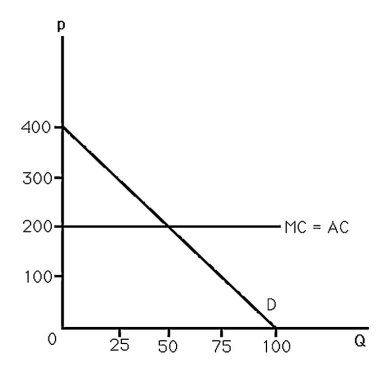 -The above figure shows the demand and cost curves facing a monopoly.The monopoly maximizes profit by selling
 (Multiple Choice)
4.9/5 (86)
(86) The deadweight loss represents the sum of additional consumer and producer surplus should the firm produce the quantity where P = MC rather than where MR = MC.
(True/False)
4.8/5 (89)
(89) Suppose a monopolist has TC = 100 + 10Q + 2Q2,and the demand curve it faces is p = 90 - 2Q.What will be the price,quantity,and profit for this firm?
(Essay)
4.9/5 (78)
(78) Which of the following total cost functions suggests the presence of a natural monopoly?
(Multiple Choice)
4.9/5 (85)
(85) If the inverse demand curve a monopoly faces is p = 100 - 2Q,and MC is constant at 16,then the firm's Lerner Index equals
(Multiple Choice)
4.8/5 (80)
(80) Which of the following DOES NOT contribute to the market power of a firm?
(Multiple Choice)
4.8/5 (83)
(83) A monopolist faces the inverse demand curve P = 60 - Q.It has variable costs of Q2 so that its marginal costs are 2Q,and it has fixed costs of 30.The monopoly's profit-maximizing price is
(Multiple Choice)
4.9/5 (77)
(77) When attempting price regulation,a government faces what problem(s)?
(Multiple Choice)
4.8/5 (88)
(88) A monopolist faces the inverse demand curve P = 60 - Q.It has variable costs of Q2 so that its marginal costs are 2Q,and it has fixed costs of 30.If a governmental agency imposes an $8 per unit specific tax on output,the deadweight loss from both the monopoly and the tax is
(Multiple Choice)
4.8/5 (72)
(72)  -The above figure shows the demand and marginal cost curves for a monopoly.The deadweight loss of this monopoly equals
 (Multiple Choice)
4.8/5 (71)
(71) A monopoly faces an inverse demand curve of P = 100 - 2Q.The marginal cost curve is MC = .5Q.What government price ceiling would represent optimal price regulation?
(Short Answer)
4.8/5 (91)
(91) Regulation is guaranteed to be more efficient than a monopoly.
(Multiple Choice)
4.8/5 (80)
(80) 
Filters
- Essay(0)
- Multiple Choice(0)
- Short Answer(0)
- True False(0)
- Matching(0)