



 Chat with AI
Exam 14: Myocardial Infarction

Exam 1: Cardiac Anatomy and Physiology66 Questions
Exam 2: Electrophysiology68 Questions
Exam 3: Lead Morphology and Placement56 Questions
Exam 4: Technical Aspects of the EKG54 Questions
Exam 5: Calculating Heart Rate27 Questions
Exam 6: How to Interpret a Rhythm Strip20 Questions
Exam 7: Rhythms Originating in the Sinus Node60 Questions
Exam 8: Rhythms Originating in the Atria50 Questions
Exam 9: Rhythms Originating in the AV Junction51 Questions
Exam 10: Rhythms Originating in the Ventricles52 Questions
Exam 11: AV Blocks50 Questions
Exam 13: How to Interpret a 12-Lead EKG57 Questions
Exam 14: Myocardial Infarction76 Questions
Exam 16: Medications and Electrical Therapy113 Questions
Exam 17: Diagnostic Electrocardiography75 Questions
Select questions type


An inferior MI is most often caused by occlusion of which coronary artery?
(Multiple Choice)
4.9/5  (70)
(70) Indicative changes of a STEMI include which of the following?
(Multiple Choice)
4.8/5 (76)
(76) Which kind of MI usually damages only the innermost layer of the myocardium?
(Multiple Choice)
4.9/5 (76)
(76) If the transition zone is between V₁ and V₂,the EKG is said to have
(Multiple Choice)
4.7/5 (83)
(83) Gwen is experiencing an acute STEMI and was taken by ambulance to a large metropolitan hospital with a cardiac center.Which of the following courses of treatment is Gwen MOST likely to receive in the 90 minutes following her arrival at the hospital?
(Multiple Choice)
4.9/5 (88)
(88) 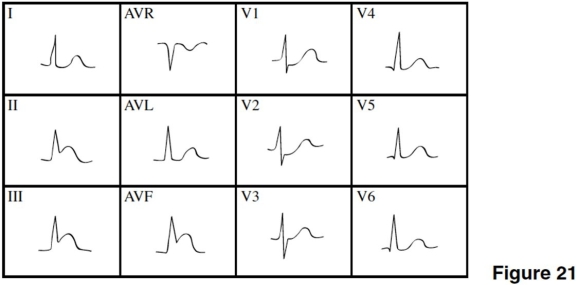 -The coronary artery that feeds blood to the damaged area of the heart in Figure 21 is the
 (Multiple Choice)
4.8/5 (74)
(74) Which of the following EKG complications can be expected following an acute anterior STEMI?
(Multiple Choice)
4.9/5 (85)
(85) 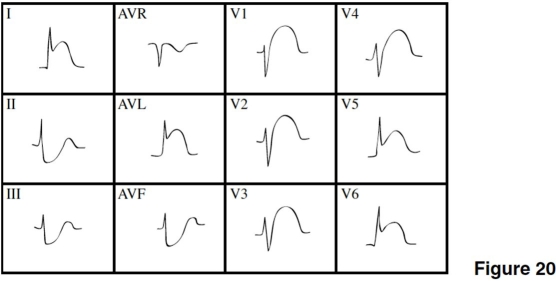 -The MI in Figure 20 is
Counterclockwise rotation is indicated from R wave transition in V₁-2.
(True/False)
4.9/5 (68)
(68) Early repolarization often has a unique EKG finding that makes recognition easier.What is that finding?
(Short Answer)
4.8/5 (80)
(80) 
Filters
- Essay(0)
- Multiple Choice(0)
- Short Answer(0)
- True False(0)
- Matching(0)