



 Chat with AI
Exam 14: Myocardial Infarction

Exam 1: Cardiac Anatomy and Physiology66 Questions
Exam 2: Electrophysiology68 Questions
Exam 3: Lead Morphology and Placement56 Questions
Exam 4: Technical Aspects of the EKG54 Questions
Exam 5: Calculating Heart Rate27 Questions
Exam 6: How to Interpret a Rhythm Strip20 Questions
Exam 7: Rhythms Originating in the Sinus Node60 Questions
Exam 8: Rhythms Originating in the Atria50 Questions
Exam 9: Rhythms Originating in the AV Junction51 Questions
Exam 10: Rhythms Originating in the Ventricles52 Questions
Exam 11: AV Blocks50 Questions
Exam 13: How to Interpret a 12-Lead EKG57 Questions
Exam 14: Myocardial Infarction76 Questions
Exam 16: Medications and Electrical Therapy113 Questions
Exam 17: Diagnostic Electrocardiography75 Questions
Select questions type


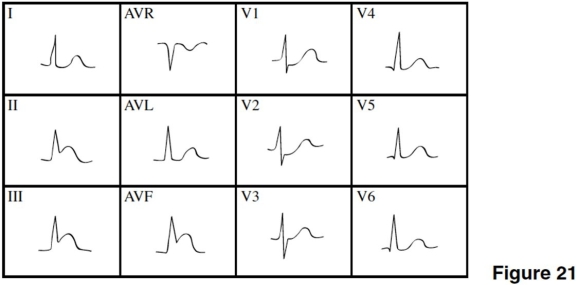 -In Figure 21,there is evidence of

Mrs.Campho had a previous inferior MI about 20 years ago.What would you expect to see on her EKG that would be consistent with her old inferior MI?
(Multiple Choice)
4.8/5  (84)
(84) A right ventricular infarction is most often seen along with inferior MI.
(True/False)
4.9/5 (64)
(64) The ________ of an old STEMI typically remains on the EKG forever.
(Multiple Choice)
4.8/5 (70)
(70) Which leads look at the lateral wall of the left ventricle?
(Multiple Choice)
4.8/5 (88)
(88) 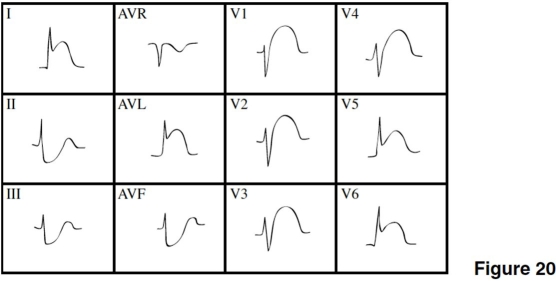 -The age of the MI in Figure 20 is
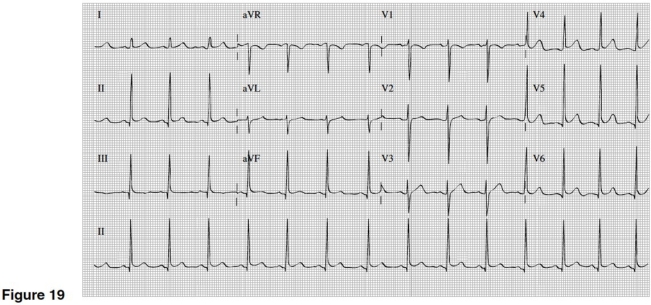 -There is evidence of which of the following in Figure 19?
Which of the following BEST describes the progression of electrical conductivity in an EKG with normal transition?
(Multiple Choice)
4.8/5 (83)
(83) What kind of MI is indicated by significant Q waves in II,III,aVF,and V₅-6?
(Multiple Choice)
4.8/5 (70)
(70) 
Filters
- Essay(0)
- Multiple Choice(0)
- Short Answer(0)
- True False(0)
- Matching(0)